That is not a legacy problem from the pandemic era. The finding comes from Premier’s 2024 Supply Chain Resiliency Report, and it reflects something procurement leaders across the healthcare industry have been managing for years. The supply chain remains far more fragile than the facilities depending on it can afford.
The Stat That Reframes Wholesale Sourcing
Premier surveyed 100 healthcare supply chain leaders for its 2024 Supply Chain Resiliency Report. Thirty-nine percent said they had canceled or rescheduled procedures at least quarterly because a product was not available, and surgical and anesthesia supplies ranked as the most affected category. The implications of that figure extend well beyond operational inconvenience. A cancelled procedure can mean a delayed diagnosis, a disrupted treatment plan, and in some cases, measurable harm to patient outcomes. A shortage that begins as a backorder in a distribution center ends up on a scheduling call with a patient.
For procurement teams managing bulk purchases across a wide range of categories, this reality has elevated the strategic importance of wholesale sourcing from a cost-reduction exercise into something closer to a risk management function.
What Wholesale Hospital Supplies Actually Covers

The category spans a broader range than most people outside procurement realize. At the protective and procedural layer, disposable exam gloves purchased in bulk, wholesale PPE, and medical gowns sourced at scale form the frontline barrier across every patient interaction. Surgical drapes and sharps containers complete the procedural safety layer for operating rooms and procedural suites.
At the diagnostic and monitoring level, pulse oximeters and patient monitors purchased through wholesale or distributor channels have become central to both inpatient and home-based care delivery. Specimen collection supplies support the laboratory infrastructure that precedes most clinical decisions.
Orthopedic supplies at wholesale volume serve the growing rehabilitation and post-surgical population, while surgical instruments sourced through specialized wholesale channels require a level of quality and sterility scrutiny that differs meaningfully from standard consumable procurement.
Wholesale Supply Cost Reference
Pricing varies by category, specification, and order volume. Below is a general cost reference for commonly ordered items through wholesale and bulk distribution channels.
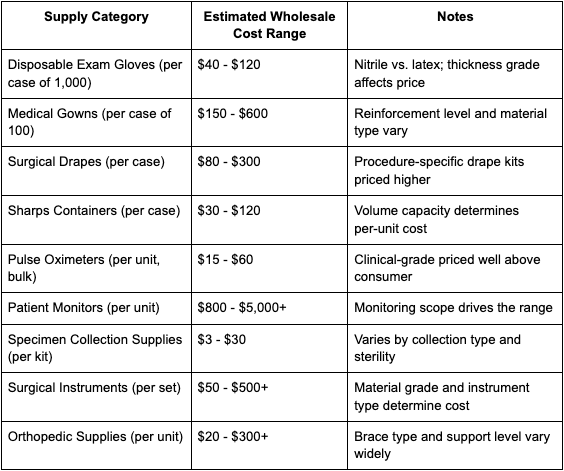
Sources: General wholesale medical supply pricing compiled from distributor catalogs and industry data (2025-2026)
Why Single-Source Dependency Is the Core Risk
The Premier data points directly at a procurement structure that many facilities have relied on for efficiency but which consistently creates fragility: concentration in too few suppliers for critical categories. When a single manufacturer accounts for the majority of supply in a given category and that manufacturer experiences disruption, whether through a weather event, a regulatory action, or a logistics failure, facilities with no alternative supplier relationship have no good options.
The most straightforward mitigation is also the most practical, building relationships with multiple wholesale and regional distributors across key supply categories before a disruption forces the issue. Facilities that had established relationships with a secondary medical equipment wholesale distributor during the IV fluid shortage of late 2024 were better positioned than those scrambling to identify alternatives under pressure.
Some facilities address this by consolidating categories with distributors who carry a broad catalog rather than maintaining separate vendor relationships for each supply type. HSS Medical Supply is one wholesale medical supply company that covers hospital supplies across protective, procedural, monitoring, and surgical categories, giving procurement teams a consolidated sourcing option alongside their primary distribution contracts.
The Lesson the Data Keeps Repeating
The 39 percent figure from the Premier survey is not a one-year anomaly. It is consistent with a multi-year pattern of supply chain fragility that shows no structural improvement without deliberate action at the facility level. The facilities that manage this best are not the ones that react fastest when something runs out. They are the ones that built supplier depth before the shortage arrived. The same principle applies beyond healthcare. Businesses in any industry can reduce disruption risk by diversifying suppliers, evaluating vendor concentration, and developing contingency sourcing strategies.