By Kandice Vincent
Ambition has a good reputation among high performers. It gets people through hard degrees, long workweeks, risky career moves, and years when few people understand what they are trying to build. Caleb Campbell has lived at the far end of that spectrum. A West Point graduate, former Army officer, and former NFL linebacker, he now writes and speaks about what happens when achievement keeps working on paper even as the person doing the achieving feels worse.
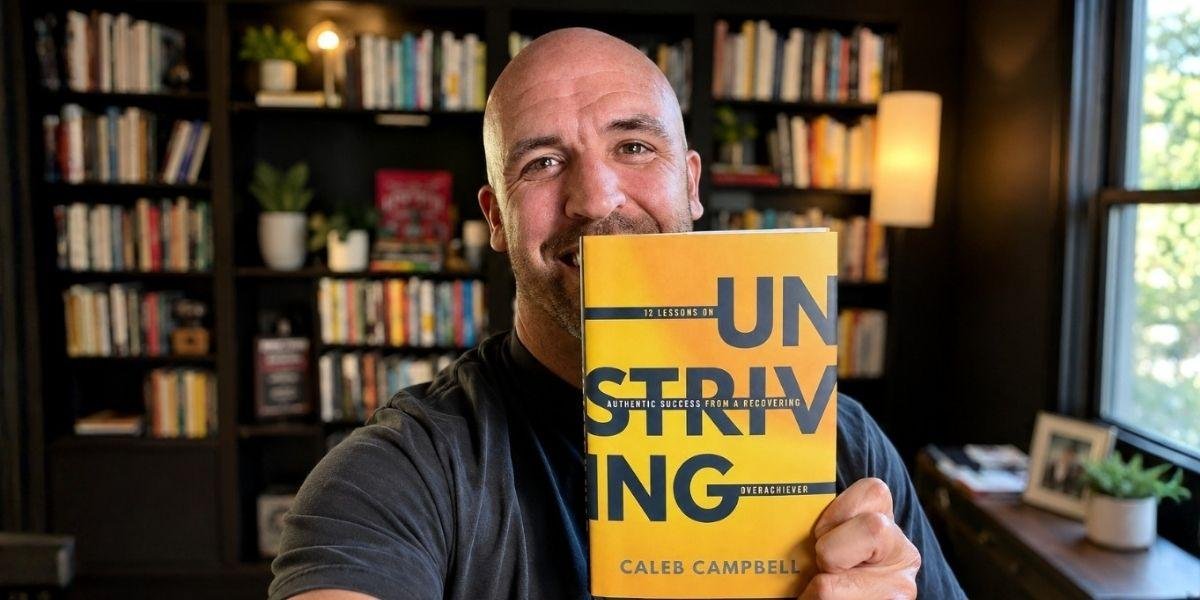
His new book, Unstriving: 12 Lessons on Authentic Success from a Recovering Overachiever, grew from his experience of reaching goals that carried enormous public value and discovering that achievement had become responsible for far too much in his private life. That gives Unstriving its most useful question: what job have you given your ambition?
When achievement becomes part of self-worth
A goal can carry two jobs at once. You may want the promotion because the work interests you, and you may also need it to confirm that you are respected. You may want to grow a company because you care about what it creates, then discover that revenue has become a running score for how well you are doing as a person. The emotional assignment attached to the goal is where strain can build.
A 2026 meta-analysis covering 192 studies and 93,552 participants found that motivation rooted in personal interest and chosen values was associated with stronger work engagement, job satisfaction, well-being, and performance, as well as lower burnout and disengagement. (Source: Hagger and McAnally Star, 2026.) The research supports Campbell’s argument that the source of a person’s drive can shape how sustainable achievement feels over time.
The warning signs arrive in ordinary moments
Campbell’s book is aimed at people who can still function at a high level because strain often shows up before a visible breakdown. Dinner with your family can become half dinner, half mental planning session. A hobby turns into another thing to improve. A free afternoon creates guilt because nothing measurable came from it. You take a week off, return to work, and feel the same pressure within a day.
These moments can reveal how much of your identity has become tied to being productive, capable, needed, or impressive. Campbell also points to people who understand their habits after years of therapy, reading, or coaching and still repeat them whenever pressure rises.
“The truth will always cost you less than pretending,” Campbell says. Admitting that you dislike a role you worked hard to earn, that you are exhausted by being everyone’s reliable person, or that a goal matters mostly because of how it makes you look can be uncomfortable. It also gives you accurate information about what needs attention.
Why time off sometimes leaves the same problem waiting
Rest matters when somebody is depleted. Sleep, fewer hours, vacations, and genuine recovery all have a place. Their limits become obvious when the source of pressure follows you home.
The American Psychological Association’s 2024 Work in America survey found that 43% of workers said they typically felt tense or stressed during the workday. The same survey found that 67% had experienced at least one outcome often associated with workplace burnout in the previous month, including low energy, lack of interest, isolation, or reduced effort. (Source: American Psychological Association, 2024.)
A person who believes they must always be useful can take Friday off and spend the day feeling guilty. Someone who relies on praise to feel secure can close the laptop and continue checking whether other people approve of them. Time away removes the immediate task, yet the private rule can keep running.
Track the moment you start proving yourself
One way to apply Campbell’s ideas is to watch your behavior for a week without trying to fix it. Keep a short note whenever you overwork, over-explain, say yes too quickly, check for praise, rescue somebody who could handle the task, or turn rest into another performance target. Write down what happened, what you did, what you hoped the behavior would earn, and what you feared might happen if you stopped.
At the end of the week, look for the recurring rule underneath the behavior. It may sound like, “I have to be the dependable one,” “I cannot disappoint people,” or “If I slow down, I will fall behind.” Once the rule is visible, test it in a small situation. Let a non-urgent message wait, ask for help before you are overwhelmed, or leave one low-value task unfinished and see what actually happens. Unstriving organizes this work through four stages Campbell calls Recognize, Reckon, Release, and Re-Imagine. In practical terms, the sequence asks you to see the pattern, face what it has been costing, loosen the rule that keeps it running, and decide what success should measure now.
Change the measure before you change the career
Successful people often reach for large solutions because they feel familiar. A new job, business, move, or major goal can create momentum, though the same internal rules can travel with you. Someone who measures their worth through being indispensable can carry that habit into a new company. Someone who needs constant progress can turn a fresh start into another race within a few months.
A smaller review can be more revealing. At the end of each week, ask whether you liked how you spent your attention. Notice which parts of the week left tension hanging around for hours afterward, where you agreed to something mainly to protect an image, and which work still gave you genuine energy. Add those observations to the numbers you already track.
This gives success a wider set of measures. Revenue can still matter. So can responsibility, craft, enjoyment, relationships, health, and whether you recognize yourself in the life you are building. Campbell puts the idea simply: “At some point, your outer life can only become as healthy as your inner life.”
Give ambition a smaller job
Ambition works well when it helps you pursue something you care about. Trouble starts when every outcome also has to settle a question about your worth. No promotion can permanently prove that you are enough, and no full calendar can guarantee that you matter. Giving ambition a smaller job removes a burden it was never equipped to carry.
For high performers, that can begin with one goal. Ask what you want from it, then look at what you expect it to prove about you. If those answers are different, you have found useful information. That examination is central to Unstriving because Campbell wants readers to keep their drive without spending their lives asking achievement to answer personal questions it can never settle.
The useful test may come after the next win. Pay attention to whether success leaves you feeling more connected to the life you are building, or simply relieved that you proved something again. Unstriving asks readers to examine that difference before the next milestone becomes another answer to a question achievement was never built to solve.
Find out more about Unstriving: 12 Lessons on Authentic Success from a Recovering Overachiever and Caleb Campbell’s work here.