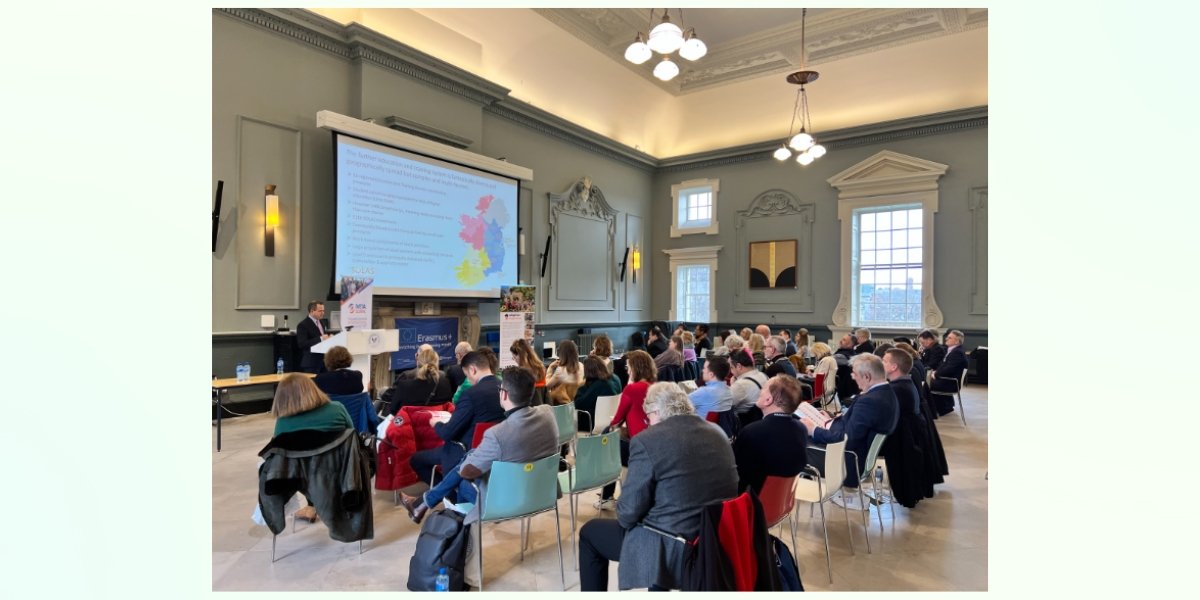
International education increasingly depends on links between universities, training bodies, governments, and professional groups. These partnerships can support joint teaching, staff development, research, student mobility, and new approaches to digital learning. The need for such cooperation is also visible in Africa, where UNESCO reported in its 2025 education data that only 9% of the population had access to higher education, compared with a global average of 38%. The same UNESCO data identified 25% of Africans aged 15 to 24 as not in education, employment, or training. These conditions have made skills development, teacher training, and flexible learning important areas for cross-border education projects.
European programmes have provided one framework for this kind of cooperation. Erasmus+ supported more than 34,400 projects involving over 85,600 organisations in 2024, according to the European Commission’s 2024 annual results, published in November 2025. The programme also provided learning opportunities to almost 1.5 million students, teachers, trainers, youth workers, and other participants during that year. Its projects cover education, vocational training, youth, and sport, creating opportunities for institutions to work together on curriculum development, professional learning, mobility, and other forms of cooperation.
Warnborough College has developed part of its international work through this project-based model. The institution was founded in Oxford in 1973 but has since then established a campus in Canterbury, while Warnborough University was established in Ireland in 1997. Since then, Warnborough College Ireland has been involved in Erasmus+ projects with universities, vocational colleges, and other organisations across Europe and abroad. Some of Warnborough College Ireland’s European academic partners include Aeres University of Applied Sciences, Fontys University of Applied Sciences, Jyväskylä University of Applied Sciences, the University of Belgrade, the University of Novi Sad, and the University of Bremen.
An example is ProVET, an Erasmus+ project focused on vocational education and training. The consortium comprises the JAMK University of Applied Sciences as the project coordinator, the Aeres University of Applied Sciences Wageningen, Warnborough College Ireland, and the Institute of Technology and Education of the University of Bremen. Partner universities from Russia and Serbia include the Russian State Vocational Pedagogical University, the University of Novi Sad, the University of Belgrade, and the Novi Sad School of Business.
The project included work on vocational development roadmaps and policy dialogue involving education ministries, including accreditation of the developed courses in Serbia. Warnborough led the pedagogical and andragogical bases of online teaching and learning, including mentoring the partner universities on developing the online courses and learning platform for professional development.
The partnership with the University of Bremen has also extended into projects involving Kenya. A 2024 European EPALE report identified the University of Bremen, Warnborough College Ireland, Maristak Durango, and Rongo University as key partners in the DEVISE4Kenya project. DEVISE4Kenya began in 2023 to combine renewable energy with digital skills development in schools in rural Homa Bay. The project involved installing photovoltaic systems to provide the rural schools with green energy, and then using low-energy devices for teacher development in digital teaching and learning.
The ultimate beneficiaries are the students, who will learn digital skills and be able to compete with their urban counterparts for jobs. European partner representative made several visits to Homa Bay, where they worked with local schools to implement the photovoltaic installations and teacher training. Conversely, Kenyan teachers visit their European partners to experience different teaching and learning approaches firsthand, with opportunities for training, job shadowing, and trying out the latest technologies.
The project illustrates how an international partnership can connect several forms of education activity. Beyond technology and knowledge transfers, the projects are designed to be sustainable so they can continue even after funding ends. They are focused on learning and practice – the Kenyan schools had to learn to install and maintain the photovoltaic equipment themselves, with European partners providing guidance. They then had to teach other schools in the area how to do the same, thus building capacity through knowledge sharing.
Such projects also reflect a wider focus within UNESCO’s 2025 work in Africa, which has placed attention on skills development, digital education, teacher capacity, and stronger higher education systems. UNESCO’s 2025 continental report with the African Union and UNICEF described education and skills development as areas requiring greater cooperation across the continent.
Warnborough’s international activity includes links with the Commonwealth of Learning, an intergovernmental organisation focused on open, distance, and technology-enabled learning. In September 2025, representatives of Warnborough College attended the 11th Pan-Commonwealth Forum on Open Learning in Gaborone, Botswana. The Commonwealth of Learning organised the forum, and the Botswana Open University and Botswana’s Ministry of Higher Education hosted it. Warnborough’s representatives contributed pre-conference workshops and sessions. The forum itself focused on technology-enabled learning, skills development, teacher support, open learning, and capacity building.
The themes discussed at the forum also show why these international relationships have become relevant to vocational and higher education. The Gaborone Declaration in 2025 proposed more extensive applications of open, flexible, and distance learning; more developed TVET systems; improved recognition of prior learning; and technology-enhanced learning. It also proposed cooperation with governments, institutions, communities, enterprises, and recognised organisations. These proposals match areas in which Warnborough has been involved, as cited by Warnborough.
The college has also participated in professional networks connected with vocational education. Warnborough College Ireland represents the European region of the International Vocational Education and Training Association, according to an organisation profile published through the European Commission’s EPALE platform. The same profile describes its work with international partner organisations and its use of face-to-face, online, and blended learning. Warnborough’s relationship with IVETA has also involved conferences and professional activities. It organised IVETA’s 40th anniversary conference in San Antonio, Texas, from December 4 to 7, 2024, alongside the annual conference of the US Association for Career and Technical Education.
Another international collaboration is now planned around the EDvance Summit in Nairobi. Scheduled to take place from October 7 to 9, 2026, the conference shall be organised by Warnborough College, the University of Bremen, and Maasai Mara University, and hosted by the Kenya School of TVET. Sponsors include the Commonwealth of Learning, while presenters include organisations and individuals associated with UNESCO and the Kenyan education sector. Some of the issues that will be discussed at this conference include access, innovation, TVET, skills development, and learning-work linkages. Alongside this, the online LEA Conference from October 30-31, 2026 is a joint effort between Warnborough, Universidad Superior de Guadalajara (Mexico) and Universidad de Aconcagua (Chile).
The planned summit extends a pattern already visible in Warnborough’s European and African projects. Rather than relying only on conventional student exchanges, the institution’s partnerships have involved online learning systems, teacher training, vocational development, renewable-energy projects, conferences, and professional networks. The available evidence does not establish that every partnership has produced the same type of academic outcome. It does show, however, that Warnborough College has built a network involving universities, vocational bodies, governments, and intergovernmental organisations across several regions.
Warnborough College’s international partnerships therefore form a broad part of its current educational activity. Its work with the University of Bremen and other European institutions has included Erasmus+ projects, while its links with African institutions have supported projects involving digital skills and vocational education. Its engagement with the Commonwealth of Learning has added another international forum for open and distance learning. As these partnerships progress, Warnborough College continues to participate in transnational education projects that bring together higher education, vocational training, e-learning, and professional development programs.