
Artists have long been pioneers in developing new art forms and techniques, constantly pushing the limits of creativity and expression. Their adventurous explorations and unique ideas led to major movements such as Impressionism and Abstract Expressionism. Each artist brings a distinct viewpoint that challenges traditional aesthetics and inspires social change. Picasso’s Cubism, for example, demolished conventional viewpoints, while Warhol’s Pop Art merged high art with market iconography. These contributions set new creative standards while influencing cultural and societal paradigms, proving art’s tremendous ability to change and mirror the human experience.
Tak Salmastyan is an artist in the ever-changing contemporary art scene whose unique ideas have significantly changed artistic expression. Salmastyan was born in Soviet Armenia, and his path from an ambitious artist to a known figure in the American art scene is a story of the pursuit of creative progress and perfection. His journey from Armenia to the United States marked a significant change in his creative activities, resulting in the development of new art forms such as BinArtism™ and Auto Plasticism.
Salmastyan’s creative path demonstrates his contribution as an innovator in the art industry. Tak Salmastyan developed BinArtism™, a novel technique reflecting the digital age’s effect on art, changing classic creative notions through a binary lens. BinArtism™ is a painting method that creates an image using only the binary number system – just two symbols: “0” and “1”. In BinArtism™, human and animal silhouettes are represented by these binary digits, with “0” typically representing the female symbol and “1” the male symbol. The image background often includes a short phrase or word expressed in binary code. This style, a direct result of modern life and computer technologies, demonstrates Salmastyan’s devotion to improving this particular style, contributing significantly to contemporary art.
Auto Plasticism, another innovative approach developed by Salmastyan, is a style that uniquely synthesizes Neo-Plasticism and Automatism. This abstract painting style adheres to strict rules, incorporating the Golden Ratio and Fibonacci Sequence in its composition layout. Auto Plasticism is characterized by using geometric shapes composed of straight horizontal and vertical lines, with no allowance for curves, diagonals, or circles. The color palette is limited to primary colors—red, blue, and yellow—along with black, white, and various shades of grey. The final layer of an Auto Plasticism work is applied with restricted hand movements only in horizontal and vertical directions. This technique allows for various colors in geometric compositions while maintaining the strict discipline of horizontal and vertical lines. The Auto Plasticism style, exclusive to Tak Salmastyan, offers a new perspective in abstract art, combining mathematical precision with artistic freedom.
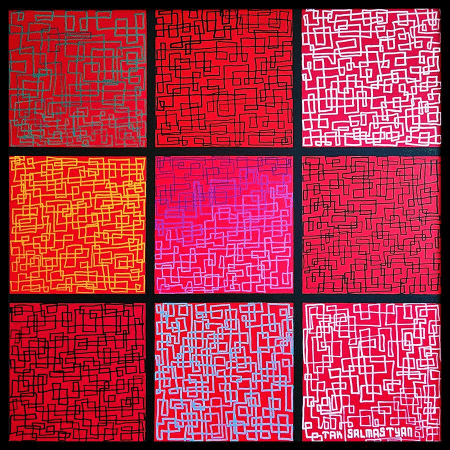
Salmastyan’s work significantly affects modern art mainly because of the new and unique styles. His contributions to contemporary art include BinArtism™ and Auto Plasticism, which challenge conventional norms. His work has received widespread critical acclaim, popular appreciation, and recognition in many art communities. Salmastyan’s achievements have been honored in significant shows, including Gallery 825 in Los Angeles and Upstream Gallery in New York, demonstrating his influence on the art scene.
Tak Salmastyan’s path comprises cultural integration and personal growth rather than only reflecting creative progress. His work, based on his Armenian background and informed by his experiences in the United States, provides a unique viewpoint on blending traditional and contemporary art forms. Salmastyan, a forerunner in the art world, continues to redefine the canvas of modern art by combining his previous experiences with his original vision for the future of art.
Salmastyan’s creative philosophy stems from his firm conviction in originality and innovation. He sees art as a limitless world unconstrained by traditional conventions. His art-making technique synthesizes his experiences, emotions, and cultural heritage, which he transfers to canvas. Salmastyan uses the power of art to elicit emotions and stimulate the intellect, which is evident in his works. His paintings are more than just visual depictions; they are infused with emotions and tales, attempting to connect with the viewer on a deeper level.
Salmastyan, an Art Institute of California instructor, has tremendously impacted a new generation of young painters. His teaching method encourages pupils to discover their own distinctive voice in the creative world. He encourages them to experiment and pushes them to think beyond the typical limitations of art. His effect as a teacher is apparent in how his pupils have gone on to carve out careers in the arts, often recognizing him as a key influence in their creative growth.
Salmastyan’s career is replete with awards and accomplishments reflecting his art and animation contributions. He won the Best Animation Award and Best Director at the Los Angeles Art-House Film Festival for his animated short film, “The Clone and the Tree of Life.” His work has been published in several journals and media, bolstering his reputation as a prominent artist. The accolades he has garnered reflect his expertise, inventiveness, and devotion to his profession.
Salmastyan envisions BinArtism™ and Auto Plasticism evolving and having a lasting impact. He aims to discover new possibilities in various creative genres using contemporary technology and approaches. His influence in the art world is evident as he continues to inspire and question modern art conventions. The role of technology in art, especially in Salmastyan’s work, is promising, opening up new opportunities for creative expression and creativity.
Tak Salmastyan’s legacy in art reflects his pursuit of innovation, influential teaching career, and substantial contributions to contemporary art. His journey from Armenia to the United States, developing BinArtism™ and Auto Plasticism, and his effect on students and the art community make him a prominent figure in contemporary art. Salmastyan’s work continues to inspire and amaze as he pushes the frontiers of creative expression, pointing to a bright and transformational future for the art world.
Published by: Holy Minoza