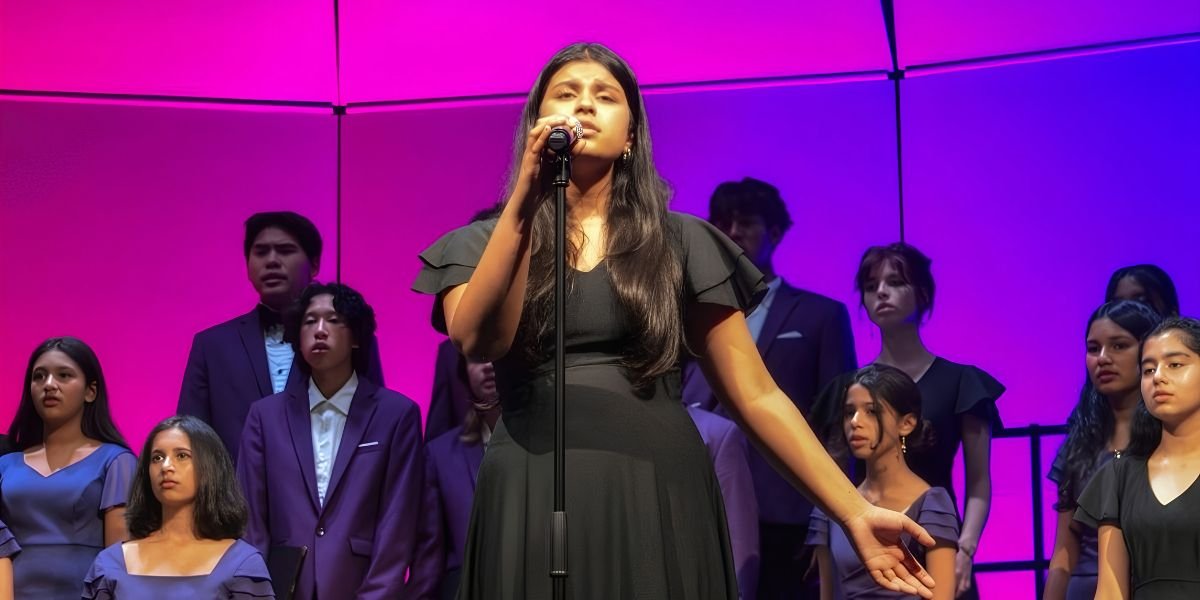
Midway through her solo audition, the backing track began skipping. The judges reached to stop and restart it, but Suhani Sharma kept singing, holding the tempo until the music caught up with her. They told her afterward that few singers could have handled it, and she went on to receive two solos at the Meyerson Symphony Center in Dallas before an audience of about 1,000 people.
For much of Sharma’s childhood, choir and computer science occupied separate parts of her life. At Monta Vista High School in Cupertino, California, she studied computer science, while a UC Berkeley summer program took that interest deeper into data science. MeloMatch AI, the application she has built, brings those interests together through machine learning, using patterns in survey data to produce personalized music recommendations. The project is not a clinical tool, and Sharma does not present it as a substitute for professional care. Its aim is narrower, to explore how technology can make music recommendations more adaptive to individual listeners. The distinction matters because the project draws on self-reported information related to anxiety, depression, OCD and insomnia without claiming to diagnose or treat any of them.
The question has a wider mental health backdrop; however, Sharma does not suggest that a music recommendation system addresses gaps in clinical care. What drew her in was the narrower question of whether patterns in the music people already listen to could make recommendations more personal. Her interest is personal as well as technical. She reaches for different kinds of music depending on how she feels, and some songs are closely tied to specific memories. That made her curious about why one listener might respond differently from another.
That curiosity became a research project built around the Music and Mental Health Survey Results, a public dataset gathered through online forums and social media. Sharma has been using the data to examine how machine learning can inform personalized music recommendations while updating the project’s methodology and evaluation. In the prototype, users report how frequently they listen to different genres and rate several indicators from one to ten. The system predicts a music preference cluster made up of similar genres, then offers a choice between Spotify playlists and tracks generated through Google’s Lyria model.
It grew as well from a long relationship with music. Sharma started piano in first grade and her elementary school music teacher selected her for solos before she had much confidence in her vocal ability. Choir became more formative after she joined in seventh grade. The theory-intensive opening lessons did not immediately draw her in, but harmonies did. What stayed with her was the sense that music creates connection through shared effort.
From there, the progression moved outward. Regional competitions in middle school led to selection for California’s All-State Choir. A seventh-grade solo earned her the Maestra Award for outstanding musical ability, which led to a nomination for the Honors Performance Series and a performance at Carnegie Hall. The Royal Conservatory of Music later awarded her a Regional Gold Award for the highest score in California at her level. The Dallas performance came at the American Choral Directors Association national conference in March 2025, after she auditioned into its National Honor Choir in the Grades 8 to 10 SSAA ensemble.
One of the two solos she sang there carried personal meaning beyond the performance. Tuttarana, by Indian-American composer Reena Esmail, sets Hindustani rhythmic syllables into choral form and fuses the Italian tutti with the tarana of North Indian classical music. Esmail attended the conference and heard Sharma sing it. For Sharma, the piece connected directly to her South Asian heritage and, after years of performing music from many traditions, became her first South Asian work in a major honor choir.
By the time she was in high school, music had started to influence the way Sharma thought about coding. Instead of tackling new programming concepts from scratch, she would apply musical ideas that she was already familiar with to understand them. This led her to ask a more general question regarding AI and art: whether technology can enable a creative experience without diminishing the human effort involved. The connection became clearer when Sharma started giving performances for the memory-care residents at the Sunny View Retirement Community in Cupertino. The concert featured jazz standards and popular music from the 1940s and 1950s, such as that by Frank Sinatra. When a room that had been initially uninterested began to clap and sing along, she gained a human perspective on the way different people respond to music.
Sharma does not describe those reactions as clinical evidence. She sees them as reasons to ask better questions about why familiar music reaches people. Girls Who Code gave her grounding in web development and an introduction to machine learning, while her school’s interdisciplinary research and design class supplied guidance as she built the application largely on her own. Before development began, she interviewed a board-certified music therapist for advice on the project.
In March 2026, Sharma presented her project at the Synopsys Championship, Santa Clara County’s regional science and engineering fair. Feedback has since informed further work on its data, methodology, and evaluation. Her research paper has been submitted for publication at an IEEE venue. She plans to continue refining the analysis and, once the system is ready, test it with users under further guidance from researchers.
MeloMatch AI is still evolving, but the larger direction is already clear. Sharma has found in music and computer science not two separate interests but a way of asking questions about how people hear sound and how technology would respond. Just as importantly, she is learning to let the evidence determine how far an answer can go. What began with years of performing and listening has become the kind of problem she wants to keep exploring through code.