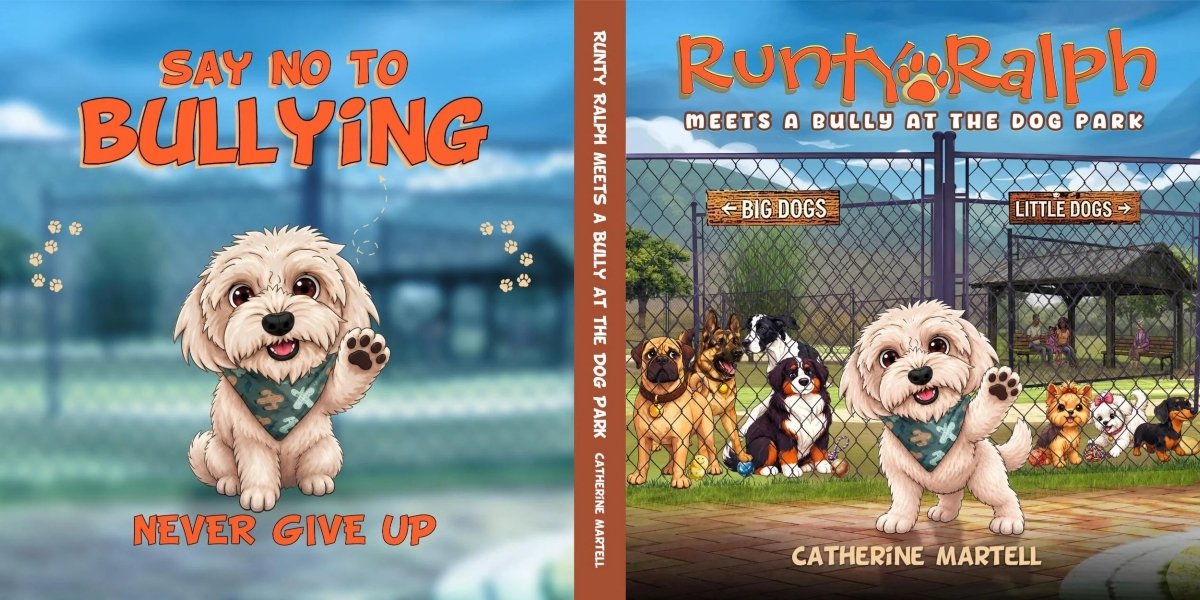
Children’s literature has always found clever ways to smuggle hard truths into gentle stories, and Catherine Martell’s ongoing Runty Ralph series is a strong example of that tradition at work. Her newest book, Runty Ralph Meets a Bully at the Dog Park, takes on one of the most persistent challenges young readers face growing up: what to do when someone bigger, louder, or meaner tries to make you feel small. Martell tells that story through the eyes of a tiny dog with an enormous amount of heart, and the result is a picture book that entertains just as much as it teaches.
The premise begins innocently enough. Runty Ralph is thrilled for a Saturday trip to the dog park with his family, a ritual filled with packed toys, treats, water bowls, and the kind of anticipation only a beloved family outing can bring. His sister Grace even lends him her favorite tennis ball for the occasion, a gesture that signals just how special this trip is meant to be. It is the sort of warm, familiar setup that instantly pulls young readers into Runty Ralph’s world before the real conflict of the story even begins.
That conflict arrives the moment the family reaches the park and discovers a new rule that separates dogs by size, with big dogs on one side and little dogs on the other. For most dogs, that division would be the end of it. Runty Ralph, true to his personality, cannot resist the pull of the forbidden side once he spots a friendly looking golden retriever who reminds him of Grace. His curiosity gets the better of him, and he wriggles through a narrow gap in the fence, only to find himself face to face with three much larger, much less welcoming dogs.
What follows is where Martell’s writing does its most important work. The bigger dogs do not simply growl or threaten. They mock Runty Ralph’s size and his name, daring him to prove that he belongs, cornering him the way a real bully might corner a child on a playground. It is an intentionally uncomfortable moment, and Martell does not rush past it. Runty Ralph is scared, and the book lets him be scared, while also showing him finding the courage to stand his ground and speak up instead of running away entirely.
Runty Ralph’s escape strategy, a clever burst of speed learned from a fast talking Yorkie friend, buys him time while his family notices what is happening and rushes toward the fence line, barking out warnings they cannot fully act on from where they stand. It is a small but meaningful detail. His family cannot physically intervene, yet their presence and their concern still matter enormously to Runty Ralph in that frightening moment.
The turning point comes when Runty Ralph finds his way to Buddy, the golden retriever, who steps in not with aggression but with an invitation for everyone to simply play together. Slowly, cautiously, the mood shifts. Curiosity replaces hostility, sniffing replaces snarling, and even the parents on both sides of the fence begin bonding over shared reassurances about their dogs. By the story’s end, Runty Ralph still faces a consequence for breaking the rule that separated the park, a choice that keeps the resolution honest rather than overly convenient. What matters most, the book suggests, is not that he avoided trouble entirely, but how he carried himself while he was scared: calm, honest, and unwilling to back down out of shame.
What elevates this particular entry in the series is its final page, where Martell steps outside the narrative to speak directly to her young readers. She encourages any child dealing with bullying, or any child who knows a peer going through it, to talk to a trusted teacher, school administrator, or parent, stating plainly that bullying is never acceptable. It is a brief but deliberate choice that turns the book into more than entertainment, positioning it as a real conversation starter for families and classrooms alike.
Martell’s gift lies in her ability to fold big emotional lessons into a lighthearted, recognizable setting. Kids do not need bullying explained to them in abstract terms. They need to see it reflected through a character they already adore, in a world small enough to feel safe but honest enough to feel real. Runty Ralph, with his oversized heart and habit of finding trouble, fits that role perfectly.
For parents seeking a read aloud that opens the door to difficult conversations without feeling heavy handed, Runty Ralph Meets a Bully at the Dog Park offers exactly that kind of gentle entry point. It validates a child’s fear, models a constructive response, and reminds readers that asking for help is not weakness, it is strategy. Martell’s willingness to let her characters feel real fear and still choose kindness makes this an addition worth having on any child’s bookshelf.