By KeyCrew Media
Most real estate searches start with a list. Bedrooms, bathrooms, square footage, a price ceiling, a rough geographic range. For luxury buyers arriving in Sharon, Connecticut, that list usually has one item that sits above all the others and that no amount of square footage, architectural detail, or kitchen renovation can compensate for: privacy.
Bill Melnick of Elyse Harney Real Estate works with buyers at the upper end of the Sharon market and has watched privacy move from a preference to a qualifying criterion in the space of a few years. “Luxury clients want privacy,” he said. “That is often something they are not willing to negotiate on.”
The implications of that shift are visible in which properties are moving and which are not, and in how buyers are revising their initial requirements as the search develops.
Why Historic Homes Can Present Privacy Challenge
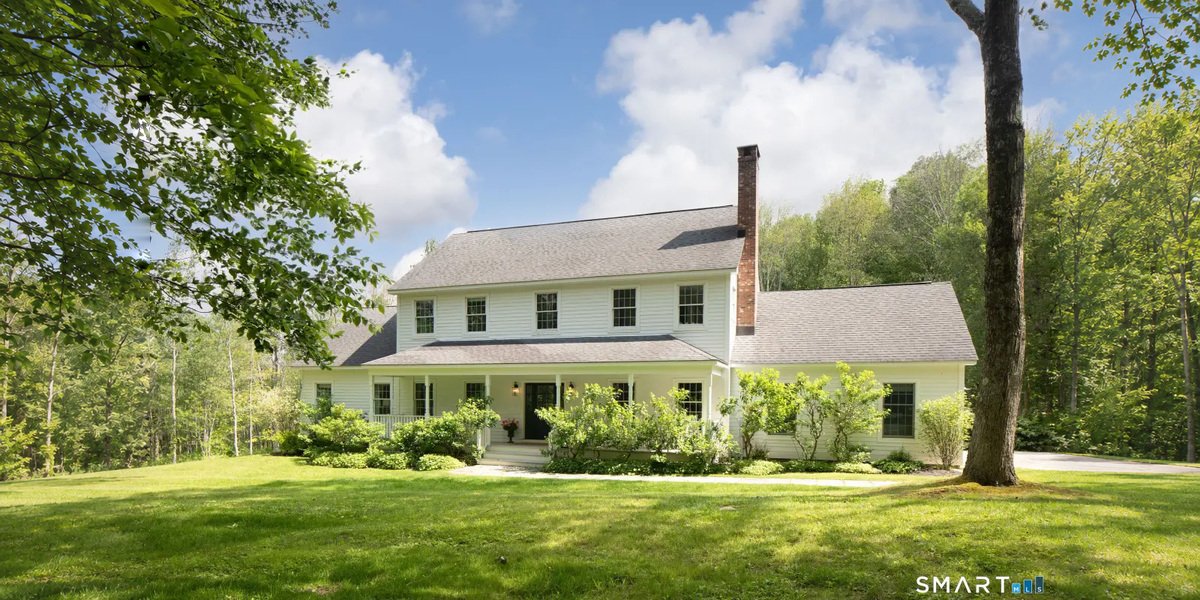
The historic character of Sharon, Connecticut is one of its genuine draws. Original Colonials, Federal style farmhouses, and 18th and 19th century estates with stone walls and mature trees are the properties many buyers arrive imagining themselves in. The reality of how those houses sit on their land is frequently the first surprise.
“The older houses up here, Colonials, even the big ones, are close to the road because that’s how houses were built back then,” Melnick said. “Even big houses needed to be close to the road for practical reasons.”
A house set fifty feet from a country road in the 1790s was a reasonable arrangement for a working farm. For a buyer in 2026 who has spent years managing the exposure and density of urban life, it registers as insufficient separation. The house may be beautiful, the land may be extensive, and the price may be competitive, but if the structure sits close to the road without a long driveway or natural screening, some luxury buyers may hesitate.
The pivot that Melnick consistently observes is buyers who arrive focused on older historic properties and shift, once they understand what privacy actually requires, toward houses built in the 1920s, 1930s, or 1940s, when residential construction began to move back from the road to capitalize on views and the kind of separation that a long driveway provides.
When the Right Land Changes Everything
The privacy requirement is closely connected to the land question, and the two together can shift a buyer’s criteria substantially from where they started. One recent transaction in Sharon illustrates the dynamic clearly.
A buyer came to the market with specific requirements around square footage and office space. The house they ultimately purchased did not fully meet those requirements. It was, by the buyer’s initial standards, too small. What it had was a location, a privacy profile, and conservation land abutting the property that made those initial requirements secondary. The buyer purchased it and planned to add on.
“They saw the location, the privacy, the abutting conservation land and decided to buy this house and then to add on to it to accommodate their needs,” Melnick said.
That kind of pivot is not unusual at this price point. The calculation shifts when a buyer encounters a property where the land is genuinely right, because the land cannot be changed. The house can be expanded, reconfigured, or renovated. The position of the house on the land, the views it commands, and what surrounds it are fixed.
What Sellers of Private Properties Need to Understand
Marketing a property where privacy and land quality are the primary assets requires a different approach than standard residential marketing. Listing descriptions organized around bedroom count and square footage miss the point of what a buyer in this segment is actually purchasing.
“It’s a specific buyer,” Melnick said. “Some people don’t want less than 25, 50, or 100 acres. They search according to that. They want to feel like they’re protected.”
Sellers of these properties benefit from marketing that leads with what makes the land exceptional: the acreage and its composition, the views and their permanence, the conservation land that abuts the property, the length of the driveway and what it screens from the road, and the building site’s relationship to the surrounding landscape.
A buyer who is specifically looking for protected privacy is not going to be drawn in by kitchen photographs. They want to understand the property’s position, its sightlines, and what can and cannot be built around it.
Sellers who communicate those qualities clearly, and agents who understand how to frame them, are better positioned to connect with buyers who value those attributes. Sharon’s combination of protected land, historic character, and genuine rural privacy has made it a consistent draw for exactly this buyer.
Sharon’s combination of protected land, historic character, and genuine rural privacy has made it a consistent draw for exactly this buyer. It is a market where the land earns its price, and where buyers who understand that tend to find what they are looking for.
Explore current listings in Litchfield County at Elyse Harney Real Estate.
About the Expert: Bill Melnick is a luxury real estate specialist with Elyse Harney Real Estate, serving Litchfield County and surrounding markets in Connecticut.
This article is based on information provided by the expert source cited above. It is intended for general informational purposes only and does not constitute legal, financial, or real estate advice. Readers should conduct their own research and consult qualified professionals before making any real estate or financial decisions.