By Christopher M. Spence
My first teaching assignment was a middle school special education class. I learned quickly that children do not all learn in the same way or at the same rate. I could explain an idea once and watch one student grasp it immediately while another still needed a different example, more time or a chance to talk it through.
That experience changed the question I asked when a lesson did not work. Instead of asking, “What is wrong with this student?” I began asking, “What does this student need from me?”
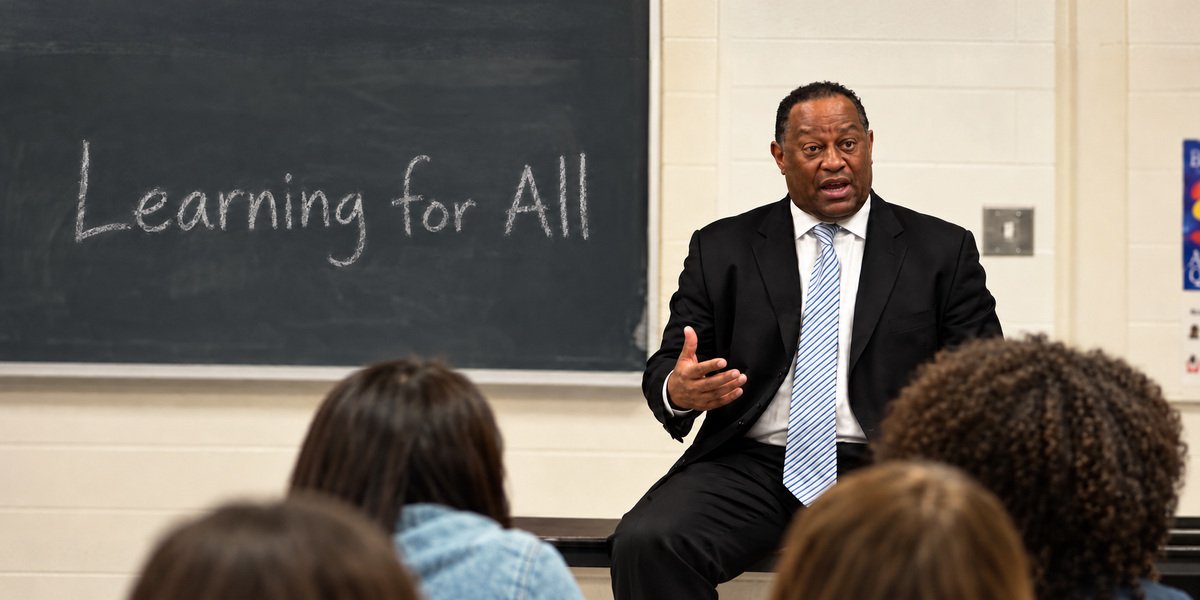
Years later, that question remains at the heart of my belief in Learning for All. Schools have long worked to ensure that every child is taught. Our responsibility goes further: to find out whether every child is learning and respond when they are not.
That promise includes neurodivergent learners. The term can describe people whose attention, communication, reading, sensory processing or ways of thinking differ from what a school typically expects. It includes some students with autism, ADHD or dyslexia, among others. No label, however, tells a teacher everything about a child. Two students with the same diagnosis may have very different strengths and need very different support.
Consider a student who understands a science concept but struggles to organize a written answer under a time limit. Another may be ready to write but lose track of directions delivered only aloud. A third may find it difficult to concentrate in a noisy classroom. In each case, the teacher needs to know what the student understands, what is getting in the way and which response will help.
Sometimes the answer is explicit instruction or more guided practice. Sometimes it is written directions, a quieter place to work, text that a student can listen to, or time to plan a response. When the skill being assessed permits it, a conversation or diagram may give a student a way to show what they know. The learning goal should remain clear and challenging; the route to reaching it can be more flexible. CAST’s Universal Design for Learning guidelines encourage educators to plan varied ways for students to engage with material, encounter information and express their learning.
Students themselves can often tell us something important. A child might say that group work is hard when nobody has a clear role, or that a long set of spoken instructions is difficult to remember. Listening does not replace a teacher’s judgment. It gives the teacher more information to work with. Families, too, can help educators understand what supports a child and what causes frustration.
For school leaders, I think of this work through three Ps: personalization, precision and professional learning. Personalization means knowing students as people—their interests, strengths, aspirations and needs. Precision means responding to what the evidence shows, rather than assuming that one program or accommodation will work for everyone. Professional learning gives teachers time to plan together, study student work and improve their instruction.
Then comes the question every school must be prepared to answer: What will we do when a student is not learning? Our response should be timely, so a child does not spend months falling further behind. It should be invitational, so asking for help does not come with shame. And it should be part of a schoolwide plan, so support does not depend on which teacher a child happens to have.
Inclusion means more than having a seat in a classroom. A student should be able to take part, build relationships, face meaningful challenges and experience success. That includes opportunities in the arts, athletics and school life, as well as academic support.
The students in my first classroom taught me to pay attention to the learner in front of me and to keep asking better questions. Learning for All is a commitment to act on the answers. Every child deserves to be seen, heard, supported and given a real opportunity to learn.
Christopher M. Spence is an educator, author and advocate for Learning for All.