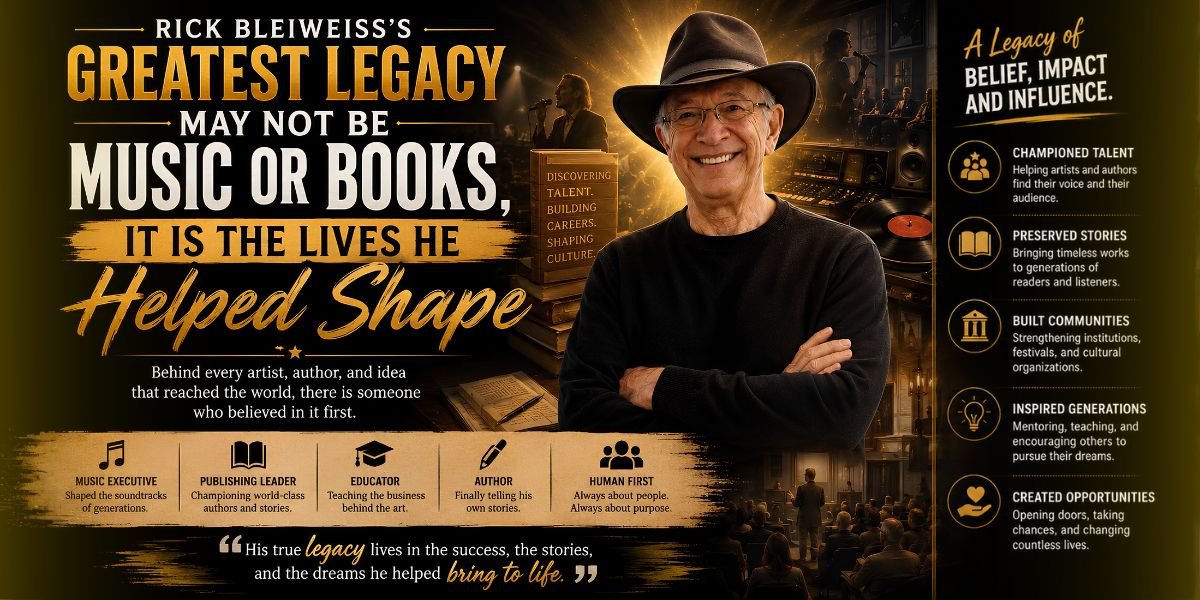
There is a peculiar obsession in modern culture with the idea of arriving early. The youngest CEO. The debut novelist is under thirty. The overnight success that arrives just in time for social media to declare someone extraordinary before they have accumulated much history. Rick Bleiweiss presents a stubbornly different story.
His first novel did not appear in his twenties or forties. It arrived when he was seventy-eight years old. By then, he had already lived several professional lives as a touring musician, songwriter, record producer, Grammy-nominated producer, record label executive, publishing executive, lecturer, columnist, and educator. He had spent decades helping other people’s work find audiences before asking readers to consider his own fiction.
It is tempting to call such a journey unusual. It is perhaps more accurate to call it patient. In an era increasingly fascinated with acceleration, Rick’s career offers an argument for artistic accumulation.
Career Built Before the Spotlight Shifted
Many novelists spend years collecting experiences to write about. Rick spent decades inhabiting entirely different creative industries. His early years belonged to music. After performing professionally for roughly fourteen years, he transitioned into production and the business side of the recording industry. The shift would eventually place him inside some of the most influential companies in American popular music, including PolyGram, Island Records, Arista Records, and BMG Distribution.
Those appointments were hardly ceremonial. They involved marketing campaigns, artist development, national distribution, and commercial strategy during decades when the record business occupied an enormous place in American culture.
His professional orbit eventually included artists whose names became part of music history. Whitney Houston, U2, Melissa Etheridge, Donna Summer, Britney Spears, Backstreet Boys, Kiss, Anthrax, The Bee Gees, TLC, NSYNC, and many others. He worked alongside executives such as Clive Davis while also earning recognition for his own production work, including a Grammy nomination and an ASCAP award. None of these achievements represented a destination. They became chapters.
Learning the Architecture of Story
It is easy to imagine that decades spent in music and publishing occupy different creative worlds from fiction. His career suggests otherwise. Producing records requires an understanding of rhythm, pacing, personality, and audience. Marketing albums asks a different question: why should anyone care about this particular story today? Publishing demands another layer entirely. Identifying manuscripts capable of lasting beyond immediate trends.
Since joining Blackstone Publishing, he has acquired works by internationally celebrated writers while helping expand one of the industry’s most significant independent publishing operations. Authors including James Clavell, Gabriel García Márquez, Catherine Coulter, Leon Uris, Heather Graham, Andrew Child, Jeneva Rose, Whoopi Goldberg, and Susan Lucci became part of acquisition efforts connected to his role in new business development. Years spent evaluating manuscripts inevitably sharpen a writer’s instincts.
One begins to recognize the difference between an entertaining premise and enduring storytelling. Perhaps this explains why Bleiweiss waited.
Beginning at Seventy-Eight
When Pignon Scorbion & the Barbershop Detectives appeared in 2022, it was not introduced as the ambitious debut of an unknown young novelist. Instead, it arrived with the confidence of someone who had already spent a lifetime observing audiences.
The novel quickly found readers. It became a Barnes & Noble selection, earned an Amazon Editors’ Pick designation, and won the Pacific Northwest Booksellers Association Buzz Book recognition. Television rights were later optioned, and the fictional world even expanded into a companion video game. Commercial success alone, however, tells only part of the story. What makes Bleiweiss’s debut noteworthy is the perspective it represents.
His detective fiction does not emerge from youthful fascination with mystery conventions. It arrives after decades spent studying human ambition, artistic careers, commercial pressures, public personalities, and the curious ways people present themselves to the world. Those observations cannot be hurried.
Quiet Rebellion Against Creative Deadlines
There is another reason his career feels increasingly relevant. Creative culture often treats reinvention as dramatic. A sharp departure from what came before. His professional life suggests something subtler.
Music informed publishing. Publishing informed writing. Teaching reinforced communication. Journalism strengthened observation. Each profession quietly prepared the next rather than replacing it. His lectures at universities and continuing education programs frequently encourage older adults to continue pursuing long-postponed ambitions, an idea reinforced simply by the chronology of his own work. The message is neither sentimental nor motivational. It is practical.
Creative ability rarely develops in isolation. It accumulates from conversations, failures, negotiations, performances, deadlines, travels, and professions that initially appear unrelated.
Career That Refuses Simple Categories
Attempting to summarize Rick Bleiweiss almost guarantees incompleteness.
- Musician.
- Producer.
- Record executive.
- Publishing executive.
- Columnist.
- Lecturer.
- Mystery novelist.
Each title is accurate. None is sufficient.
Perhaps that explains why his fiction feels less like the beginning of a writing career than the latest expression of a much longer creative life. The detective novels are connected to everything that preceded them, not because they recount his experiences directly, but because they inherit decades of observation about people, ambition, performance, and the narratives individuals construct around themselves. There is something quietly reassuring in that idea.
Not every important story begins with youthful promise. Some require decades of preparation before they can finally be written. Rick Bleiweiss’s career suggests that creative lives are not measured by when they begin, but by how completely they continue to evolve.