War literature has long documented strategy, sacrifice, and survival. Many accounts leave one question unanswered: What occupies the mind of a service member when the greatest battle is not only on the front lines, but also thousands of miles away at home?
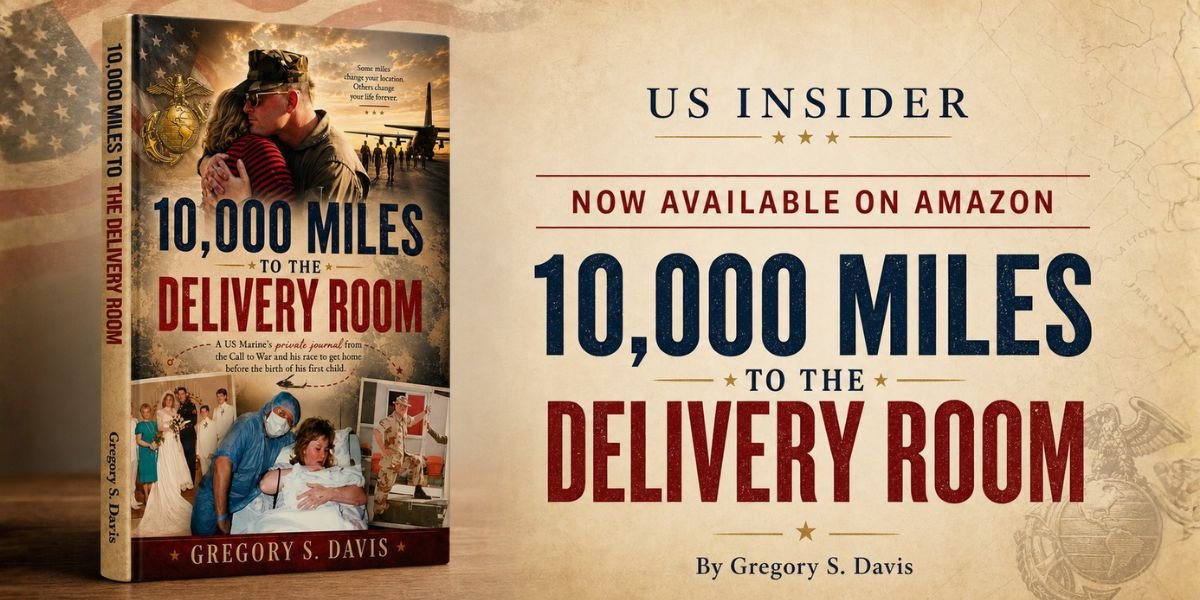
Gregory S. Davis addresses that question in 10,000 Miles to the Delivery Room: A US Marine’s Private Journal from the Call to War and His Race to Get Home Before the Birth of His First Child. His memoir shifts attention from military operations to the emotional reality of deployment, presenting an honest record of one Marine reservist balancing duty to country with the overwhelming desire to return home before the birth of his daughter.
Different Kind of War Story
Readers expecting a traditional combat memoir may be surprised by Davis’ approach. While the Persian Gulf, naval mines, and military operations remain an important part of the narrative, they are not its defining focus. Instead, the book asks readers to consider what military service looks like between the headlines.
The story follows a young husband whose life changes in a single phone call. Activation orders arrive just as he and his wife, Audra, begin preparing for their first child. Suddenly, ordinary milestones, doctor appointments, decorating a nursery and sharing the anticipation of becoming parents, are replaced by deployment preparations, military transport and the uncertainty of war.
That contrast gives the memoir its emotional weight. The greatest countdown is not tied to military objectives, but to the expected arrival of a daughter he has yet to meet.
Journal That Preserved the Moment
One of the book’s strongest qualities is its authenticity. During deployment, Davis committed himself to writing every day, recording thoughts without knowing they would one day become a published work. Decades later, he deliberately chose to preserve the original voice of those journals, making only minimal edits for readability.
That decision allows readers to experience uncertainty without the filter of hindsight. There is no attempt to reshape emotions into polished reflections. Fear, humor, frustration, and hope exist together exactly as they did aboard the USS Tripoli.
The result feels less like a memoir written years later and more like sitting beside a Marine trying to make sense of each passing day while counting the miles home.
Family Becomes the Mission
Perhaps the book’s most compelling idea is that survival often begins with purpose. Military memoirs frequently emphasize discipline, teamwork, and endurance. Davis acknowledges those qualities while presenting another source of strength: family. Again and again, his journal returns to the same promise: that he will make it home.
That repeated commitment becomes the emotional center of the narrative. His wife, unborn daughter, and family are not secondary characters waiting at the end of the story. They are the reason every decision matters.
The perspective also shines a light on reservists, whose civilian responsibilities continue even after deployment begins. Unlike active-duty personnel whose careers revolve entirely around military life, reservists often leave behind homes, spouses, careers, and communities that continue moving forward without them.
Value of Honest Memory
There is remarkable restraint in Davis’ storytelling. Rather than magnifying danger for dramatic effect, he spends equal attention on routine maintenance, long stretches of waiting, cramped living conditions, seasickness and handwritten journal entries. Those ordinary moments reveal the psychological reality of deployment as clearly as moments of crisis.
That balance gives the memoir relevance beyond military audiences. Parents, spouses and anyone who has experienced prolonged separation from loved ones may recognize the universal emotions beneath the uniform.
What the Memoir Leaves With Readers
In preserving his younger self on the page instead of rewriting history, Davis offers readers something increasingly uncommon. It is an authentic record created in the moment, before memory had the opportunity to soften or reshape it.
10,000 Miles to the Delivery Room ultimately reminds readers that every service member carries two responsibilities. One to the nation and another to the people waiting at home. It is in the space between those responsibilities that this memoir finds its lasting significance.
For readers drawn to firsthand military history, and for military families especially, the book documents the waiting as carefully as the danger. It is available in print and digital editions.