By: Raquel Homes
There’s something quietly radical about a practitioner who admits she got it wrong. Not in a client’s story, not in a professional setting, but in her own home, in her own marriage, during one of the most significant transitions of her life. Michelle A. Hardwick spent a decade navigating menopause while her husband, John, stood right beside her. She never once asked him how he was doing, not because she didn’t care, but because she was consumed by the intense and ever-changing parts of navigating menopause alone. That admission is where Menopause Wingman begins, and it’s what gives the book a weight that most wellness guides simply don’t carry.
This isn’t a clinical overview written from a comfortable distance. It’s a handbook built from lived experience, professional expertise gathered across three countries, and the unedited voices of real men who had been quietly struggling in a silence nobody thought to break.
The Chapter That Hits Hardest
Of everything in the book, Michelle A. Hardwick says the intimacy chapter generates the most emotional response from readers. And when she explains why, it’s not difficult to understand.
Men, she says, tend to need intimacy to feel loved. Women tend to need to feel loved in order to be intimate. Menopause arrives and flips that dynamic completely upside down. The hormonal changes alone are significant: dryness, soreness, zero libido, hot flushes interrupting tender moments. A woman’s body can feel like it’s turned against her. Add sleep deprivation and bone-deep exhaustion on top of that, and intimacy can start to feel like one more demand on a body that has nothing left to give.
That withdrawal isn’t rejection. Michelle A. Hardwick is clear about that. It’s survival. But for the partner on the other side of it, the distance can feel devastating and deeply personal, even when it has nothing to do with them.
Her answer to this isn’t a checklist. It’s a conversation starter. Different timing, different kinds of touch, more planning, more communication. The intimacy roadmap that existed before menopause could be completely reimagined, and that reimagining, she points out, can actually be interesting. Discovering what works now. Connecting in new ways. Intimacy doesn’t have to end. It just gets to evolve.
What Transformation Actually Looks Like
Michelle A. Hardwick pushes back firmly on the idea that menopause is something a couple simply has to endure and wait out. She’s seen what happens on the other side when both people show up for it properly, and it looks like something genuinely better than what came before.
Once a man truly understands that what’s happening isn’t about him, much can shift. He stops reacting from a place of confusion and starts responding from a place of knowledge. She can feel the difference. Supported. Understood. No longer alone in it. And that’s when, as Michelle A. Hardwick puts it, hope arrives.
Hope for what the next chapters look like. Hope that the relationship isn’t contracting but expanding into something deeper, more honest, and more authentic than what existed before. She describes menopause as a pressure cooker (something that can push a fragile relationship to its breaking point), but worked through with the right tools, the right understanding, and the right communication, what comes out when the pressure lifts is richer and more real than what existed before.
She’s not speaking theoretically. Her own relationship is in a stronger place because of what she and her husband, John, navigated together. That’s not a brochure claim. That’s what she lived.
The book has already been drawing significant attention. Loretta Dignam, Founder of The Menopause Hub, Forbes Top 50 Over 50 honouree and Ireland’s leading menopause advocate, describes it as giving partners “the tools, language and confidence to become allies rather than bystanders.” That endorsement speaks to exactly what Michelle A. Hardwick set out to create, not a book about menopause, but a book about love, presence, and showing up.
Three Countries, Three Fresh Starts, One Book
Michelle A. Hardwick built her practice across three countries: New Zealand, Wales, and Ireland. Each one is a complete restart. Each one required earning trust in communities that didn’t know her, explaining her work from scratch, understanding the specific history and collective wounds of a new place.
With roots in North Wales, half Swiss (her mother was born in Zurich), and now living with her husband John in County Cork, Ireland, Michelle A. Hardwick brings a rare and richly layered perspective to her work. She has navigated different cultures, different communities, and different ways of understanding emotional life. That breadth is woven into every page of Menopause Wingman.
There were stretches of real financial difficulty. Periods of self-doubt. Nights lying awake reflecting on a client’s story, working alongside them in her mind, accompanying them on their journey inward, not leading the way but illuminating the path. But there were also moments she describes as exquisite, watching someone unlock something they had carried for decades, being trusted with a truth that had never been spoken aloud before, witnessing a breakthrough in real time.
That accumulation of experience, the hard parts and the extraordinary parts together, is what kept her going when the writing of this book got difficult. And it shaped something fundamental about how she wrote it. She didn’t want to produce an academic text. She wanted something a man could pick up at any point in the journey and find himself somewhere in the pages.
Where This Conversation Needs to Go
Michelle A. Hardwick is already thinking well beyond the book itself. Her hope is that Menopause Wingman reaches younger generations before they need it, so that when their time comes, they’re already informed, already aware, already capable of showing up differently than previous generations did.
She wants to see partners included more routinely in healthcare conversations, in workplace wellbeing policies, and in the broader cultural framing of menopause as a shared transition rather than a private female burden. She wants men talking to each other about this openly, the way women have always supported each other through the most defining chapters of their lives.
Workshops, programmes, spaces where men feel genuinely safe to ask the questions they’ve been too afraid to raise. That’s where she’s heading next.
The book, she says, is the beginning of that work. Not the end.
Alongside the book, Michelle A. Hardwick works 1:1 with women navigating the emotional complexity of menopause (the anxiety, panic, fear, and overwhelm that can arise during this profound life transition), as well as with partners who want to show up more fully for the person they love. For those seeking that deeper support, she can be reached through MenopauseWingman.com.
And for a woman whose life and work have spanned three countries and three continents, what comes next feels less like a new beginning and more like a natural unfolding.
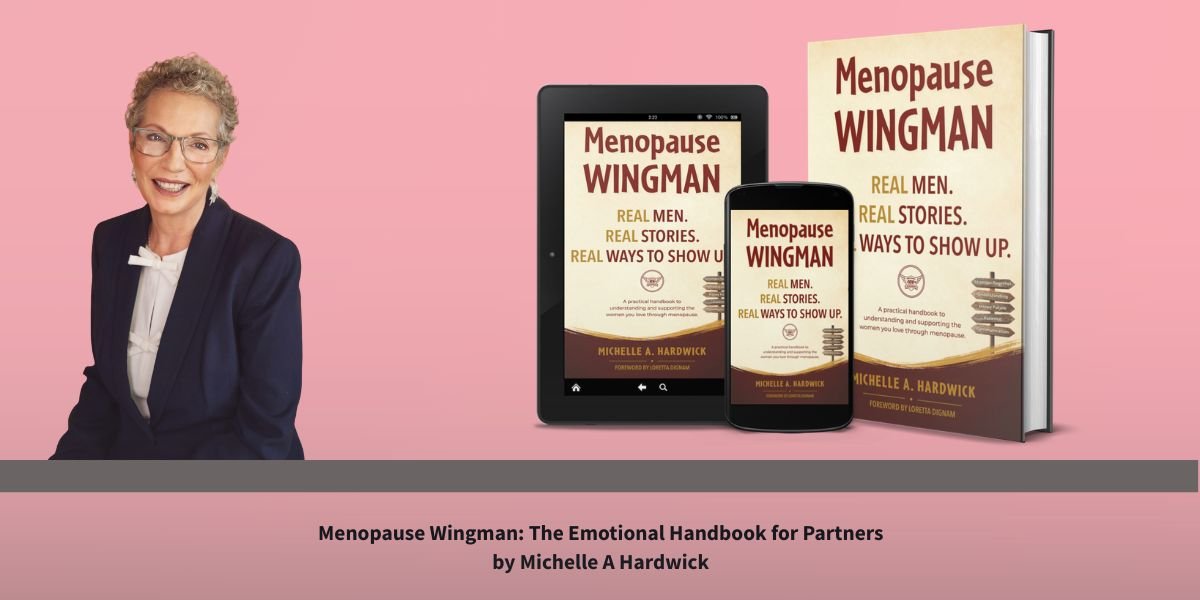
Menopause Wingman: The Emotional Handbook for Partners by Michelle A. Hardwick is available now on Amazon and soon as an audiobook at MenopauseWingman.com. Because no woman should face this alone, and no partner should either.
Disclaimer: This article is for informational purposes only and is not intended to provide medical, therapeutic, or relationship advice. Readers should consult a qualified healthcare professional or licensed practitioner for guidance related to menopause, mental health, intimacy, or relationship concerns.