By: Anthony Jude Eze
Today, even the smallest businesses rely on digital tools, from email and cloud storage to payment systems and online customer engagement. While these tools offer significant advantages, they also introduce potential exposure to cyber threats. Although large corporations may have the resources to invest in advanced security infrastructure, small and medium-sized enterprises (SMEs) may face challenges due to limited resources, time, or technical expertise.
In my role as a certified ISO 27001 Lead Auditor and consultant, I have worked with numerous organizations, including many SMEs across a variety of industries. One noticeable trend is that while these businesses are doing their best to operate efficiently, information security is often not prioritized as highly as it should be. This gap can create vulnerabilities that cyber threats may exploit.
The risks associated with cybersecurity extend beyond individual businesses. When SMEs experience security breaches, it can disrupt supply chains, expose customer data, and diminish trust across entire sectors. Thus, developing practical, cost-effective, and scalable security strategies for SMEs is increasingly important for the broader digital economy.
Why ISO 27001 Can Help SMEs Enhance Their Security
Cybersecurity is a critical function that can help build customer trust, protect revenue, and ensure compliance. The good news is that SMEs don’t necessarily need significant investments to improve security.
ISO 27001, the internationally recognized standard for information security management, offers a risk-based, scalable framework that can be adapted to the size, industry, and maturity of an SME. Instead of attempting to secure everything at once, it enables organizations to:
- Focus on addressing the most significant risks
- Implement affordable controls
- Foster a culture of ongoing improvement
Common Vulnerabilities Faced by SMEs
While SMEs form the backbone of many economies, they often struggle to implement the same level of cybersecurity practices seen in larger organizations. Based on my experience working with SMEs, here are some common gaps that introduce vulnerabilities:
1. Lack of Formal Security Policies
Many SMEs operate informally regarding cybersecurity. Some may trust their team to “do the right thing” or believe their operations are too straightforward to require detailed protocols. However, the absence of formal security policies means:
- There are no clearly documented guidelines on how data should be created, stored, shared, or deleted
- Incident response is often reactive and inconsistent
- Employees may be unclear about their responsibilities, particularly in remote or hybrid work settings
2. Weak or Inadequate Access Controls
Access control is one of the most essential yet frequently overlooked security measures. In many SMEs, you’ll find:
- Shared passwords across users or departments
- Generic admin accounts without individual accountability
- Universal access to sensitive files, regardless of an employee’s role
This setup creates an environment where internal mistakes or external breaches can lead to significant damage, with one compromised account potentially granting access to critical business data.
3. Limited Staff Awareness and Cyber Hygiene
Cybersecurity training is often overlooked in small businesses, not due to negligence, but due to time and budget constraints. However, the human element remains one of the largest vulnerabilities. Without regular awareness training, employees are more likely to:
- Click on phishing links or open malicious attachments
- Use weak or repeated passwords
- Fall victim to impersonation scams (e.g., fake vendor invoices or urgent CEO requests)
4. Over-Reliance on Third-Party Vendors
SMEs increasingly rely on third-party vendors for services like IT support, cloud hosting, payroll, and payment processing. While outsourcing can be a cost-effective solution, it also introduces potential risks if vendors are not properly vetted. Common issues include:
- Assuming vendors have sufficient security without verification
- Failing to sign adequate data protection or confidentiality agreements
- Not monitoring changes in vendor operations or ownership
Practical and Scalable Information Security Controls for SMEs
While SMEs may not have enterprise-level budgets, they can still implement several low-cost, high-impact security measures:
1. Risk Assessment: Keep It Simple and Practical
An information security risk assessment is a structured process that helps identify risks to your digital assets, assess the likelihood of these risks occurring, and estimate their potential impact. This approach allows SMEs to focus their security efforts where they are most needed, rather than attempting to secure every possible vulnerability.
A comprehensive risk assessment evaluates:
- Threats: Potential exploiters of weaknesses (e.g., hackers, insider misuse, malware)
- Vulnerabilities: Weaknesses that could be exploited (e.g., weak passwords, outdated software)\
- Impact: The potential damage or loss if the threat is realized
An effective information security risk assessment doesn’t just identify threats and vulnerabilities; it also considers how those risks affect the confidentiality, integrity, and availability of your critical business assets. This is known as the CIA triad, and it forms the foundation of any mature security program.
Step-by-Step Guide for SMEs:
1. List Your Top 10 Business-Critical Assets
Examples include:
- Customer database
- Company laptops
- Email system
- Payroll software
- Website/backend
- Cloud file storage
- Supplier platforms
2. Identify Threats & Vulnerabilities
For each asset, ask:
- What could go wrong? (Threat)
- What weakness exists? (Vulnerability)
- How would it happen?
3. Determine Impact Using CIA
For each asset, consider how a security failure would affect:
- Confidentiality: Would sensitive data be exposed?
- Integrity: Could data be changed or corrupted?
- Availability: Would the system or service become unavailable?
4. Create a Risk Register Like This: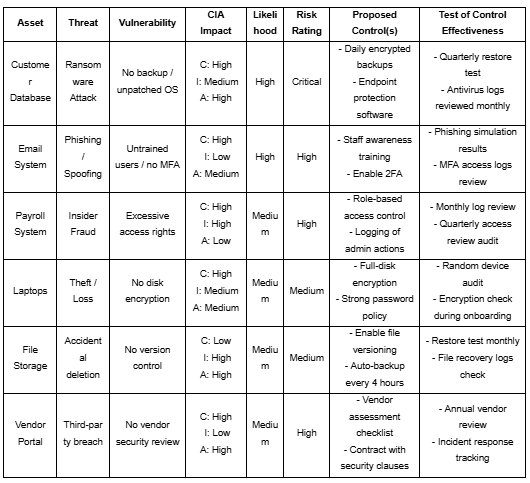
Consider using ISO 27005, the companion standard to ISO 27001 that provides a structured approach to risk management. It helps you score risks by likelihood and impact, making prioritisation much easier.
5. Prioritize Your Mitigations
Risks that score high in CIA impact + likelihood should be addressed first.
For example:
- Implement backups for high-availability assets
- Train staff to reduce confidentiality risks from phishing
- Use access controls to protect data integrity
6. Maintain & Update the Register
Update your risk register:
- At least once a year
- After security incidents
- When adding new vendors, apps, or systems
2. Define the Scope Clearly
Many SMEs make the mistake of attempting to apply ISO 27001 across their entire organization from day one, which can be overwhelming. Instead, the standard allows organizations to start small and expand their Information Security Management System (ISMS) in phases.
The goal is to determine which systems, processes, and locations will be covered in the initial phase, based on:
- Business Criticality: What systems or assets are essential to your operations (e.g., payment systems, customer database)?
- Risk Exposure: Where the likelihood and impact of an attack are highest
- Legal or Contractual Requirements: Areas where laws or partner agreements require specific controls
3. Build a Lean, Effective ISMS
An ISMS is the structured system that keeps your security program organized and auditable. While SMEs may fear the complexity of ISO 27001, a simplified, digital ISMS is easier to maintain and more effective.
An SME-focused ISMS typically includes:
- Information Security Policy: A brief, leadership-approved statement of commitment to security
- Risk Register: A dynamic list of assets, threats, vulnerabilities, and mitigation strategies
- Control List with Assigned Owners: Ensuring each control has a designated person accountable for its implementation
- Incident Response Procedure: Clear instructions for responding to and recovering from security incidents
4. Access Control and User Authentication – Strengthen the First Line of Defense
Access control and user authentication are essential for protecting your business from unauthorized access. To strengthen this defense, SMEs should implement:
- Multi-Factor Authentication (MFA)
- Unique logins for every user
- Role-based access (Principle of Least Privilege)
- Immediate access revocation for departing employees
- Password management and enforcement policies
5. Encryption and Backup – Plan for Uncertainty
Even with the most robust security measures in place, unexpected events can still occur—devices can be stolen, malware can compromise files, or accidental deletions may happen. Encryption and regular backups provide a safeguard for when the unexpected happens, ensuring that data remains secure and recoverable.
Key Actions:
- Enable full-disk encryption on all devices
- Back up critical files regularly
- Regularly test backup systems to ensure they are functional
6. Cyber Awareness Training – Encourage Frequent Learning
Even the best technical measures can be undermined by a single user mistake. Ongoing cyber awareness training is critical for reducing human error.
- Make training sessions brief, regular, and engaging
- Include cybersecurity topics in employee onboarding
- Provide visible reminders of safe practices
7. Vendor and Third-Party Risk – Evaluate Your Partners Carefully
The security of your organization depends not only on your own controls but also on the strength of your third-party vendors. To reduce the risk posed by third parties, SMEs should:
- Maintain a vendor inventory
- Incorporate security clauses into contracts
- Conduct regular vendor security reviews
8. Monitor, Review, and Improve
The strength of ISO 27001 lies in its continuous improvement model, the Plan–Do–Check–Act (PDCA) cycle. Regularly monitoring and updating security practices ensures your defense evolves with changing threats and business needs.
- Plan: Identify new risks and set objectives for security improvements
- Do: Implement controls and perform security activities
- Check: Review logs, conduct audits, and test controls
- Act: Adjust and improve based on findings from monitoring and audits
Summary
Cybersecurity is critical for organizations of all sizes. For SMEs, the challenge lies in knowing how to start, how to prioritize, and how to implement meaningful protections without overextending resources.
Fortunately, scalable and cost-effective solutions are available. Frameworks like ISO 27001 provide SMEs with a practical, adaptable roadmap to assess risks, strengthen defenses, and build a culture of responsibility—all without requiring significant financial investments or specialized infrastructure.
From my experience working with numerous SMEs, I’ve seen how even modest efforts—such as clearer access policies, staff training, and basic logging—can greatly improve resilience and enhance customer trust.
Eze Anthony Jude, PCQI
ISO 27001:2022 & ISO 9001:2015 Lead Auditor | Consultant
Disclaimer: The information provided in this article is for educational and informational purposes only. The content is based on professional experience and does not constitute legal or professional advice. Businesses should consult with relevant professionals or experts to tailor their information security strategies to their specific needs and ensure compliance with applicable laws and regulations. While every effort has been made to ensure the accuracy of the information presented, no guarantees are made regarding its completeness or applicability to all situations.