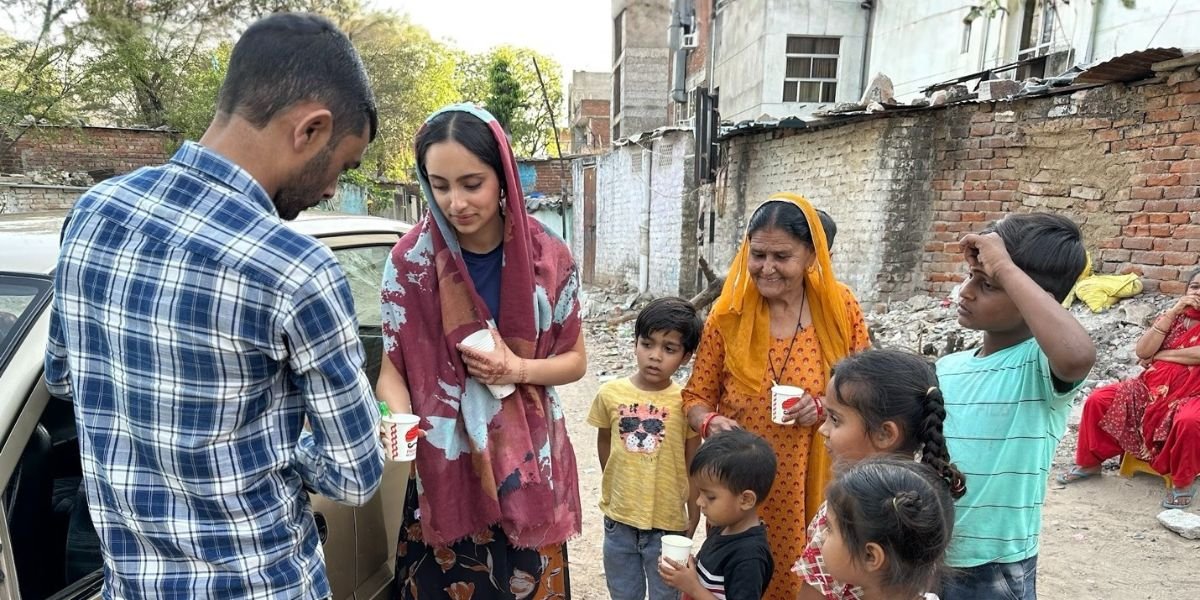
Before ProGrads International expanded across countries, Sana Kalra’s idea of service was taking shape during an early visit to India. There were books and school supplies, followed by several hours spent sitting with children in an underserved community. Kalra returned the next day, then kept thinking about what would happen after she left. Handing over resources was easy to understand; knowing whether they were the right resources was harder. “I think that was when I started realizing that helping cannot just mean arriving with what you think people need,” she says. “You have to spend time with them first.” That idea would eventually shape ProGrads International, the nonprofit Kalra founded and now runs at 16.
The roots of ProGrads go back to family travel. Kalra remembers seeing poverty in India while staying with her grandmother and later encountering similar hardship during a trip to Jamaica. Those experiences, she says, made it meaningless to return home without doing something. What stayed with her was the gap between visiting and leaving, and the knowledge that a single delivery of supplies would not change the conditions she had seen. Her father became an important resource, helping with travel arrangements and the work of getting an organization off the ground. Kalra, meanwhile, wanted room to build something with its own identity. Rather than run an occasional donation drive, she wanted to return to communities and build programs around what each place actually needed.
ProGrads has since worked in seven countries: India, Jamaica, China, Mexico, Portugal, Spain and the United States. Its work ranges from English-learning programs in Spain to STEM activities in China, with visits shaped around local feedback. The organization has reached more than 500 children. In one Chinese community, students were already comfortable with reading and languages, so returning with more of the same would have been convenient but not especially useful. Keeping that in mind, the curriculum for students was redesigned and emphasis was placed on robotics instead.
For Kalra, the measure of that approach is what continues after a visit. “If every place gets the exact same program, then you are really designing it for yourself, not for them,” she says. ProGrads stays in contact with partner staff and children after visits. In Shanghai, an education coordinator later reported that several students kept practicing beginner coding exercises and one began attending extra technology classes. A literacy coordinator at a Chicago family shelter noticed younger students reading aloud with more confidence, and staff in Monterrey and Guadalajara reported children still journaling afterward. These partner-reported outcomes help Kalra adjust future visits.
Not all of the feedback has been easy to hear. Staff at a shelter in Monterrey reported that several children were upset once a visit ended, unused to that much individual attention. Kalra treats that as an argument for permanence rather than a reason to visit less. Her longer-term ambition is to build local chapters led by students and community members so the work does not depend on her family traveling from place to place.
Convincing people that a teenager could run any of this has been an uphill task. Kalra recalls putting up fundraising flyers in her community and being asked whether a student could really be behind an international nonprofit. The skepticism made sense to her. Her family already traveled frequently, which made international visits more feasible and Kalra is open about that advantage. The answer, as she sees it, is to build stronger local relationships and imagine a future in which community partners have greater ownership of the work.
Medicine has given Kalra another version of the same lesson. She hopes to become a surgeon and previously secured a gastroenterology internship. There she learned that colonoscopies were sometimes canceled because patients did not complete preparation requirements, while paper instructions or routine messages were not always enough to keep them on track. Hence, Kalra built KashGastro, a web-based preparation tool that combines daily checklists and short surveys with preparation videos, to close that gap. She assembled the system herself while the gastroenterologist advised her on the medical content. The doctor later reported that cancellations had become less frequent, and the tool is now used by roughly 70 to 80 patients each month.
The impact became more tangible when Kalra heard directly from one of the patients using the tool. After a procedure, Kalra spoke with a woman with dementia who told her the reminders had helped her keep track of the preparation. “You can look at a cancellation and assume somebody did not follow directions,” Kalra says. “Then you meet the patient and realize nobody ever asked whether the instructions worked for them.” The encounter reinforced the same lesson ProGrads had been teaching her, that a resource only works if the person receiving it can actually use it.
However, Kalra does not want every part of her life reduced to that single theme. Her classical Indian dance training, which spans more than 13 years, remains personal to her. Bharatanatyam and Kuchipudi connect her to her Indian identity distinctly, apart from medicine or nonprofit work. Track and varsity tennis offer another outlet for the discipline and persistence that have shaped much of her life.
That leaves ProGrads as the clearest expression of how her thinking has evolved. Kalra began with the understandable urge to help but the work has pushed her toward a harder question: who gets to define what useful help looks like? As she thinks about expanding ProGrads through local chapters, her answer seems increasingly clear. The aim is not for Sana Kalra to be present in every community, nor for one model to be repeated everywhere. It is to build something responsive enough that people closer to each community can shape what comes next. For a founder who started by wanting to contribute, the larger ambition may be learning when leadership means building and when it means making room for others to lead.