By Johnson Wright
The Cross-Disciplinary Practice and Frontier Exploration of Architect Yichao Jin
Yichao Jin is an architect internationally recognized for his outstanding integration of architectural design and advanced building technology research. He holds a Master of Science in Design: Advanced Architectural Design (MSDAAD) from the University of Pennsylvania, where he received rigorous, technology-driven training centered on digital design methodologies, environmental simulation, and cutting-edge construction systems.
Since completing his graduate studies, Jin has accumulated over five years of professional experience as a project architect, continuously working on supertall towers, large-scale public buildings, and experimental architectural projects. His practice demonstrates a sustained and clearly defined research trajectory focused on building performance optimization and the implementation of advanced technologies, distinguishing him from conventional architectural practitioners.
He has successfully translated his design philosophy into built projects, where ideas are rigorously tested and refined through practice. As a result, his work has received wide international recognition, including:
Platinum Award, American Muse Design Award (MUSE)
Honorable Mention Award (Collection and Exhibition), China Design Intelligence Award (DIA)
Architectural Design Award, American Architecture MasterPrize (AMP)
Top 100 Most Influential Designers, International Design Pioneer Award (IPDA)
These honors collectively underscore his international influence and his contribution to advancing contemporary architectural design through research-driven practice.
Technology-Driven Sustainability: Redefining Building Performance Through Scientific Methods
In the field of sustainable architecture, Jin’s work extends far beyond conceptual or stylistic expressions. Instead, he applies quantitative analysis, advanced simulations, and integrated technological systems to directly improve energy efficiency, environmental responsiveness, and physical building performance.
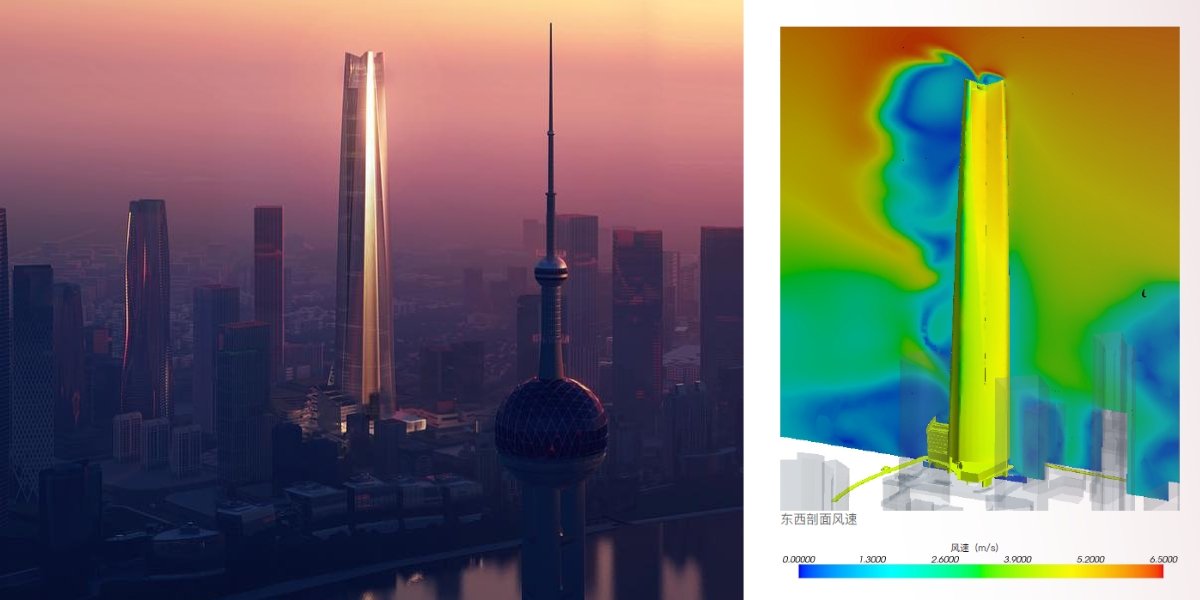
A representative example is the North Bund (Lot 91), 480-meter Supertall Tower Project at Shanghai, a landmark development planned as the third tallest building in Shanghai. Competing against hundreds of world-renowned international firms, the project team achieved Second Prize in a global architectural competition. Jin played a critical role by leading the Computational Fluid Dynamics (CFD) wind environment analysis. Through systematic comparisons of multiple tower morphologies, he rigorously evaluated wind pressure distribution across different massing strategies. As a result, the optimized tower form achieved an approximately 42% reduction in overall wind pressure at critical height zones compared to conventional square tower geometries.
In the Conghua Agricultural Exhibition Center, Jin advanced sustainable design to the level of active energy generation and environmental self-sufficiency. The building achieves full operational energy autonomy through rooftop photovoltaic systems. Responding precisely to local climatic conditions, Jin designed an optimized shading system to mitigate summer solar heat gain, while an integrated roof-based stack ventilation system enables continuous natural airflow driven purely by thermal pressure, without mechanical assistance.
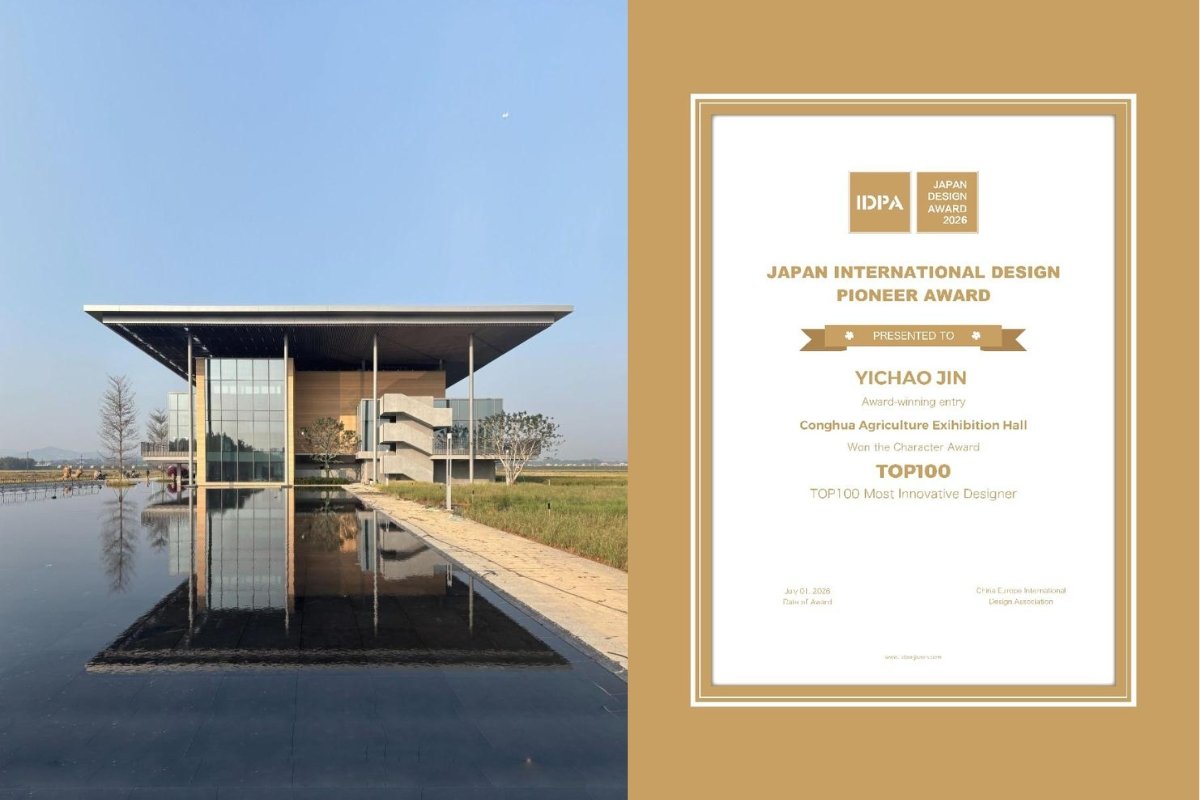
Due to its exceptional integration of architectural technology and ecological strategies, this project led to Jin’s selection for the International Design Pioneer Award (IPDA), where he was further recognized as one of the Top 100 Most Influential Designers, reflecting clear international professional acclaim for his work.
At a deeper research level, Jin has also made original technological contributions to façade system development. He co-developed an adaptive curtain wall system capable of physically responding to real-time solar radiation intensity through a mechanically constrained shading mechanism. The research culminated in a nationally granted patent, titled “A Building Curtain Wall System Based on Solar Radiation Intensity” (Patent CN202422394696).
Advancing New Construction Paradigms: Experiments in 3D Printing and Artificial Intelligence
Beyond sustainability research, Jin has pursued frontier exploration in digital fabrication and additive manufacturing, particularly in the application of 3D printing technologies to architectural design.
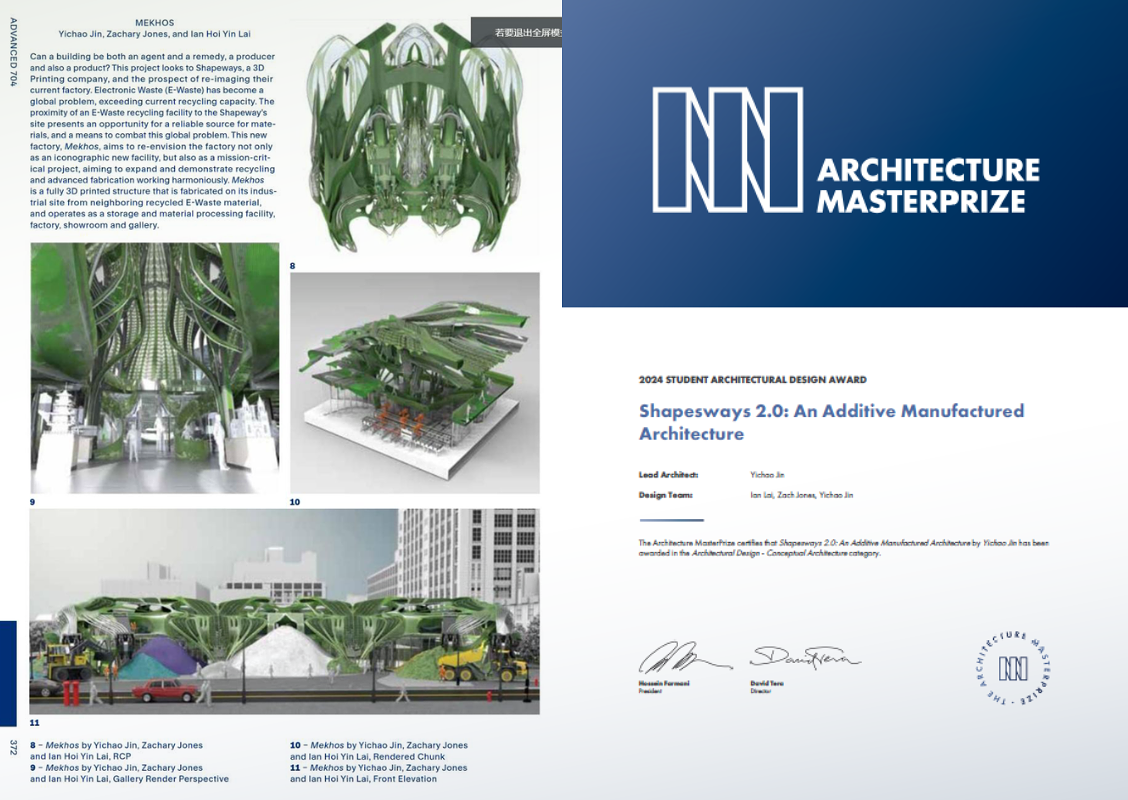
While at the University of Pennsylvania, he led a design studio research project focused on architectural reuse of electronic waste through 3D printing construction logic. By rethinking material cycles and fabrication processes, the project investigated how architectural structures could move beyond traditional component-based limitations and adopt biomimetic, highly complex, and performance-driven geometries enabled by additive manufacturing. The project received strong critical acclaim for its theoretical rigor and technological foresight and was ultimately awarded the American Architecture MasterPrize (AMP), affirming its international academic and professional significance.
Sustained Innovation at the Intersection of Architecture and Technology
Taken as a whole, Yichao Jin’s academic background and professional career reveal a coherent, sustained, and highly advanced research trajectory. By using technology as both method and medium, he has consistently expanded the boundaries of architectural practice. His work delivers quantifiable performance improvements in built projects while also advancing theoretical and experimental models for future construction methodologies.
Confirming materials:
1.”Platinum Award, American Muse DesignAward (MUSE):