There was no single moment. Yongwook Im is clear about that. No dramatic scene on a pitch, no one conversation with a teammate that resolved into an idea. What there was instead was six years of competitive soccer, and the slow accumulation of something he could not stop noticing once he had seen it.
At games and training sessions, he noticed that young athletes did not have the same access to quality sports clothing and equipment. Many of the teams he played on were well equipped. Others were not, and that contrast made the pattern clear. Over time he came to understand that apparel affects more than comfort or performance. It affects a player’s confidence and their willingness to participate at all. Access to sport, he realized, is not evenly distributed, and he was inside the system well enough to see exactly where the gaps fell.
Green Loop came out of that observation. It matters, he says, that the idea did not come from something he read. It came from being part of the environment in which inequality exists.
Turning an Observation Into a Product
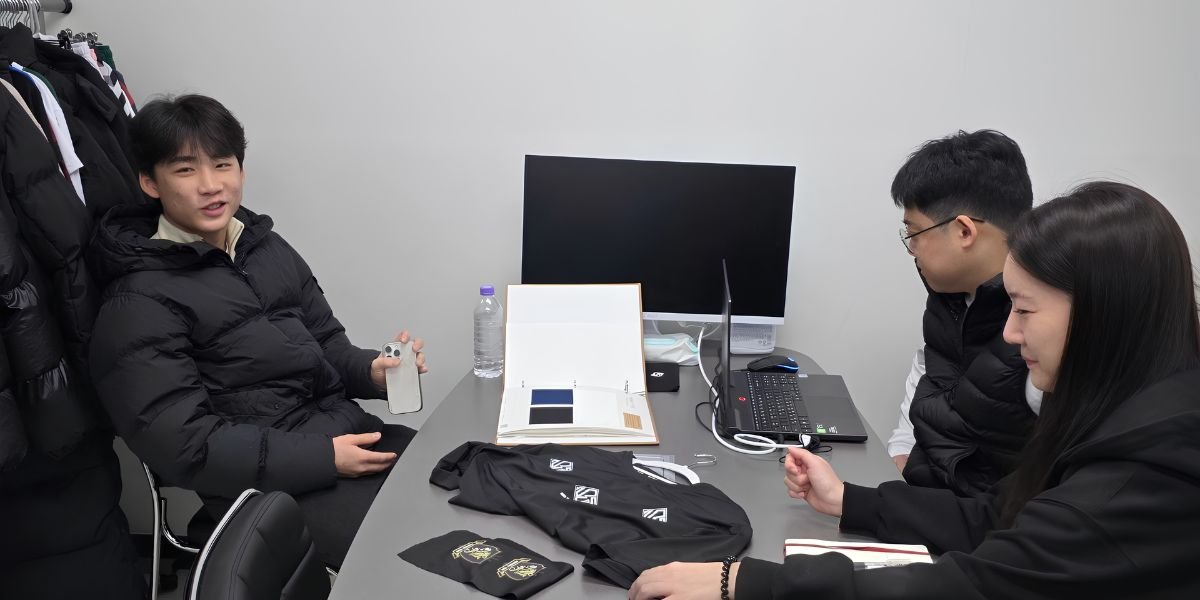
The first problem was material. Green Loop’s premise is that recycled materials can be turned into athletic apparel good enough for actual play, which meant Yongwook had to satisfy two constraints that pull in opposite directions. The garment had to be genuinely sustainable, and it had to be affordable enough for the people it was meant to reach to buy. He researched sustainable textile options and weighed four variables against each other: durability, comfort, production cost, and environmental impact. Because the shirts were meant to function as sportswear rather than merchandise, he also tested each option against a practical question. Would anyone want to wear it while playing?
He settled on the materials that offered the best balance across sustainability, quality, and affordability. The lesson he draws is more interesting than the choice itself. Selecting a sustainable material, he found, is not a matter of identifying the most environmentally friendly option available. It is a matter of identifying the most environmentally friendly option that can realistically be produced and sold.
Pricing a Mission
The same tension appeared again at the pricing stage, and this is where Green Loop stopped being a project and became a business.
Yongwook had to account for the base cost of the shirt, the recycled material, printing and design, packaging, and remaining production expenses, then set that total against a price students and other customers would actually pay. The complication was that profit was not the objective. All Green Loop proceeds were designated for underserved youth athletes, which meant the margin had to be large enough to fund something meaningful while the price stayed low enough to keep the product accessible.
He describes this as the moment the venture had to be treated as an actual business rather than a charitable one. The reasoning is worth stating plainly: if the model wasn’t financially viable, the social mission wouldn’t survive. A donation drive can afford to run at a loss once. A cycle cannot. That distinction is embedded in how he describes Green Loop’s purpose: not one-time giving, but a structure in which environmental responsibility and community support reinforce each other.
The First Hundred Shirts
Green Loop’s initial customers came almost entirely from Yongwook’s school community, a deliberate starting point. Selling locally let him test whether people would respond to both the product and the mission attached to it before attempting anything larger.
They did. Green Loop has now sold more than 100 shirts and recycled 500+ plastic bottles, which he treats as evidence of something specific. The idea had moved past concept into something people were willing to financially support. All profits went to underserved youth athletes, meaning each transaction funded the gap he had spent six years observing. The product itself is public at greenloop-platform.web.app, which is currently the venture’s only externally verifiable footprint.
By the standards of established social enterprises, 100 shirts is modest. By the standards of a seventeen-year-old building a supply chain, a price model, and a customer base from nothing, it is the difference between an idea and an operating business. He leads product design, material sourcing, branding, and the development of the long-term production and donation model himself.
Where the Shirts Go
The distribution side of Green Loop is further along than the sales figure alone suggests. In March 2026, the organization delivered 70 jerseys to the Cheongsol Elementary School Care Center in Bundang, Seongnam, where roughly 60 children received them and wore them for soccer classes and at tournament events. Five days later, a second delivery of 30 shirts went to the Gangdong Community Child Welfare Center in Seoul. Those two are part of a wider partner network of community child centers and children’s schools serving low-income and multicultural families, spanning locations including Songdo, Seongnam, and Jeju, and Green Loop has been working with the Korean UN Volunteers Association to extend that reach further.
The Cheongsol delivery is the one that shows the model completed. Yongwook has coached soccer with children at the centers Green Loop supports, which means he has stood on a field and watched sixty kids play in a matching kit made from recycled bottles, wearing gear they did not have before. That is the loop the organization is named for: bottles become fabric, fabric becomes a jersey, the jersey reaches a child, and the person who first noticed the gap from inside the game is there when it closes.
What the Field Taught Him About Building
Yongwook played varsity soccer from ninth through eleventh grade, recording 15 goals and 25 assists as a right winger and attacking midfielder. Asked which number better represents him, he chooses the assists without hesitation. His position asks him to create opportunities for other players rather than finish plays himself, which requires reading the field, tracking where teammates are moving, and making fast decisions based on what helps the team rather than what helps his own line.
The connection he draws between soccer and Green Loop is not about inspiration. It is about method. A varsity spot, he points out, is not won once and then held. Every season required training again, competing for playing time again, responding to mistakes, and proving he could still contribute. What that taught him was that improvement usually comes from consistency rather than a single breakthrough.
He approached Green Loop the same way, which was necessary because he began with no real experience in sustainable material sourcing, budgeting, product development, or marketing. Rather than expecting the business to work immediately, he learned from mistakes, adjusted based on feedback from mentors and peers, and kept going through periods of incremental progress. Soccer supplied the original insight behind Green Loop. It also supplied the working method that got more than 100 shirts designed, produced, and sold.
What Comes Next
Yongwook is unusually disciplined about what Green Loop has not yet done. Its recognition so far is limited to his school community, with no press coverage and no formal accolades, and he is not pursuing either as a goal in itself. Recognition, he argues, should follow impact rather than substitute for it.
His stated priorities for the coming year are specific. He wants to increase shirts sold, establish a clear partnership with a youth sports organization, and document exactly how many athletes Green Loop has supported. That last item is the one he returns to. The venture’s current weakness is not its mission or its model but its measurement, and he knows it. Only once those outcomes exist would he consider entering student entrepreneurship or social impact competitions, or approaching publications that cover youth sustainability.
He intends to study sports management, with the longer aim of building organizations that make athletic participation more accessible while holding to environmentally responsible production. It reads less like a pivot than a continuation. He spent six years inside the system noticing who it left out. The work now is building something durable enough to change that.