By: Harper Calloway
The Choice That Makes No Sense Until You Understand the System
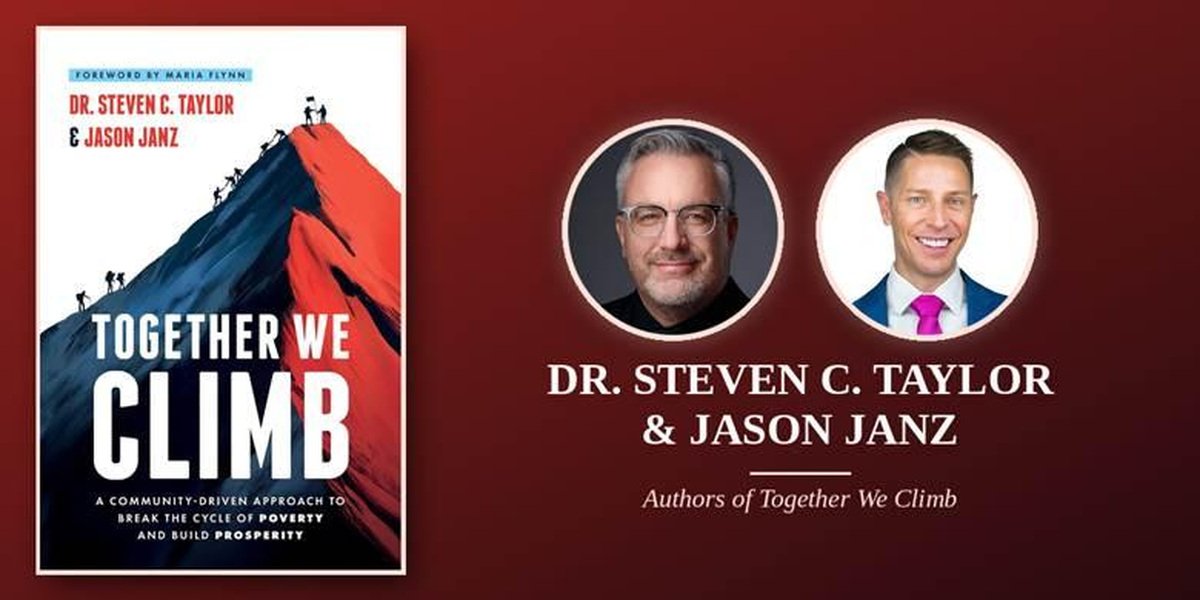
Frankie had an offer for a seventy-thousand-dollar-a-year job. She turned it down. On the surface, that looks like a failure of ambition or judgment. In reality, it was a precise calculation. Taking the job would have cost her housing assistance, childcare support, and food benefits, with no promise the contract would last. She ran the numbers and decided she could not afford the risk. Steven C. Taylor and Jason Janz open Together We Climb with that kind of story because it captures the central argument of the book in a single human moment: poverty is not primarily a failure of personal responsibility. It is a failure of systems design, and the people navigating those systems are often making the most rational decisions available to them inside a structure that was never built to let them out.
The Poverty We Picture and the Poverty That Actually Exists
Public conversation about poverty has been shaped for decades by an image that does not match the data. Most people picture poverty as a person at an off-ramp holding a cardboard sign. Homelessness is about two percent of people in poverty. More than a third of working-age adults in poverty have jobs. The largest group of Americans in poverty is White. And poverty is growing fastest in the suburbs. When the stereotype and the reality are that far apart, it becomes very difficult to design solutions that address what is actually happening. The book is an attempt to close that gap, written by two people who have spent their careers working at the intersection of policy and practice and who understand that neither good intentions nor good data alone is enough to change the outcome.
What Tiffany’s Story Reveals About the Benefits Cliff
Tiffany did the math on the back of an envelope in her Chevy Caprice before a post office night shift. Thirty hours of overtime during the Christmas rush. Five hundred dollars before taxes. After the housing authority recalculated her rent and charged her back for the difference, she had netted forty-seven dollars. About a dollar fifty an hour. That experience was not unusual. The benefits cliff is not a metaphor. It is a concrete structural feature of the American safety net, and it can leave families financially worse off when increased earnings trigger reductions in essential assistance. Steve and Jason argue that fixing it requires benefits to phase out gradually as earnings rise rather than disappearing all at once, so that a raise means a family is actually better off.
CrossPurpose and the Family Doctor of Poverty
Jason Janz built CrossPurpose in Denver after growing up in poverty himself. The organization started as a job training program, which Jason now calls the niche approach: focused on one piece of the problem and unequipped for everything else. When students began losing housing mid-course or having childcare fall through, the training became irrelevant. CrossPurpose had to evolve into what Jason calls the family doctor of poverty, a navigator connected to more than two hundred partner organizations that knows the person and stays with them across the full arc of their journey. It is a more expensive model and a more demanding one. It also requires a level of coordination that traditional job training programs rarely provide. CrossPurpose has built its work around this comprehensive approach, helping participants navigate the interconnected challenges that can stand between them and lasting economic stability.
When Hard Skills Are Not the Problem
Calvin was a strong student. He landed a job. Then he vanished. When someone finally reached him and heard his story, they learned that every thunderstorm in Denver sent his nervous system back to a traumatic experience from his earliest childhood. His apparent unreliability had nothing to do with work ethic or commitment. It had to do with unhealed trauma that no job training program had ever addressed. Father Gregory Boyle, whose work with formerly incarcerated people in Los Angeles informs much of the relational philosophy behind the book, puts it plainly: if you do not help people heal from core wounds, they will get a job and lose it the first time a boss triggers them. That conviction became the foundation of CrossPurpose’s Tree of Me program and of the book’s emphasis on spiritual capital as a real and necessary component of economic mobility.
The Relational Infrastructure Nobody Funds
Raj Chetty’s research on twenty-one billion Facebook friendships produced one of the most important findings in the recent social science of poverty: cross-class connection is among the strongest predictors of upward mobility researchers have identified to date. If low-income kids had the same cross-class friendships as high-income kids, their adult incomes would rise about twenty percent. That number is not a soft measure of community feeling. It is a structural outcome of who you know and who knows you, and it is as real as a job training certificate or a housing voucher. Together We Climb treats relational capital as genuine infrastructure, as load-bearing as a paycheck, and argues that any serious anti-poverty framework has to invest in building it deliberately rather than hoping it emerges on its own.
What Utah Did That the Rest of the Country Has Not
Utah pulled its workforce and benefits programs together into a single Department of Workforce Services in the mid-1990s. Whether a resident needs food assistance, unemployment support, or housing help, they walk through one door and leave with one plan that includes job training. The results, measured over three decades, have been remarkable. While national SNAP participation rose between 1994 and 2024, Utah’s fell. Across 2020, unemployment in Utah averaged 4.9 percent, compared with 8.1 percent nationally. The state is now piloting ways to pair financial planning with coaching so people can take a raise without immediately losing the benefits that made the raise possible to accept. Utah’s model is not perfect, and it is not easily replicated overnight, but it demonstrates that the coordination problem Steve describes is solvable. Someone just has to decide to solve it.
The Mountain Model and the Goal Nobody Names
Most anti-poverty frameworks stop at employment. A person with a job is considered a success. Taylor and Janz argue that employment is not the destination. It is a stop on the way up the mountain, and treating it as the summit is one of the reasons so many families remain on the same precarious perch, employed but one crisis away from losing everything. The Mountain Model that Steve and Jason have built goes all the way to generational wealth: emergency savings, a retirement account, and at least one appreciating asset that can be passed to the next generation. Three in four American families never receive an inheritance. The difference between a family that does and one that does not is not primarily a difference in how hard they worked. It is a difference in whether the systems around them were designed to let them build anything.
What Business Leaders Are Being Asked to Do
Together We Climb asks the business community to do familiar things differently. Recruit from the twenty-seven million hidden workers who are screened out before a human sees their name: parents, caregivers, people with records, people without degrees. Hire for virtue first and skill second, because skills can be taught. Look at your benefits package as a wealth-building tool rather than a compliance requirement. Dan Schulman discovered when he was leading PayPal that junior employees had four to six percent of their income left after basic expenses. Some were selling plasma. That is not a workforce problem. It is a design problem, and it has a design solution. The most powerful anti-poverty program ever invented, Steve and Jason write, is a good job inside a value-creating business. That means employers are not peripheral to this work. They are central to it.
Did You Climb Alone?
Taylor and Janz end every public presentation with the same question. Did you climb alone? No one ever says yes. Someone mentored you, hired you, connected you, believed in you, or simply showed up when things fell apart. The book’s ask of its readers is straightforward: if someone helped you reach the top of your mountain, will you help someone else reach the top of theirs? That is not a vague call to goodwill. Steve and Jason give specific guidance for policymakers, business leaders, and neighbors. Look for the cliffs in your programs. Ask whether your entry-level jobs lead somewhere. Start with dinner. The changes that move a family up the mountain often begin with one relationship, one connection, one person who decided to show up. This book is an argument that all of us have that to offer.
Together We Climb by Steven C. Taylor and Jason Janz, with a foreword by Maria Flynn, is available on Amazon.