America regulates everything except the one thing running every part of the system: language.
We treat words like harmless little tools, but they can hijack identity faster than any drug and destabilize a community faster than any weapon.
Chase Hughes, a former military behavioral specialist and the guy Dr. Phil pointed to on national television as “the best behavior profiler in the world,” has spent two decades watching people collapse or come alive based purely on the phrasing he used.
His conclusion is simple and uncomfortable:
The country isn’t divided by beliefs. It’s divided by the language that controls them.
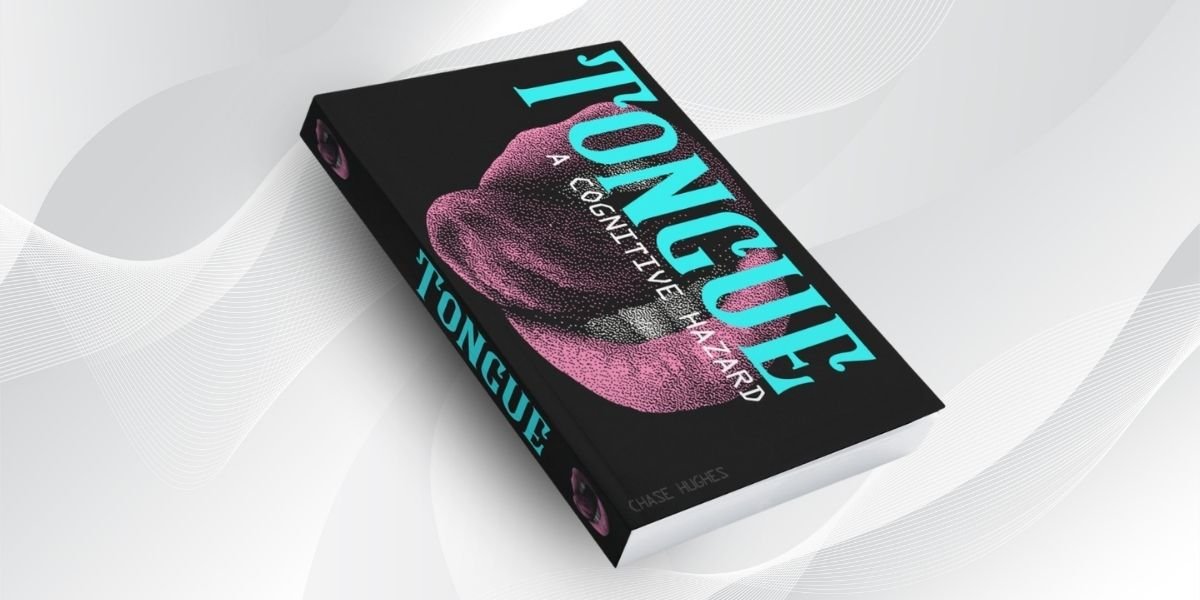
And the book he just released, Tongue: A Cognitive Hazard, is the strangest, shortest, most psychologically abrasive way he could have delivered the warning.
This thing is not a normal book.
It’s not even pretending to be.
It looks like a book.
It sits on a shelf like a book.
But when you open it, you realize you’ve walked into a psychological machine.
A Book You Don’t “Read”—You Endure
Most books try to teach or entertain.
TONGUE doesn’t care about either.
It’s lean — barely over 100 pages.
But the pages are designed like pressure points, not chapters.
Some pages slam you with dense psychological content.
Some pages feel like a riddle.
Some pages are only a sentence long.
Some are visually disorienting on purpose.
Sometimes the pacing stops hard, like the book is watching you.
Sometimes there’s too much silence.
Sometimes the silence is louder than the words.
People keep saying the same thing:
“I didn’t read it. I went through it.”
That’s the entire design.
Hughes engineered the book the way intelligence programs use stress, confusion, and pattern breaks to sharpen someone’s awareness. He wanted readers to actually feel what language does to their perception — not from a safe distance, but from inside the machinery.
Some readers devour it in one sitting and sit still for twenty minutes afterward, trying to recalibrate.
Others stop halfway through because something in the structure hits too close.
A few get angry at the format and throw it across the room.
Hughes considers all three reactions correct.
Why a Book This Strange Matters Now
America is drowning in language that isn’t designed to inform — it’s designed to provoke.
- Outrage scripting
- Therapy-speak is weaponized to hurt people
- Political language engineered for emotional hijack
- Social media algorithms are amplifying the most volatile phrasing
- Corporate messaging that hides intentions behind sanitized vocabulary
- Influencers who speak with manufactured intimacy to bypass skepticism
People don’t notice how much of their emotional life isn’t theirs anymore.
They’re living inside someone else’s sentence structure.
Hughes didn’t write Tongue to fix that.
He wrote it to expose it.
And exposing it meant breaking the reader’s rhythm.
Breaking their default.
Breaking their unconscious trust in the shape of a “book.”
That’s why Tongue is short:
Not because the author had nothing to say — because attention is fragile, and the point wasn’t to fill pages.
The point was to jolt the reader awake.
That’s why the pages look wrong:
Because nothing changes awareness faster than interrupting expectation.
That’s why the whole experience feels strange:
Because clarity often arrives through discomfort, not comfort.
A Warning From Someone Who Knows How Language Breaks People
Hughes didn’t learn any of this in a classroom.
He learned it while training people who needed to read intent under extreme pressure. He learned it inside interrogation rooms. He learned it while watching people’s emotional systems crack open from the wrong metaphor or stabilize from the right one. He saw firsthand how language could override fear, interrupt panic, uncover deception, or collapse resistance.
So when he says the country is in trouble because linguistic triggers are everywhere, he’s not speculating.
He’s reporting.
And when he engineered a book that feels more like a psychological gauntlet than a smooth read, it wasn’t for art.
It was for accuracy.
He wanted people to feel the thing he’s trying to warn them about.
Why Readers Can’t Stop Talking About It
Most books leave readers with concepts.
TONGUE leaves them with an altered perception.
They walk around afterward, noticing:
- how certain people use vagueness as control
- how some sentences are crafted to create guilt
- how political messaging avoids truth but nails emotion
- how advertisers rely on urgency wording
- how narcissists speak in loops
- how some partners weaponize tone while claiming innocence
- how a single phrase can shape a child’s entire identity
- how arguments escalate because of rhythm, not content
And maybe most disturbingly:
How much of their inner voice wasn’t written by them?
That realization lands hard.
It has to.
The Book Is Weird Because Reality Is Weirder
Hughes didn’t create a traditional narrative because language doesn’t work in a straight line.
Language works like weather — swirling, influencing, pushing, pulling, reshaping perception minute by minute.
TONGUE mimics that.
Sometimes with pages that feel incomplete.
Sometimes with abrupt shifts.
Sometimes with uncomfortable silence.
Sometimes, with a sense that the book is trying to get your attention, not entertain you.
It’s bizarre.
It’s unpolished on purpose.
It’s uncomfortable by design.
It’s also one of the few books in circulation that doesn’t lie to readers about how influence works.
Why Hughes Is Sounding the Alarm Now
The flood of AI-generated content means humans will soon be outnumbered by sentences that weren’t written with human intention. That shift will change the psychological environment more than any political policy ever could.
Hughes wants people prepared.
Not paranoid.
Prepared.
Aware of the strings rather than controlled by them.
He’s not asking for a movement or a belief system.
He’s asking people to stop walking blindfolded through a landscape built out of language they didn’t choose.
The Last Unregulated Force
We regulate weapons.
We regulate information.
We regulate food, medicine, cars, and screens.
We regulate every danger we can name.
But language?
The most powerful influence device on the planet?
It moves freely.
Silently.
Constantly.
TONGUE doesn’t fix that.
It exposes it.
And it does it in the most uncomfortable, unforgettable way possible.
If the book feels strange, abrasive, or unsettling, good.
That means it’s doing its job.
Because the truth is simple:
Language is controlling people far more than they control it.
And Hughes is one of the few people willing to show them.