There has been a gradual increase, at universities and research centers, in the number of students who start scientific work well ahead of their predecessors. Many U.S. programs report that over forty percent of college undergraduates enter their institutions having completed prior research or competitive projects. This reflects an academic environment wherein early inquiry is encouraged, where science fairs are gateways to professional interest, and in which those students displaying persistence in the sciences often transition into formal research settings before completion of their first university year. These trends underscore a larger pattern wherein early success informs long-term academic growth.
This trend has become particularly evident within biomedical science. Disciplines like cancer biology and epigenetics depend on intricate experimental design, data interpretation, and interdisciplinary collaboration. Students who enter with prior knowledge of laboratory techniques often find that earlier work serves as a helpful bridge to more advanced training. Educators frequently comment that initial exposure to hypothesis testing and controlled experimentation at the secondary school level can ease adjustment in molecular labs. This is especially evident where research groups examine gene regulation, chromatin structure, or the biochemical systems influencing disease. Student researchers are increasingly contributing to dataset development and supporting ongoing investigations as these areas grow.
Against this backdrop, Stephen Robert Litt’s trajectory has developed within a framework marked by media exposure, public interest, and participation in competitive science events. Litt first gained recognition for studies completed during his school years, such as work with planarian worms and research involving epigallocatechin gallate derived from green tea. His projects were featured in local reporting in Georgia and later drew national attention after he advanced to the Regeneron International Science and Engineering Fair in 2022. These appearances have placed him in the small number of high school researchers qualified, often multiple times, for major fairs to which almost two thousand students from more than eighty countries make their way each year.
Universities often cite recognition in competitive settings because steady advancement in science fairs reflects experience in presenting data, designing controlled comparisons, and answering detailed questions about results. Litt’s work fit these expectations through awards at the Georgia Science and Engineering Fair and his 2022 Top Overall Project recognition at the Cobb-Paulding Science Fair. He was also a multiple-time finalist at the Regeneron International Science and Engineering Fair, which evaluates roughly two thousand students each year. His projects brought invitations to visit the Allen Discovery Center at Tufts University and to present to the Women’s Malignancies group at the National Institutes of Health. Media coverage documented the broader academic and public interest in his research.
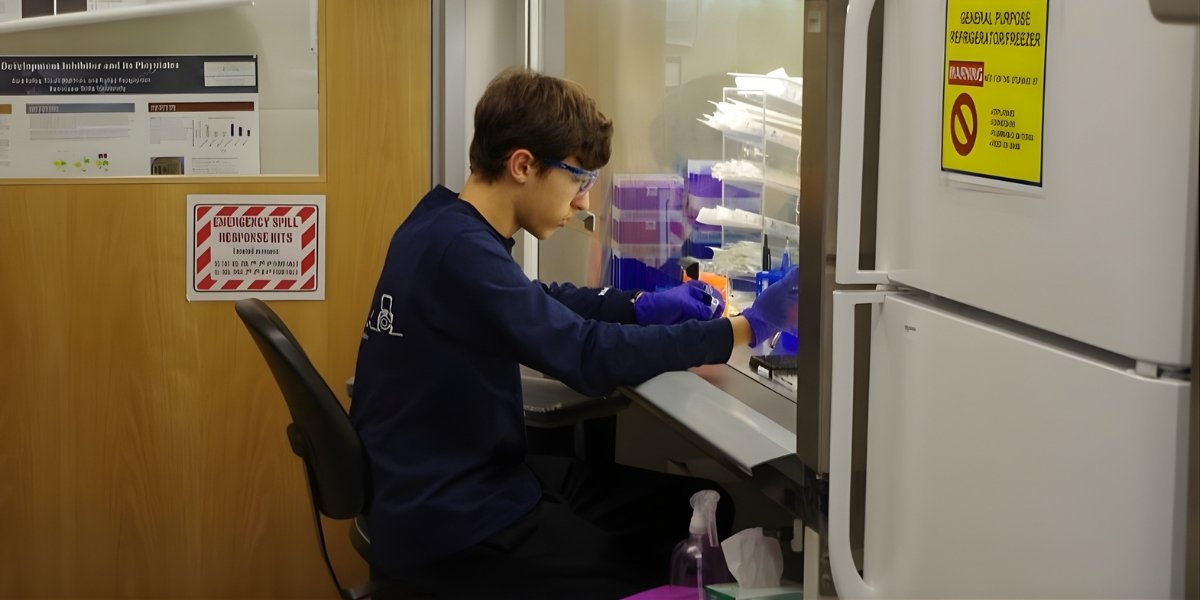
His development continued as he started research at the University of North Carolina at Chapel Hill, joining the Strahl Lab in the Department of Biochemistry and Biophysics. The group investigates histone modifications and the epigenetic systems that regulate gene expression. Work in this area draws from chemistry, structural biology, and cancer biology, and students are expected to learn techniques that include protein analysis, sample preparation, and interpretation of molecular assays. Litt’s involvement in the lab reflects the growing number of undergraduates who enter research groups early in their academic careers and contribute to projects that probe the biochemical basis of disease.
The combination of his previous science fair background and his current role has contributed to supporting the development of an academic identity based on curiosity, structured training, and a broader exposure to scientific communication. Media interviews and education features about his projects at school helped to build a public record of his interests at an early stage. Attention of this kind is not unusual for students whose work coincides with areas of current widespread interest, such as cancer biology or regenerative studies. According to surveys by education organizations, over twenty percent of published youth science features from 2020 to 2023 were on health and disease studies because these areas reap much audience interest. Litt’s work fit within those trends and allowed him to interact with platforms outside the classroom.
Visibility and responsibility can affect how student researchers approach future projects. In Litt’s case, the shift from independent experiments to work in the laboratory has transferred his focus to understanding chromatin states, the regulation of genes, and histone modifications. These topics constitute key components of cancer epigenetics, a research area that investigates how chemical marks on DNA and proteins are able to influence tumor growth. Researchers in this area point out that early exposure to biological questions helps students connect with more advanced ideas when they join university laboratories. Litt’s turn toward these kinds of questions illustrates how the themes of earlier projects by a student scientist can link with more detailed investigation later in that student’s academic career.
Another element of his emergent academic life has to do with collaboration and mentorship. Many students working in research settings over multiple years are integrated into peer learning models wherein younger undergraduates are responsible for educating their newer peers about safety rules, equipment handling, and documentation practices. Litt’s sustained participation in science fairs and laboratory spaces situates him within these larger movements. Although the reach of his own mentorship positions will change as he proceeds through his career, the line of continuity linking his early projects to current research demonstrates that this may be an aspect of his experience that colors the ways in which he will engage in teamwork and communication in the coming years.
Institutions have increasingly recognized youth participation in biomedical science as part of a larger movement toward early engagement. According to data from recent national surveys, the number of students involved in structured laboratory internships has increased by nearly thirty percent between 2018 and 2023. Litt’s trajectory represents this emerging trend and positions him in a cadre of students that connect independent inquiry with formal research exposure. His trajectory shows how individual successes during secondary school are translated into long-term participation within university laboratories whose ongoing projects contribute to the research agenda on cancer epigenetics.
As his work progresses, the sustainability of his contributions will lie in how he integrates training, research, and communication. His engagement in the Strahl Lab offers avenues to support research studies into disease biochemical mechanisms. He has experience with some level of public engagement and media attention, suggesting that his presence will remain connected to the visibility of youth-driven scientific inquiry. These elements make up the foundation of his nascent academic identity and show how today’s student researchers may progress from early investigations to advancement in training while contributing to wider conversations in contemporary biomedical science.