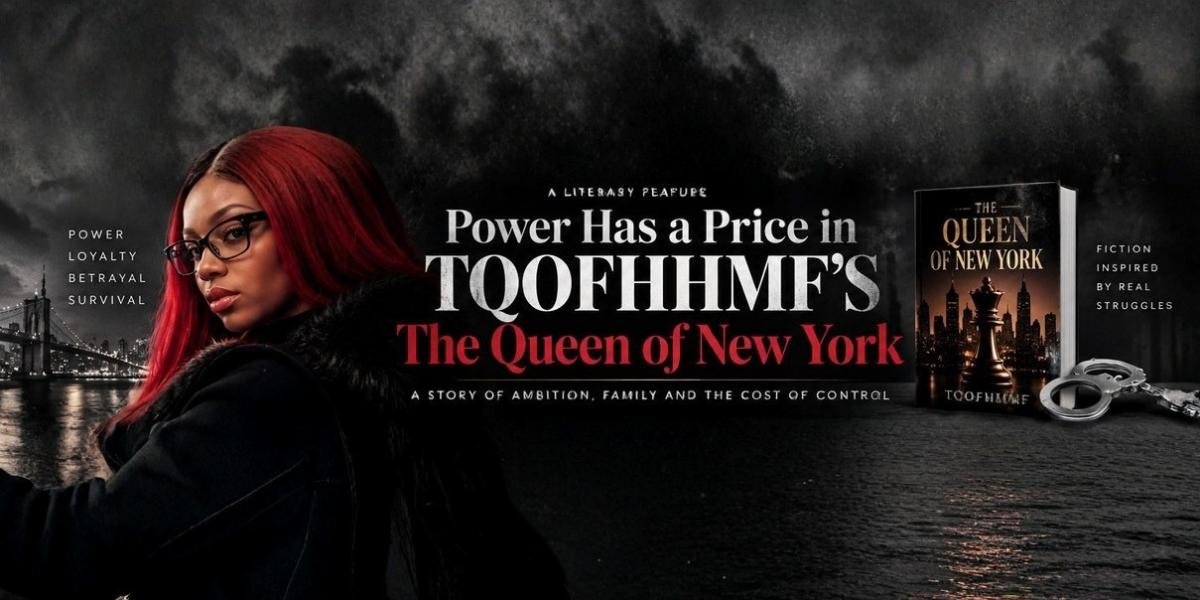
A compelling crime protagonist rarely becomes memorable because she is fearless. What usually makes her interesting is the moment fear, loyalty, ambition, and responsibility begin pulling her in different directions.
That is the territory surrounding Snow Bedero, the central character in TQOFHHMF’s The Queen of New York.
Set in 1993 New York City, the novel follows Snow after her return from Rikers Island, placing her back inside an underworld shaped by influence, criminal rivalry, law-enforcement pressure, and uncertain loyalties. Yet beneath the external danger lies something potentially more complicated: the burden of maintaining power once other people begin depending on it.
Snow Bedero Is Not Written to Be Simple
Crime fiction has no shortage of powerful characters. Far fewer are allowed to be powerful and emotionally complicated at the same time.
Snow’s described world includes dangerous opponents and public struggles for authority, but the story also connects her closely with her brothers and with the grief surrounding her family.
Without emotional stakes, power can quickly become spectacle. With them, every decision becomes more expensive.
A person may be ruthless toward an enemy yet vulnerable where family is concerned. Someone who appears completely controlled in public may make an irrational choice in private. Loyalty can become both protection and weakness.
Snow is presented as a protagonist whose authority and vulnerability coexist, creating room for morally difficult choices rather than easy heroism.
That ambiguity is often where crime fiction becomes most addictive. Readers do not necessarily need to approve of a protagonist. They need to understand why they cannot stop watching her.
New York Becomes More Than a Background
The novel’s 1993 setting gives its world a particular texture.
New York during the period can function not merely as scenery but as part of the story’s pressure system, a city where status can be visible while the machinery supporting it remains hidden.
That contrast fits Snow’s journey especially well. From the outside, control can look glamorous. Inside the structure that produces it, control may depend on constant negotiation.
Who can be trusted? Who is cooperating only because it is profitable? Who is waiting for weakness? And how much of the person who originally wanted power survives once maintaining that power becomes a full-time occupation?
Those are the questions capable of turning a crime story into a character study.
The Novel Began in Another Medium
The history behind The Queen of New York adds another dimension to the project.
A feature about TQOFHHMF’s career traces the project back to a screenplay conceived in 2007. Nearly two decades separate those early screen origins from its life as a published novel.
That transition is particularly interesting because film and fiction create suspense differently.
A screenplay often works through what audiences can see: movement, expression, environment, and performance. A novel can stay inside a character long after the visible action has ended.
The sound of a door closing can become a memory. A conversation can acquire a second meaning several pages later. An apparently confident decision can be followed by the thought the character refused to say aloud.
For someone working across music, writing and production, the novel becomes another instrument rather than simply another product.
The Voice Behind the Story
TQOFHHMF’s creative career did not begin with fiction.
Her official biography describes a path beginning in Southside Jamaica, Queens, and continuing through rap performance, mixtapes, and entertainment work. Her public roles have included recording artist, writer, producer, and director.
That background makes her move into fiction feel less like an abrupt reinvention and more like an expansion.
Music teaches economy. A performer learns how quickly an audience decides whether to keep listening. Rhythm matters. Tone matters. A line must carry personality.
Fiction allows those instincts to stretch. A character’s voice can develop gradually. A conflict can simmer rather than explode immediately. Silence can become meaningful.
That may be especially useful in a story built around people who cannot always say what they really intend.
Beyond The Queen of New York
TQOFHHMF is also preparing another project, Big Shot Bowlers: Turning the Hood into Hope.
The upcoming title suggests that readers may see a substantially different emotional landscape from the one surrounding Snow Bedero. While details of the unpublished narrative should remain for the eventual book, its public positioning around hope suggests that TQOFHHMF is interested in exploring more than one kind of struggle.
Writers become easier to understand once readers can compare different works. The first book tells an audience what captured the writer’s imagination once. The next books begin revealing what continues to matter.
For TQOFHHMF, those recurring interests may include survival, ambition, identity, loyalty, and the possibility of changing the position a person has been given.
For now, Snow Bedero remains the figure standing at the center of that literary introduction.
She returns to New York carrying history with her. What she does with the power she intends to reclaim, and what that power eventually asks from her, is where the real intrigue begins.
Explore the book: The Queen of New York on Amazon
Author website: TQOFHHMF official website