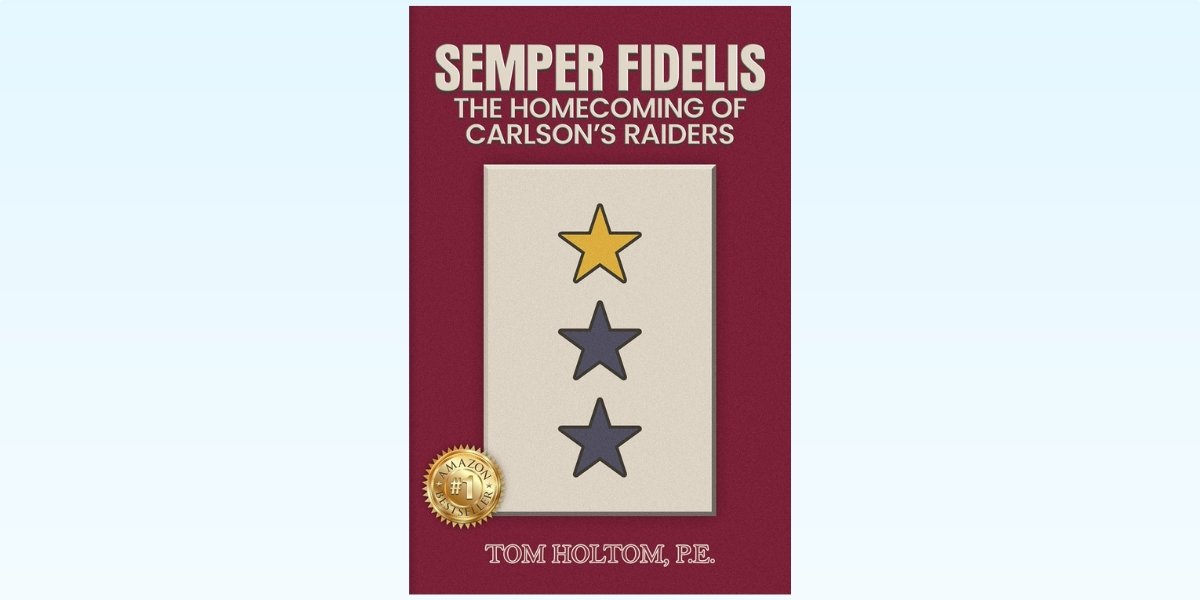
Some promises outlive the people who make them. In Semper Fidelis: The Homecoming of Carlson’s Raiders, author Tom Holtom builds a quiet, powerful story around one such promise, a family’s vow to bring a fallen Marine home, no matter how many years it takes. The book follows the Makin Island Raid of August 1942 and the long effort that finally honored the men who never returned from it.
The raid itself reads like the origin of American special operations, because it was. Lieutenant Colonel Evans Carlson led the 2nd Marine Raider Battalion onto a Japanese-held island in the Pacific, struck fast, and slipped back out by submarine. Their password, “Gung Ho,” later became a Marine rallying cry, and the unit went on to inspire the Navy SEALs, the Army Rangers, and the Green Berets. Among the Raiders stood Captain Gerald Holtom, an intelligence officer who spoke fluent Japanese and believed his country had to answer Pearl Harbor. He did not come home.
A Loss the Family Refused to Accept
Holtom centers the human cost without ever tipping into melodrama. Readers meet a mother who stitches a gold star onto her window banner, a father who reads a government letter in a darkening room, and brothers who quietly decide that someone in the family will see their lost Marine laid to rest. That single, stubborn promise becomes the engine of the entire book.
For years, it looked impossible. Local Gilbertese families had buried nineteen Raiders on the island, and the military eventually stamped their files “non-recoverable.” On paper, the case was closed. Yet the story shows how grief, loyalty, and patience can outlast an official verdict.
When “Non-Recoverable” Was Not the Final Word
Decades later, a recovery team in Hawaii reopened the search, working from old records and the memory of the islanders who had tended the graves. What follows is a homecoming that ranks among the most significant ceremonies ever held at Arlington National Cemetery. Holtom treats that moment with restraint, letting its weight land on its own rather than forcing it.
What gives the book its authority is the author’s closeness to the events. Holtom writes as next of kin, not as a distant observer, and that perspective shapes every page. He resists the urge to over-explain, trusting clean scenes and real history to carry the emotion. The result feels less like a war novel and more like a witness statement passed down through a family.
The book quietly answers a question many readers carry: does a country truly remember the ordinary people who serve it? For anyone who fears history forgets its quietest heroes, Semper Fidelis offers a clear, moving counterexample. It shows what it takes, and how long it can take, to make good on the words “no man left behind.” The answer here spans more than half a century, and it arrives one careful record, one preserved memory, and one kept promise at a time.
Some stories inform. Others restore something. Semper Fidelis does both, honoring not only Captain Gerald Holtom but every Raider who waited far too long to come home. It adds a deeply personal chapter to the recorded history of Carlson’s Raiders, and it leaves readers thinking about the promises worth keeping for a lifetime.