
Dear new business owner,
You’ve got a gap. Maybe a larger loan has been approved but won’t close for two months. Maybe a big customer’s payment is on its way, or you’re waiting for a building sale. Someone has told you that a bridge loan could solve it. You’ve asked whether a company as young as yours can get one.
I’m writing to tell you the truth as plainly as I can: it’s possible, but it depends far less on your company’s age than on what’s waiting on the other side of the bridge. Please read the parts in order. The numbers in them are illustrative, and the business is fictional.
1. A Bridge Needs Two Banks
I mean riverbanks. The near bank is today, and the far bank is a specific, identifiable source of repayment. Lenders call that the exit. A loan with no exit isn’t a bridge at all. It’s just short-term debt, and it can become long-term trouble.
Before anything else, write one sentence: “I will repay this loan on or about [date], using [source].” If you can’t fill in both blanks, please stop here and look for a different solution.
Strong exits include a signed commitment for permanent financing, a property under contract, or a confirmed receivable from a reliable payer. Weak ones include “sales should pick up” and “we’re talking to investors.” A lender may accept a weak exit if the collateral is strong enough. That means the lender is protected, not that you are.
2. Why Your Age Matters Less Than You Fear
Bridge lenders commonly focus on collateral and the exit. A six-month-old business holding a signed SBA commitment and a building may look much better to them than a five-year-old company with neither one.
That said, I won’t flatter you. Young companies have less margin for error, and many lenders do set minimum requirements. When you investigate, a provider page such as Fundivi bridge capital can show you the type of situation these products are meant for. Eligibility is decided case by case, and funding is possible only for qualified applicants.
3. What It Actually Costs
Let me introduce you to Harborlight Bakery, a fictional seven-month-old shop that has a permanent loan expected to close in four months. It needs $75,000 now to secure ovens before a price increase.
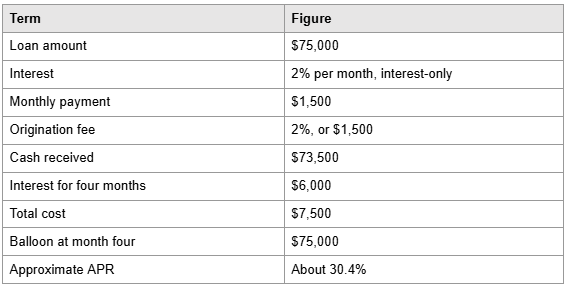
Please notice the balloon. Your monthly payments do not reduce what you owe. On the last day, the whole $75,000 is due, and that’s why the exit matters so much.
4. Please Plan for the Delay
Closings slip. Appraisals come in late, and underwriters ask for one more document. So I’d ask you to price the two extra months before you sign.
Suppose Harborlight’s permanent loan runs two months late, and its lender charges a 1% extension fee, or $750, and raises the rate to 2.5% monthly for those two months.
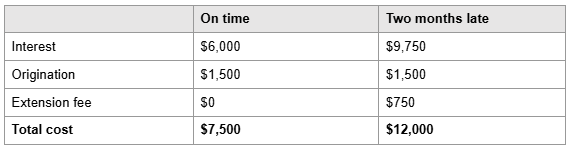
Delay adds $4,500. That’s a 60% increase in the total cost. Ask for the extension terms in writing, and find out whether an extension is your right or only something the lender may allow. If your bakery couldn’t absorb that, the bridge may be too narrow. Keep a reserve equal to at least those extra costs, and keep it somewhere you won’t be tempted to spend it on flour.
5. Check the Far Bank Yourself
Don’t simply accept that your exit is sound. Get the commitment letter and read its conditions. Is there an expiration date? Does it forbid additional debt? Will your bridge lender’s lien have to be released before the permanent lender can close? Introduce the two lenders to each other early, because one surprised lender can cost you weeks. Your permanent lender may also treat new debt as a change in your finances, and may need to approve it before you take it on.
You might also ask how a bridge provider sources its money. A Washington City Paper release on card-processing loans covers a different kind of product, and that’s the point: if card receipts are your real source of repayment, a product built around those receipts may be a more honest match than a bridge loan.
6. If You Own Real Estate
Property-backed bridges are the most established version. Lenders often lend a percentage of value. At an illustrative 65% loan-to-value on a $400,000 building, you might borrow $260,000, leaving $140,000 of value as the lender’s cushion.
Please be careful here. If that’s your home, or if the exit is the sale of the property, then a falling market or a failed buyer puts something important at risk. Speak with an attorney before you pledge it.
7. Other Ways Across
I would be doing you a disservice if I didn’t ask whether you need a bridge at all. Before you commit, please consider these options:
1. Ask the seller to hold the price or accept a deposit.
2. Ask the permanent lender about an interim disbursement.
3. Ask your customer for partial payment on the order.
4. Finance the equipment directly through its dealer.
5. Use an existing line of credit, if you have one.
Owners considering a fast advance as a stopgap might review this list of merchant cash advance alternatives as well. An advance taken to bridge a gap often collects from daily sales right when you need them most, and it usually comes with no balloon but a much shorter runway. Whatever you compare, compare it in dollars over the same stretch of time.
8. Learn the Market Before It Sells to You
The quickest way to protect yourself is to know the vocabulary and the common range of terms before the phone rings. Find out what is normal for loans of your type, in your area, and ask a banker or accountant you trust. Then gather at least two written quotes, and compare them on net proceeds, total cost, extension terms, and prepayment rules.
9. What I’d Check on Signing Day
☐ The exit is documented, with a date
☐ The net amount wired is stated clearly
☐ Interest, fees, and balloon are all in dollars
☐ Extension terms are written down
☐ Prepayment terms are understood
☐ Collateral and guarantees are precisely identified
☐ An attorney has reviewed anything involving real estate
If you are still building your shortlist at this stage, general reference sites such as BusinessLoansCompanies.com lender comparisons can help you see who operates in this space and what they tend to ask about.
Please don’t let a deadline talk you out of this list. Any lender who objects to the time it takes you to read the contract has told you something about how the rest of the relationship will go.
10. A Last Word
You started a business, so I know you’re comfortable with risk. A bridge concentrates risk into one date. If the far bank is solid, then a bridge can be a sensible tool. If it’s fog, you’ll want to wait for the fog to clear.
Build your record in the meantime. Keep clean books, keep one bank account for the business, and keep talking to your bank. Those habits may give you cheaper options the next time you face a gap. And when you do cross, write down what the crossing cost you, in dollars and in sleep, so you can judge the next one fairly.
With respect, and with hope that the crossing goes well,
A fellow believer in reading the fine print
Frequently Asked Questions
How long do bridge loans usually last?
Often from a few months to about a year, depending on the lender and the exit.
Do I need collateral?
Commonly, yes. Real estate and other assets are typical, and a personal guarantee is often requested too.
Can a bridge loan cover payroll?
Possibly, but payroll needs rarely come with a clear exit. Ask yourself what repays it.
Is interest-only normal?
Yes, it’s common for bridge loans, which means the principal comes due at the end.
What happens if my permanent loan falls through?
You’ll still owe the balloon. You may need to extend, refinance, or sell collateral, so have a backup plan.
Are bridge loans available without a credit check?
Some lenders emphasize collateral, but most still review credit. Be cautious of any guarantee of approval.
Can I repay early?
It depends on your agreement. Some lenders charge minimum interest or prepayment fees, so get this in writing.
Disclaimer: This article is for general informational purposes only and does not constitute financial, lending, legal, tax, or investment advice. The examples, figures, rates, costs, timelines, and scenarios presented are illustrative only and do not represent actual offers or guaranteed terms. Bridge loan requirements, pricing, collateral, repayment structures, approval criteria, and funding timelines vary by lender, product, and applicant. Readers should carefully review the terms of any financing agreement and consult qualified financial or legal professionals before making financing decisions.