Maritime operations present numerous pressing challenges, particularly in marine environments where wind-driven waves, powerful currents, and unpredictable weather systems impose significant hydrodynamic stresses on vessels. Under such conditions, hull integrity, seakeeping stability, and structural endurance become critical. Shipbuilders have long sought to enhance hull performance to withstand these forces.
However, one of the most effective methods for assessing a vessel’s likely capabilities remains full-scale sea trials in extreme weather. Safehaven Marine, an Irish corporation, conducts rigorous testing in challenging maritime conditions like extreme weather to evaluate operational resilience and seaworthiness.
Safehaven Marine, headquartered in Youghal, County Cork, was founded in 1998 by naval architect and seasoned mariner Frank Kowalski. The company specializes in designing and manufacturing pilot boats, search-and-rescue (SAR) vessels, high-speed interceptors, and naval patrol vessels, all engineered for strong performance in heavy seas and turbulent weather. Over the past two decades, Safehaven Marine has delivered over 160 vessels to global operators, including coast guards, naval forces, and port authorities. Many of these operators require vessels capable of sustained operations in force 9 and 10 conditions with wave heights exceeding 8 meters.
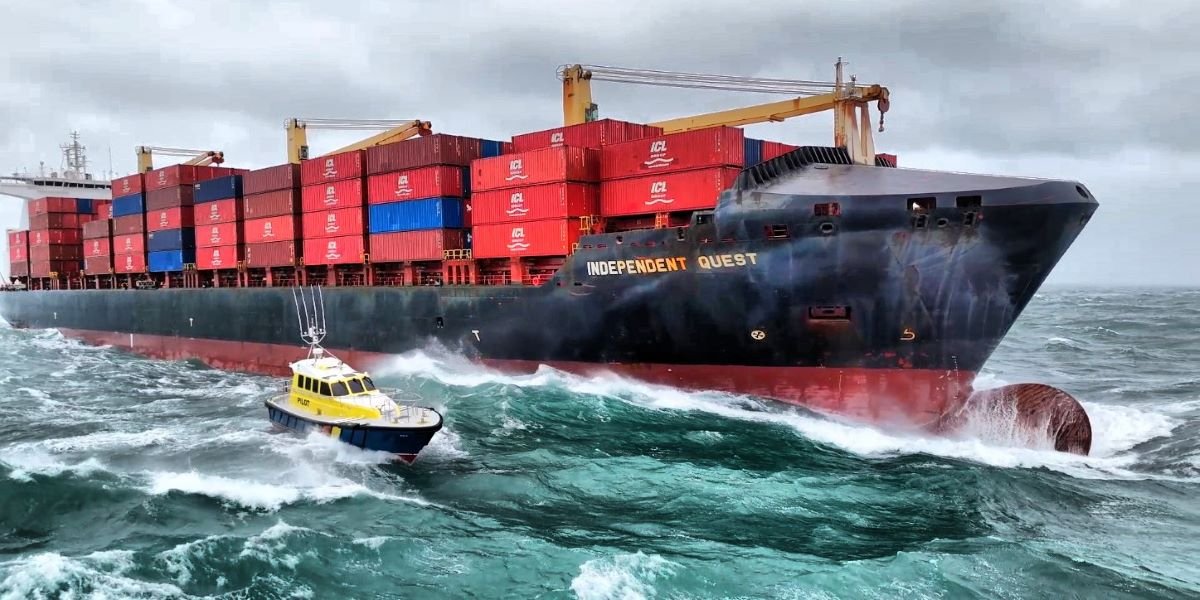
Sea trials in extreme conditions provide a valuable proving ground for Safehaven Marine’s designs, ensuring that vessels can often maintain course stability, dynamic roll response, and structural integrity when subjected to powerful wave impact loads. Cork Harbour, located on Ireland’s south coast, is considered an ideal testing ground due to its intense tidal races, unpredictable wave refraction, and exposure to deep Atlantic swells. The region frequently experiences storm-force conditions, with waves exceeding 10 meters—an environment that closely approximates some of the harshest operational scenarios these vessels might encounter.
Safehaven Marine’s philosophy of real-world validation over theoretical modeling stems from Frank Kowalski’s extensive experience operating vessels in challenging offshore conditions. This practical experience has shaped Safehaven Marine’s design ethos, focusing on hull geometry optimization, structural reinforcement, and hydrodynamic efficiency. Early in its history, the company built commercial workboats such as passenger ferries, fishing boats, and dive vessels. However, its shift to pilot and patrol boats began in 2005 when it secured a contract with the Port of Cork to deliver a purpose-built pilot vessel. The success of this project helped mark Safehaven Marine’s expansion into high-performance commercial and defense sectors, supplying vessels to navies, offshore installations, and port operators worldwide.
While computational fluid dynamics (CFD) modeling and scale-model tank testing provide valuable insights into wave interaction, hull stress distribution, and buoyancy dynamics, Safehaven Marine’s full-scale storm trials offer highly reliable empirical data. These trials not only validate vessel seakeeping but also often highlight potential structural fatigue points that might not be apparent in controlled environments.
Before each extreme-weather trial, Safehaven Marine’s engineering team establishes structured test protocols, monitoring critical performance metrics such as hull flexure, impact loads, directional stability, and hydrodynamic lift coefficients. Test vessels are equipped with precision accelerometers, strain gauges, and data loggers to capture real-time stress distributions across the hull and superstructure. Crews undergo intensive safety briefings, focusing on wave timing, throttle modulation, and heading control techniques to mitigate excessive structural loads.
The trials also evaluate propulsion system efficiency, maneuverability under high wave loading, and dynamic pitch and roll behavior. Safehaven Marine’s vessels are engineered with deep-V hulls, sharp entry bows, and reinforced transoms to better handle wave slamming, plunging crests, and sudden heeling forces. Self-righting capabilities, essential for SAR and naval applications, are tested under controlled capsize scenarios, aiming to ensure vessels can recover even after being completely inverted.
Safehaven Marine’s Interceptor and Wildcat series have gained a reputation for their sturdy hull construction and notable stability in violent seas. The XSV (Extreme Special Vessel) range, featuring the XSV17 and XSV20, is tailored for high-speed naval interception and endurance missions, leveraging wave-piercing bows and ultra-low drag hull designs for enhanced speed and efficiency in pursuit operations. These vessels have undergone extensive trials in storm-force Atlantic conditions, demonstrating their capability to sustain speeds above 50 knots in turbulent seas.
Beyond commercial and military applications, Safehaven Marine has recently expanded into the luxury yacht sector, incorporating lessons from extreme-weather testing into its T-2000 Voyager, launched in 2024. This high-performance expedition yacht aims to merge ocean-crossing endurance with high-speed hull hydrodynamics, offering a unique combination of storm-ready durability and luxury cruising comfort.
Safehaven Marine’s commitment to pushing design limits through real-world storm testing has earned it a strong reputation in the maritime industry. The company has set multiple Union Internationale Motonautique (UIM) world records, including the fastest circumnavigation of Ireland and Rockall (2017) and a record-breaking 1,000-nautical-mile endurance voyage from Ireland to Iceland (2021). These achievements highlight Safehaven’s commitment to engineering excellence, safety innovation, and impressive seakeeping capabilities.
As the industry continues to evolve with advancements in composite materials, hybrid propulsion, and digital monitoring systems, Safehaven Marine remains at the forefront, integrating next-generation hull dynamics, adaptive trim control, and enhanced hydrodynamic flow optimization into its designs. Whether in high-latitude Arctic operations, monsoon-laden Southeast Asian waters, or force-10 gales in the North Atlantic, Safehaven Marine’s vessels are designed to set benchmarks for durability, reliability, and performance at sea. Its pursuit of nautical innovation ensures that each vessel launched from its state-of-the-art shipyard in Youghal is prepared to face the fury of the world’s oceans with confidence and capability.
Published by Drake M.