By: Vanilla Heart Publishing
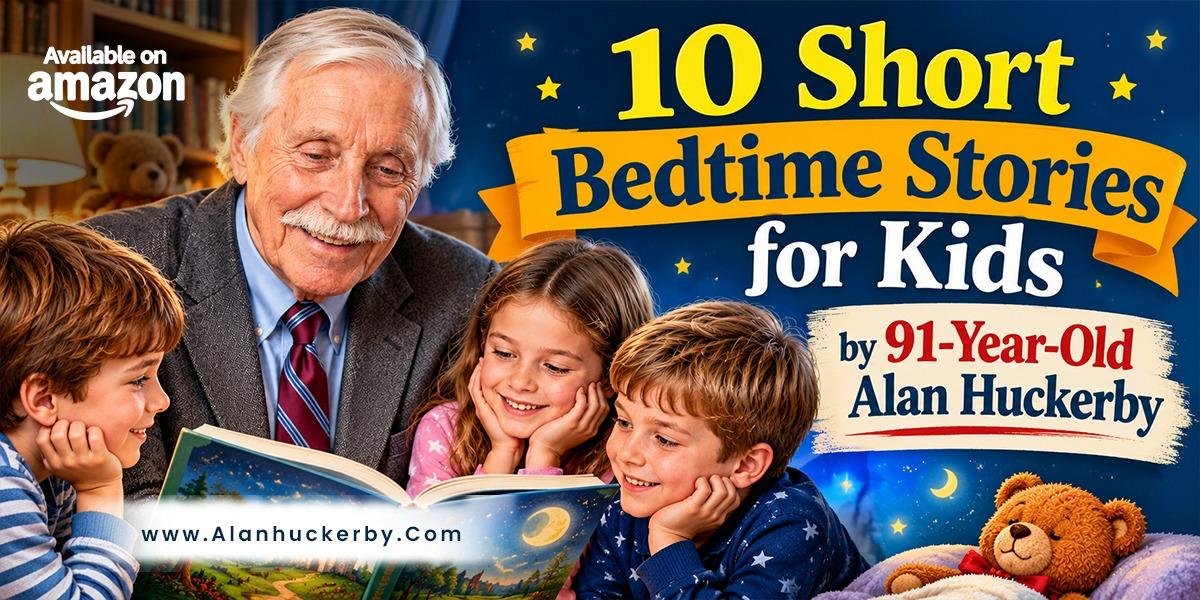
Many children’s stories begin with a memory or an overheard conversation. Author Alan Huckerby has said that the ideas for his ten short children’s stories came from everyday scenes: leaves blowing across a lawn, a bird struggling in a storm, two girls talking in front of a shop window. This article looks at the origins he has described so far.
Key Takeaways
- Huckerby has described the real-life moments behind several of his ten children’s stories.
- Autumn came from watching two children play in falling leaves.
- Bird Life began with a small hummingbird struggling in gusts of wind outside his window.
- The idea for Marla came from a shop display and two young girls discussing it with their mother.
- Mouse Life draws on a period when he lived alone and the value of even one friend.
Writing From What He Sees
Huckerby also writes crime, science fiction and historical novels. For these short stories, his comments, supplied with each story’s press release, show that each started from a single image or feeling.
The five accounts below are given in his own words, with a note on how each moment appears on the page.
Autumn: Two Children and the Leaves
Huckerby has said Autumn came from a scene he happened to witness. “It was autumn, and the wind and leaves were falling. I saw two children playing with the leaves, and it just seemed so lovely that I had to write about the scene. Hopefully, children who read what I have written can understand the feelings I felt.”
The finished story keeps the setting and gives the children names and imaginations. Bernadet and Jarden turn the leaf pile into an invading spaceship and a family of trees.
Bird Life: A Bird in the Wind
The second story began at a window. “I was looking out of the lounge window, watching the rain fall and the wind blow. Then I saw a very small hummingbird struggling in the wind gusts. A story about a child and an injured bird came immediately to mind. It shows the innate kindness of children that should be freed more.”
His closing remark explains why the story is built around a child rather than an adult rescuer. Jenna is the one who carries the injured bird, makes the visit to the vet and then feeds the chick every few hours for two weeks. In his view, that kind of care comes naturally to children and deserves more room to be expressed.
Brother and Sister: Two Children Who Differ
Huckerby describes the third story as a portrait of a relationship rather than an event. “This is a story about two young children, both different in their own ways, but always there when the other one is in trouble. They are able to talk to each other and listen to their responses. They may argue at times, but always, in the end, they work together.”
The story follows Toby and Jenny from childhood into adult life. Because the pair stay close through arguments and diverging career plans, the loyalty he describes has time to be tested.
Marla: Age Is Irrelevant to Ideas
The fourth story grew from a visit to a shop. “I was passing a large storefront just as the staff was rehanging displays. Two young girls standing with their mother were discussing the various displays. They both showed such knowledge for such a young age. Then I thought, age is irrelevant to ideas and thoughts.”
That final sentence is the thesis of the story. Marla is seven when she rearranges the window display, and the shop staff and customers respond with applause. The idea that young people can hold serious ideas became the plot.
Mouse Life: A Memory of Being Alone
The fifth account is more personal than the rest. “I thought about the time I lived alone and then how it felt to just have even one friend. At times things can seem very bad, but always remember that good always follows bad.”
The story gives that feeling to a field mouse. Erick has little to offer a lost child except blankets and food, yet his company over two days is what matters. Of the five, this is the one where the source is an emotion rather than a scene, and the closing message is stated directly.
What the Accounts Have in Common
Read together, the five comments show a consistent method. Each starts with something small and observed, whether weather, a conversation, or a feeling, and each ends with a short moral about kindness, loyalty, or courage.
Another pattern is the presence of pairs. Two children in the leaves, two siblings, two girls at a window, a mouse and a child: companionship is the unit he returns to most. This echoes the importance he places on family and loyalty in discussing his own upbringing in Leicester, where he was raised after being orphaned in the Second World War.
Frequently Asked Questions
Are Huckerby’s children’s stories based on true events?
Not as full accounts. He has said each started from a real moment, such as a scene he saw or a feeling he remembered, which he then turned into fiction.
Which story has the most personal origin?
Mouse Life. He has said it came from remembering a time when he lived alone and what it meant to have even one friend.
Why do so many of the stories feature children helping others?
He has said the story of Bird Life shows the natural kindness of children. Several others, including Brother and Sister and Playtime, centre on children looking after one another.
Where can readers find the stories?
The ten titles and further details are listed on the author’s website, alanhuckerby.com.