By Mickey Johnson
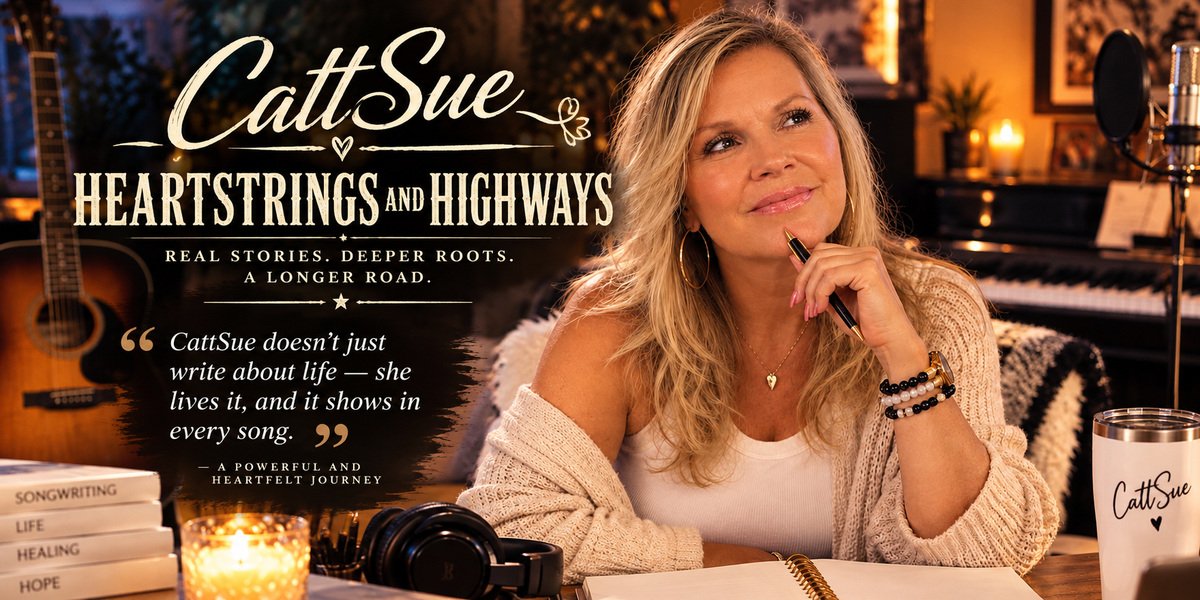
There are albums that want to impress you, and then there are albums that want to tell you what happened. CattSue’s Heartstrings and Highways belongs emphatically to the second category. It is not interested in posturing, clever detachment, or wrapping pain in pretty paper. It comes at you carrying family ghosts, old wounds, memories that won’t die, and the kind of hope that has had to fight for every inch of ground it still owns. Across 11 songs, CattSue writes about love, grief, motherhood, abuse, addiction, faith, family, and the strange burden of carrying the past while trying to function in the present. Nearly all of it was written solely by her, which matters, because this does not feel like a singer interpreting somebody else’s emotional architecture. It feels lived in.
“A Whisper on the Wind” is one of the clearest examples. CattSue lost her mother when she was only four and a half years old, and the song does not attempt to turn that into some grand cinematic tragedy. Instead, it deals in fragments: National Park, New Jersey, photographs, a Mrs. Beasley doll, and the ache of no longer being able to remember exactly what her mother’s voice sounded like. That is the real horror of loss — not just that somebody is gone, but that even the memory of them can begin to disappear. The song understands that grief is often less about monuments than details, the strange little objects and impressions that remain after a person does not.
“More Time” hits from another direction. Here it is her father, remembered not through grand gestures but through the things that make a life recognizable: sitting by the river, watching the Eagles, hearing familiar stories, remembering words that stayed after the man himself was gone. That is where Heartstrings and Highways keeps finding its power — in the ordinary. “Little Man” works in much the same way, taking the sound of a child’s footsteps down a hallway and stretching that image across the years until the little boy becomes the grown son who now steadies his mother. Time moves quietly until suddenly it has stolen decades.
“Mother’s Heart” takes the family theme into rougher territory. This is not motherhood dressed up for greeting cards and Sunday brunch. It is sacrifice, disappointment, distance, hurt, and the brutal realization that giving everything to someone does not mean they will always understand what it cost you. There is bitterness in there, but there is love too, and that combination is what makes it believable. CattSue is not afraid to let family remain complicated, which gives the record considerably more weight than it would have if every wound were wrapped neatly by the final chorus.
“Broken” is about survival without pretending survival means victory. The narrator is still bruised, still carrying damage, still standing. Sometimes that is all survival is. Then comes “In the Light,” which gives the record its broadest sense of purpose. The song was written for survivors of trafficking, abuse, and exploitation, and CattSue’s connection to that world is not abstract. A family member and friends were trafficked, and she has spoken openly about the issue. The song does not treat survivors like symbols. It gives them agency. The language is about taking back a name, a voice, a life. By the time the song moves from “I” to “we,” it has stopped being confession and become declaration.
That distinction matters because too much music about trauma leaves the victim trapped inside the thing that happened to them. CattSue refuses that ending. Elsewhere, “Gold Star Heart” looks at military sacrifice through remembrance, while “Many Moods of the River” lets landscape become memory itself, the water carrying the emotional presence of people who are no longer physically there. The record keeps returning to the idea that memory is not passive. It shapes the present, interrupts it, colors it.
And then there is “When the Clouds Come Home,” co-written with David Murphy. This one is about addiction, and even the title gets it right. The clouds do not simply arrive. They come home. That is the terrible familiarity of addiction. The darkness already knows the road. The thunder has been heard before. The storm does not need directions. But the song also reaches outward. It recognizes that isolation is part of the danger and solidarity part of the fight.
That is ultimately what Heartstrings and Highways is about: not pain for its own sake, but connection. Between mother and child. Daughter and parent. Survivor and survivor. Addict and fellow traveler. Past and present. CattSue is not reinventing Americana here. She is using it the way it was always meant to be used: to carry stories that would otherwise disappear.
There are moments when the album gets sentimental. Good. Sentiment is only a problem when it isn’t earned. On Heartstrings and Highways, it usually is. CattSue is not decorating pain. She is documenting it. And by the end, what remains is not despair. It is endurance. The road keeps moving, the ghosts keep riding shotgun, and somehow, you drive on.
If you want, I can also make it read even more like a magazine feature review, with fewer track-by-track transitions and a smoother narrative flow.