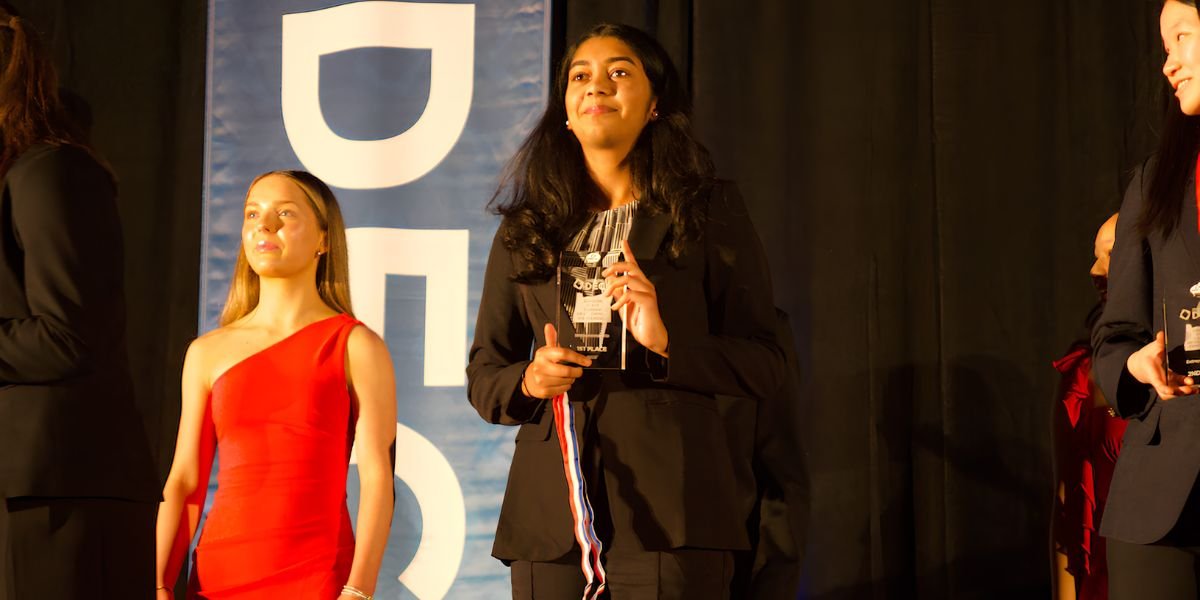
For Ojal Kulkarni, learning languages in Oregon came with an irony. Spanish, the foreign language on her school timetable, was often easier to engage with than Marathi, her own mother tongue.
It was not because Marathi mattered any less. Ojal spent years at Marathi school learning to read, write, speak and understand the language that connected her to her family and culture. But while Spanish lessons came with games and interactive activities, she remembers her own Marathi-learning experience very differently.
“The way I learned it was so boring,” she says.
For years, Ojal assumed that was simply part of learning a difficult language. Then, in eleventh grade, she returned to Oregon Marathi Shala as a volunteer and began working with kindergarten students. Watching children lose focus, repeat mistakes and struggle to stay engaged, she started to question an assumption she had carried since childhood.
Maybe Marathi had never been the problem. Maybe it was the way she had learned it.
Ojal decided to build another way.
At first, she thought she knew what that meant.
If boredom was the problem, the answer seemed obvious: make Marathi fun. Ojal filled the platform with games and interactive activities, creating the kind of learning experience she would have wanted as a child.
Then she discovered that engagement alone was not enough.
Take colors. A game could ask a child to match a color with its Marathi word, but if that word had never first been introduced, heard, and practiced, there was little for the game to reinforce.
Ojal had solved for attention before solving for understanding.
She began redesigning the platform around that distinction. Instead of simply making games progressively harder, she structured them around what students needed to learn first and what they could practice afterward. Vocabulary was introduced before it was tested; games became part of the learning sequence rather than the sequence itself.
The website had begun as an attempt to make Marathi less boring. Building it forced Ojal to confront a harder problem: making someone want to learn is not the same as knowing how to help them learn.
It was a lesson that would reshape Ojal’s understanding of entrepreneurship, too.
Her first serious encounter with entrepreneurship had begun with a rejection. After ninth grade, she applied to Stanford’s Innovation and Entrepreneurship course and did not get in. She enrolled in Strategic Marketing instead, where a final project asked students to develop a new product concept.
Ojal created SprayShoe, a portable recovery-shoe concept built around a sprayable material that could form around a reusable sole. The idea was partly informed by her own experience with running injuries and struggling to find the right support for her feet.
At that stage, entrepreneurship came with relatively clear markers. Create an idea, make the case for it and make sure it maxes out every learning target in the judge’s rubric.
Then came DECA, a global student organization built around business and entrepreneurship competitions.
Ojal placed ninth in her first year. She returned the following year having prepared much earlier and placed first at Oregon’s state competition in both the Innovation and Entrepreneurship events. By then, she had also reapplied to Stanford’s Innovation and Entrepreneurship course.
This time, the answer was yes.
But the most important part of that full-circle moment was not simply being accepted. It was what the course made her question about the way she had been approaching ideas.
One principle stayed with her: focus on the problem before becoming attached to the solution.
For a student who had spent years learning how to invent, pitch, and compete, it marked a subtle shift.
The question was no longer just, “What can I build?” It was becoming, “What is actually worth solving?”
And the Marathi website gave her a place to test that question outside a classroom rubric.
After more than six months of development, the platform has reached 42 users across 156 learning sessions, with 56 words built into its current learning sequence. Parents at Oregon Marathi Shala have already been given access, and the school plans to incorporate the website into students’ learning and homework as the new school year begins.
More importantly, Ojal is beginning to receive the kind of feedback a competition judge cannot provide. One user praised the platform’s organized levels and audio features, while suggesting that more advanced learning techniques be added for students progressing beyond the basics.
For Ojal, that suggestion did not undermine the idea. It made the next step clearer.
She sees mistakes not as setbacks, but as bringing her a step closer to the final result.
A judge could tell her that an idea had won. A learner could tell her what it still needed.
There was no first-place finish waiting at the end of this project, and no rubric telling her when the website was valuable. Its value would have to be measured differently, by whether learners could actually use it, whether the structure helped them progress, and whether their feedback continued to change what she built.
Competitions had taught Ojal how to make an idea worth presenting. Building for real users was teaching her how to make one worth returning to.
And for a website born from a language she had once struggled to enjoy learning herself, returning may be the most meaningful measure of all.