“Small business loan” is an umbrella term for money borrowed by a smaller company under an agreement to repay it. Under that umbrella sits a wide variety of species, each with different habits, habitats, and hazards. A few can be funded in roughly 24 hours. Many can’t.
Consider this your field guide. Like a guide to birds or trees, it’s arranged so you can identify what’s in front of you, learn how it behaves, and know what to watch out for. Each entry notes how quickly you might see funds.
How to Use This Guide
Before you start identifying products, note three facts about your own business. They’ll determine which entries apply to you:
- Average monthly deposits over the past six months
- Time in business based on your formation date and first revenue
- Purpose of the money, stated in one sentence
As a rough rule, the U.S. Small Business Administration defines “small” using size standards that vary by industry, based on employees or annual receipts. Lenders may use their own definitions as well, so don’t assume a program’s label applies to you without checking. If the whole process seems unfamiliar, an explanation of the Fundivi application process shows the basic stages of an online request from beginning to end.
Entry 1: The SBA 7(a) Loan
Habitat: Banks, credit unions, and approved non-bank lenders.
Identifying marks: Partial federal guarantee, long terms, capped rates.
Best for: Established businesses seeking working capital, acquisitions, or refinancing.
Watch for: Extensive paperwork, guarantee fees, and personal guarantees from significant owners.
24-hour outlook: Not realistic. Plan on weeks or months.
Entry 2: The SBA 504 Loan
Habitat: Certified Development Companies working alongside private lenders.
Identifying marks: Long-term fixed rates for major fixed assets.
Best for: Buying real estate or large equipment.
Watch for: Occupancy rules, job-creation or public-policy goals, and complex closings.
24-hour outlook: Not realistic.
Entry 3: The Microloan
Habitat: Nonprofit intermediaries, community lenders, and CDFIs.
Identifying marks: Small amounts, often paired with coaching.
Best for: Startups and very small firms that banks don’t serve.
Watch for: Limited size and application timelines that depend on the organization.
24-hour outlook: Unlikely, though well worth the wait for eligible borrowers.
Entry 4: The Bank Term Loan
Habitat: Local and national banks.
Identifying marks: Monthly payments, lower rates, financial statement review, and possible covenants.
Best for: Profitable businesses with a track record.
Watch for: Collateral requirements and slower approvals.
24-hour outlook: Rare, even for existing customers with strong relationships.
Entry 5: The Online Short-Term Loan
Habitat: Fintech lenders and funding platforms.
Identifying marks: Fast decisions, shorter terms, weekly or daily payments, sometimes factor pricing.
Best for: Time-sensitive needs with a fast payback.
Watch for: High effective cost, little or no savings for early payoff.
24-hour outlook: Often possible for qualified applicants.
Entry 6: The Business Line of Credit
Habitat: Banks and online lenders.
Identifying marks: Revolving access, charges based on the amount drawn.
Best for: Repeated short-term gaps.
Watch for: Draw fees, renewal terms, and the possibility of a reduced limit.
24-hour outlook: Possible with online providers. Immediate if already open.
Entry 7: The Merchant Cash Advance
Habitat: Specialized funders and brokers.
Identifying marks: Technically a purchase of receivables, with factor rates and frequent remittances.
Best for: Card-heavy businesses that have limited options and a high-return use of funds.
Watch for: Very high effective costs, stacking pressure, and contract clauses that favor the funder.
24-hour outlook: Often possible.
Entry 8: Card-Sales Financing
Habitat: Payment companies, platforms, and specialized funders.
Identifying marks: Repayment tied directly to card or platform receipts.
Best for: Merchants with consistent card revenue.
Watch for: Processor requirements and how the split affects daily cash. This State Journal piece on merchant card loans describes one recent entry into this category.
24-hour outlook: Possible if no processor change is needed.
Entry 9: Invoice Factoring
Habitat: Factoring companies and some banks.
Identifying marks: Sale of unpaid invoices at a discount, with your customers’ credit carrying much of the weight.
Best for: B2B companies with slow-paying customers.
Watch for: Long contracts, minimum volumes, and notices sent to your customers.
24-hour outlook: Usually only after the account has been set up.
Entry 10: Equipment Financing
Habitat: Banks, captive finance arms of manufacturers, and independent lenders.
Identifying marks: The equipment usually secures the debt.
Best for: Vehicles, machinery, and technology with resale value.
Watch for: Automatic lease renewals and obligations that continue if the equipment fails.
24-hour outlook: Possible for routine deals from established vendors.
Comparing the Species
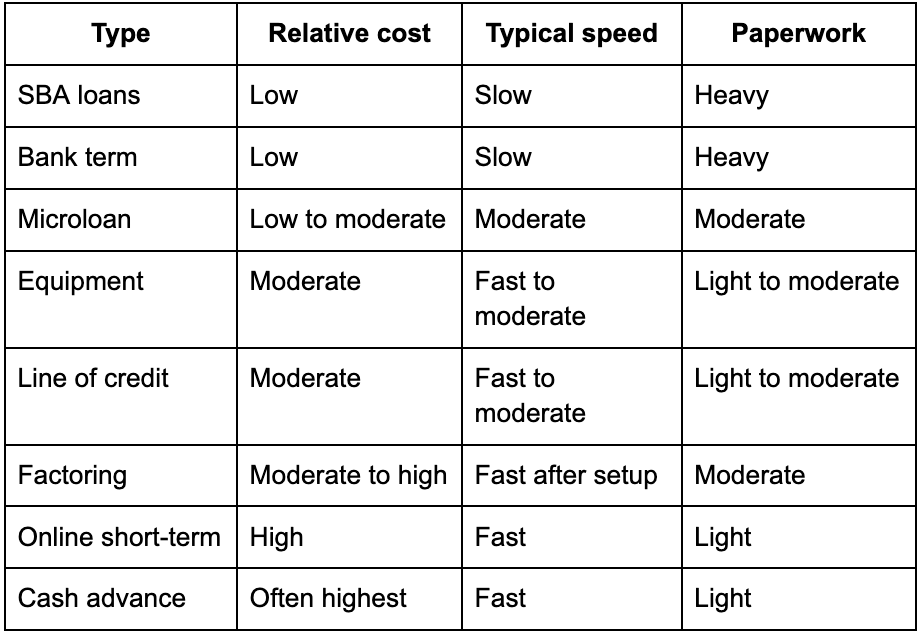
Notice the pattern: faster products generally demand less paperwork and cost more. There’s no widely available product that’s simultaneously very cheap, extremely fast, and easy to qualify for. Anyone offering all three deserves extra scrutiny. For businesses with strong sales, an article on unsecured financing for high-revenue companies gives another view of the fast end of the market.
Field Notes: What Makes One Species Fit
Identify your situation below, then see which entries deserve your attention.
- A high-return purchase is needed by tomorrow: Entries 5, 6, 7, or 8
- A contractor awaits payment on invoices: Entry 9, with Entry 6 as a backup
- Equipment has broken down: Entry 10
- You’re buying a building next year: Entries 2 or 4
- You have a modest startup need: Entry 3
- You want cheaper long-term capital: Entries 1 or 4
Dangerous Look-Alikes
Every field guide warns about species that can harm you. In this market, be on guard for:
- Advance-fee scams, where someone demands payment before releasing funds
- Impersonators, who use names similar to those of real lenders
- Debt-relief traps, which ask you to stop paying creditors and instead pay them
- Fake pre-approvals, sent by text or email to create false urgency
Protect yourself by verifying a company through independent sources, calling a number you found yourself, and refusing to send money or sensitive login details on the strength of an unsolicited message.
What a One-Day Attempt Requires
If your field notes point toward one of the faster entries, gather complete bank statements for the last three to six months, owner identification, your EIN, formation records, and a list of current debts. Apply early on a weekday and keep your phone close, since a verification call is routine. Ask for the total repayment amount, the cash you’ll actually receive, the payment schedule, and early payoff terms before you sign anything. Funds may arrive the same day or the next, depending on the provider’s review and the transfer method. Remember, too, that the fastest option isn’t always the wisest. When you have a month to spare, a slower product could save thousands of dollars. Search hubs such as the BusinessLoansEngine.com product finder can offer additional names, although you should always confirm a company’s details independently.
Frequently Asked Questions
Which small business loan is easiest to get?
Products based on recent revenue, such as advances and short-term online loans, tend to have more accessible standards, but they generally cost more.
Which one is cheapest?
SBA and bank loans are usually among the lowest-cost options for those who qualify. Grants are cheaper still, but competitive and limited.
Is a same-day loan safe?
It can be, when offered by a legitimate provider with clear terms. Verify the company and read the entire contract before signing.
Can I combine loan types?
Yes, businesses commonly use more than one, such as an equipment loan and a line of credit. Check that each agreement permits additional debt.
Do I need a business plan?
Fast products rarely require one. SBA lenders, microlenders, and startups seeking bank money are far more likely to ask.
Where should I begin?
Start with your own bank and a free counselor at an SBDC or SCORE chapter, then compare quotes from online providers if speed matters.
Will applying affect my credit score?
A soft inquiry won’t, while a hard inquiry may have a small effect. Ask which type each provider uses before you authorize a check.
Can a sole proprietor qualify?
Yes, for many products, though lenders usually want a dedicated business bank account.
Disclaimer: This article is for informational purposes only and does not constitute financial or legal advice. Loan terms, eligibility, costs, and funding timelines vary by lender. Funding within 24 hours is not guaranteed. Business owners should review all financing terms and consult a qualified financial professional before making decisions.