Some of the most dangerous problems begin quietly.
A fatigue crack can spread through an aircraft structure long before it becomes visible. A fragment of debris can circle Earth unnoticed until it collides with a satellite. Heat can seep into a building every day, adding to an energy bill without ever looking like an emergency.
Ehaab Sayed has become fascinated by that moment before the damage is irreversible.
At 16, he is developing a model to evaluate the feasibility of a quantum-dot-based early-warning system for fatigue cracks in aircraft and rocket structures. His idea is rooted in a property called photoluminescence: as stress develops around a crack, changes in the surrounding material could alter the way embedded quantum dots emit light. In Ehaab’s model, that measurable shift acts as the warning signal, while his current work explores how viable the system could be in real-world aerospace applications.
That instinct to notice a problem before it reaches breaking point was not always what physics meant to him.
His fascination with the subject intensified after discovering a book he remembers as The God Equation. Suddenly, physics stopped looking like something contained within a classroom. He began seeing it in aircraft, buildings, materials and the technologies around him. Engineering offered the next question: if physics could explain why something failed, could he use that knowledge to stop the failure from happening?
That new fascination first found an outlet in competition. Ehaab threw himself into Olympiad preparation, sometimes completing more than 50 physics and mathematics problems in a day. Competitions gave his growing interest in physics something tangible to work towards: every problem had a defined challenge, every test produced a result, and progress could be measured in rankings and selection rounds.
The discipline carried him into the UAE’s official International Olympiad selection exams, where he ranked highly enough to be considered for both the physics and economics national teams. After months of preparation, the route ahead seemed clear.
Then it disappeared.
The UAE’s participation in the International Physics Olympiad was cancelled, removing an opportunity Ehaab had spent months working towards for reasons that had nothing to do with how hard he had prepared.
The disappointment forced him to confront something that solving another fifty questions could not fix. There was no mistake to correct, no concept to revise and no harder problem set that could reopen the route.
“Your worth is not tied to one competition,” Ehaab says now.
It was an uncomfortable lesson, but an important one. Until then, much of his relationship with physics had been built around problems whose boundaries were already known: the question was given, the rules were fixed and somewhere, however difficult to reach, a correct answer existed. Losing the Olympiad opportunity began pushing him towards a different kind of challenge, one where neither the route nor the answer had been decided for him.
One of those challenges was waiting outside his own front door. Living in the UAE meant living with extreme heat and the energy demands of keeping buildings cool. Ehaab began investigating reflective roof coatings, asking whether passive cooling could reduce heat entering a building without simply relying on more air-conditioning. He experimented with different compositions, including titanium dioxide nanoparticles, and began thinking not only about whether a material worked, but whether its cost and placement made it practical. The research became a GENIUS Olympiad finalist project.
The experience changed what precision meant to him. In competition, precision meant arriving at the correct answer. In research, it meant controlling variables closely enough to trust the result, recognising when an elegant solution was too expensive, and changing the design accordingly.
That distinction now shapes his aviation work.
Ehaab’s interest in aircraft safety grew after watching Sully, a story in which a pilot’s decisions avert catastrophe. But it left him thinking about the opposite possibility: what happens when a problem develops silently and there is no extraordinary intervention available at the final moment?
Fatigue cracks gave that question a physical form.
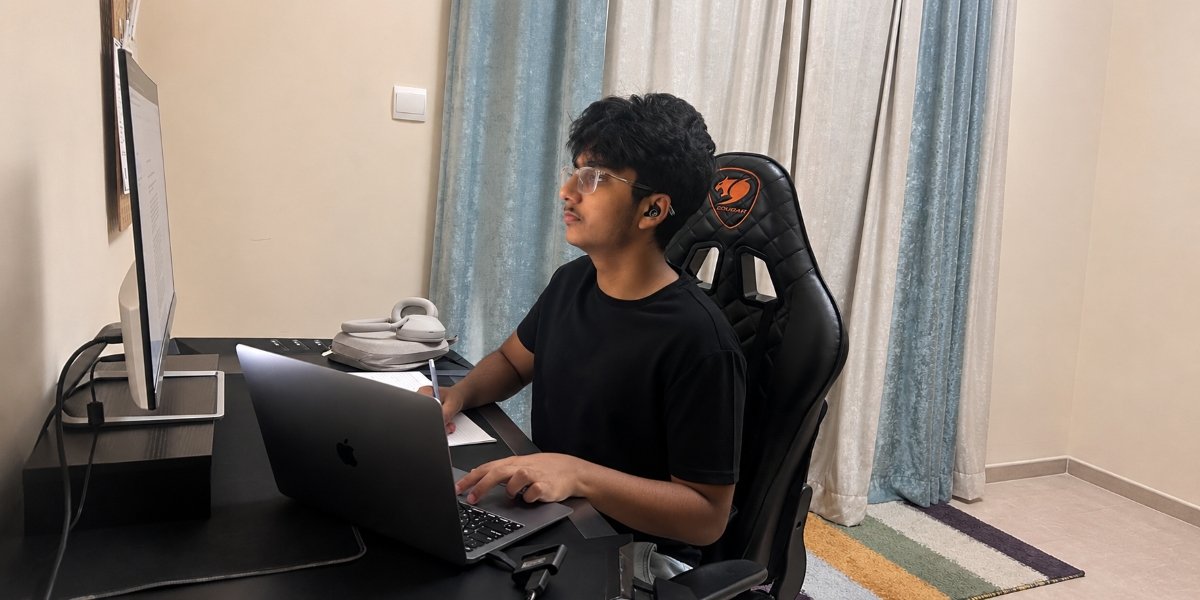
When access to actual quantum dots proved difficult, Ehaab could have left the idea as a theoretical one. Instead, he began modelling it. He is now building an interactive website and simulation that could demonstrate how photoluminescence changes might be monitored across aircraft, while connecting the concept to existing aerospace inspection standards. The system remains a work in progress, but that is precisely what attracts him: there is no answer sheet confirming in advance whether the idea will ultimately prove viable.
The scale of his questions has since expanded beyond aircraft, and beyond Earth.
During a visit to a secluded beach in Oman, Ehaab was struck by the amount of rubbish that had accumulated despite how few people seemed to visit. It made him think about how human activity can leave a mark even in places that seem untouched. In orbit, the consequence is debris: discarded components and fragments capable of colliding with satellites at enormous speeds.
His first instinct was ambitious: could lasers track and eliminate smaller debris? The deeper he investigated, however, the clearer the limitations became. The technology was highly experimental and demanded resources beyond what he could realistically access.
Once again, the route closed. Once again, Ehaab changed the question.
Working with Dr Miles Stopher, Director of Admissions in Cambridge’s Department of Engineering, he shifted towards studying how collision risk in low Earth and geostationary orbit might instead be mitigated and prevented. His developing research compares existing proposals, examines the gaps between them and considers how technical approaches interact with relevant policy. He does not describe himself as the person who will solve orbital pollution. His aim, he says, is to play “a humble part in aiding” researchers with the resources to take the work further.
Ehaab still competes; he has since become an International Engineering Olympiad finalist, earned a place on the Stanford Math Tournament Distinguished Honor Roll and continues pursuing advanced physics. But competition is no longer the only way he measures progress.Olympiads taught him to keep working until he found the answer.
Research is teaching him something harder: when the route disappears, when the first solution fails, and when no answer has been written yet, the work is to keep asking a better question before the problem reaches breaking point.