Housing now eats up the largest share of most American household budgets, and the way that money gets spent has not changed much in a generation. A house is bought, lived in, paid down, and eventually sold. The structure itself sits idle most of the day and earns nothing along the way.
Mayan Metzler thinks that arrangement is overdue for a rewrite. His New York company, TerraLux, builds modular homes designed to function as more than passive shelter. Metzler calls each unit a Healing Home, and the catalog now spans ten distinct variants, each engineered around a specific human activity. The bet is that purpose-built structures can do something a generic house never could, which is actively support how their owners live and earn something back in the process.
Ten Modules Built Around How People Actually Live
TerraLux’s lineup currently includes Sleep, Focus, Recovery, Creator, Performance, Longevity, Kitchen, Garden, Social, and Live. Each module is built for one defined use rather than as part of a single all-purpose house. Owners assemble small clusters of modular homes on their land, combining the modules that match their actual rhythms.
A Sleep Home is tuned for deep rest, with circadian lighting and acoustic treatment shaped around recovery conditions. A Creator Home arrives configured as a fully built content production studio, ready for filming, podcasting, or photography work without the usual setup overhead. Recovery modules host wellness sessions with visiting practitioners. Performance Homes handle physical training. The Garden, Kitchen, Social, and Live variants round out the more conventional residential functions.
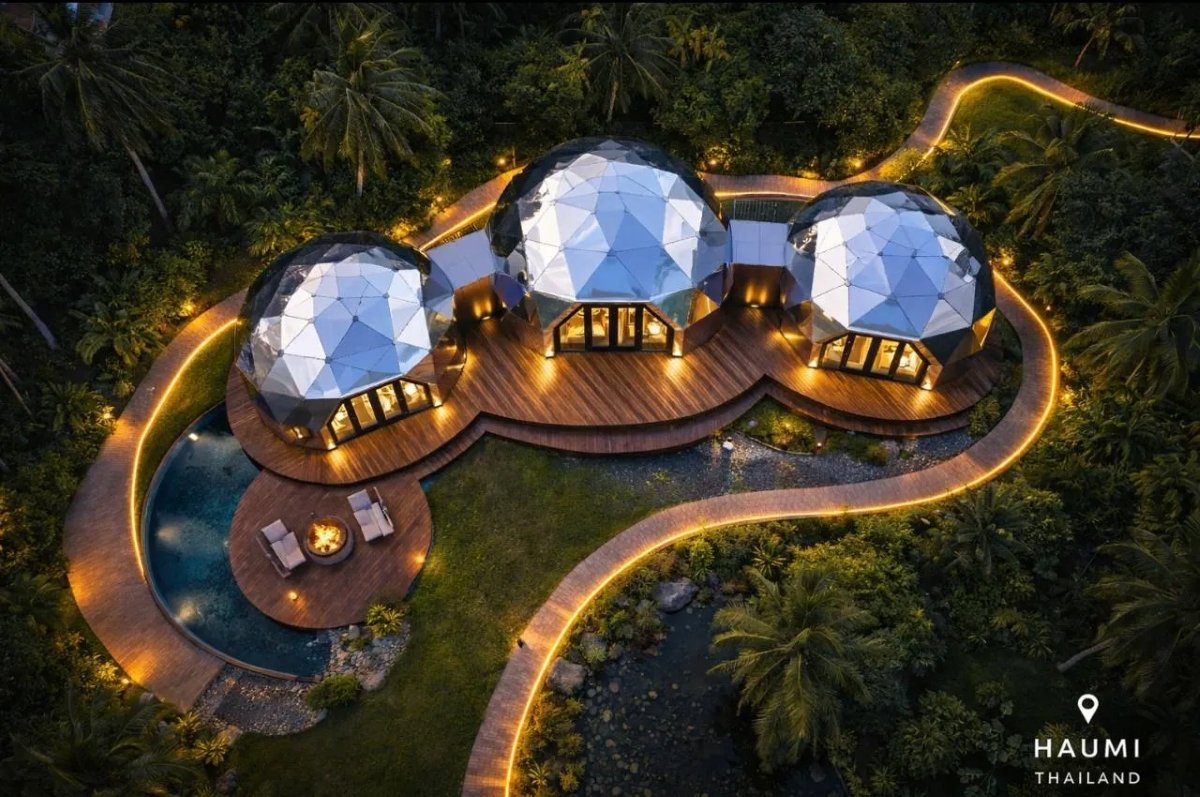
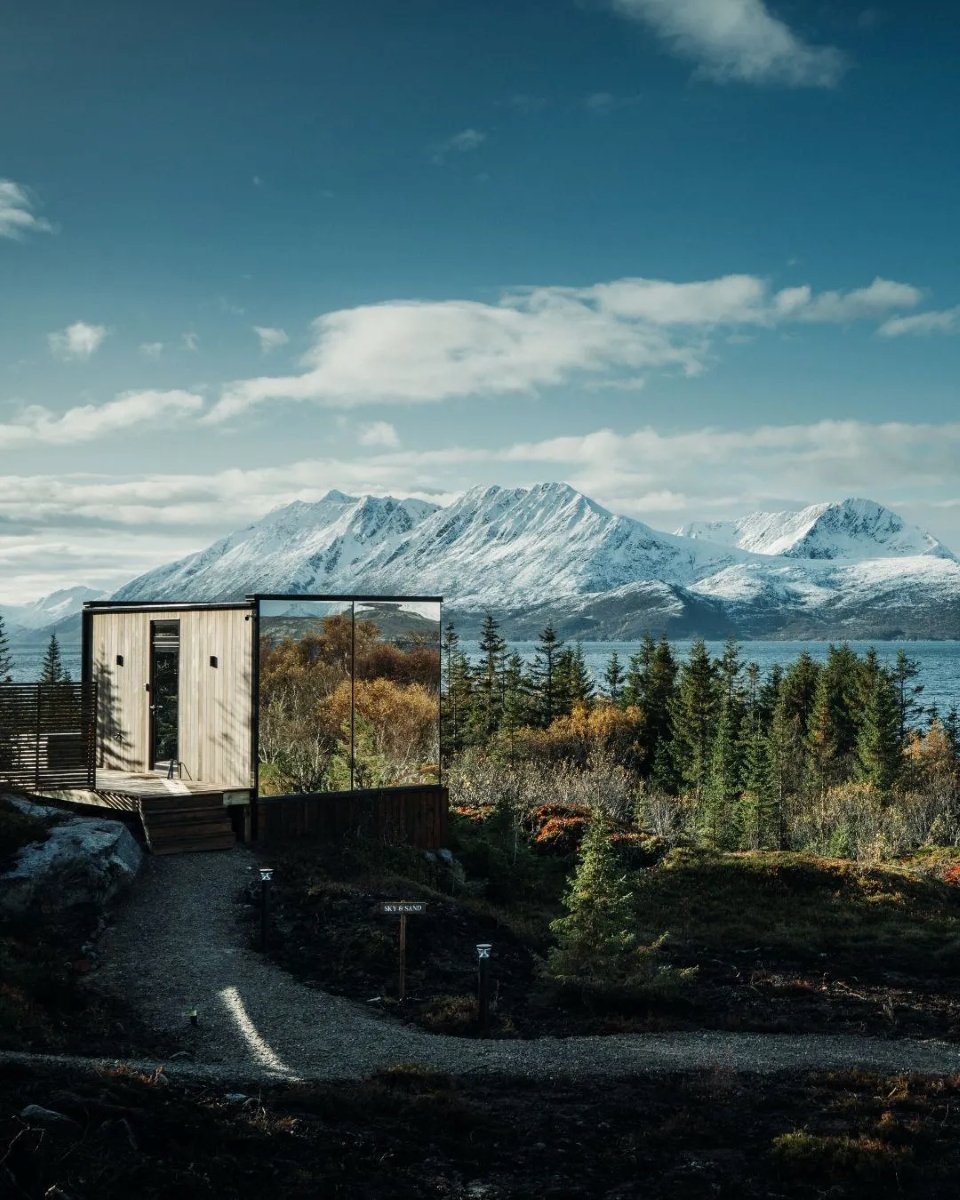
Architecturally, the modular homes refuse any single design language. Geodesic domes wrapped in tropical greenery share catalog space with mirror-clad alpine cabins, earth-integrated structures covered in living vegetation, clean-lined glass micro-homes, and curved cabins built around slow-living principles.
Wellness Baked In Rather Than Bolted On
Every TerraLux build runs on a shared framework called Homes That Heal. The system treats elements that conventional construction tends to overlook as primary design choices rather than optional upgrades. Air optimization, circadian lighting, filtered and mineralized water, sound frequency tuning, low-EMF design, and integrated planting beds for food production all arrive as baseline features.
“The goal is to create spaces that actively support human biology, not just house it,” Metzler has said. The parts of a home that touch a person most directly, like the air, the light, the water, and the sound, get a level of design attention that most builders skip entirely. Materials and finishes are selected with indoor air quality in mind, and the build process is structured to keep off-gassing chemicals out of the interior environment from the day a unit is occupied.
The Income Side of Modular Homes
Single-purpose design also reshapes the economics of ownership. Because each module is engineered for a defined function, each can operate as more than a private residence. A Creator Home, with its production studio configuration, can be rented to local freelancers, agencies, and filmmakers needing a shoot location. Recovery modules can host visiting practitioners with their own client books. Sleep Homes, finished in photogenic exteriors and built for rest conditions, fit naturally into the premium short-term rental market.
TerraLux describes the shift in plain terms: property moves from cost center to active asset. The modular homes are positioned to generate alongside their residential role, a framing that lands differently at a moment when buyers are watching every line of the household budget. A building that can earn while serving as a home changes the basic arithmetic of ownership.
A Browser-Based Planning Studio
TerraLux complements the physical product with a digital tool. The Spatial Network operates as a planning studio inside a browser, where an owner can drop Healing Homes onto a representation of their land, test different configurations, and see how a finished property ecosystem might come together. Someone working through layouts on screen can rearrange a small property dozens of times in an afternoon, something that would take weeks of architectural revision in a traditional build.
Membership turns the platform into an ongoing relationship rather than a one-time purchase tool. Members access preferred pricing on new units, early visibility into fresh variants at launch, partner benefits across the TerraLux collaborator network, and a direct line into the wider community of owners. Most owners expand their footprints over time, so membership operates as the entry point into a longer arc of ownership rather than a single transaction.
Big Hollow Green Puts the Idea on the Ground
To see what TerraLux is actually building, visit Big Hollow Green, the company’s flagship location in the Catskills about two and a half hours north of Manhattan. The property doubles as a working showroom and a place where guests can stay inside a Healing Home and feel the design decisions in real time. Geodesic domes, alpine cabins, and earth-integrated structures sit together on the same land, giving visitors a sense of what a full modular homes ecosystem looks like when assembled at scale.
Big Hollow Green is the first marker in the ground. Metzler has described a longer plan to build a wider network of TerraLux locations across different climates and regions, each one assembling its own mix of Healing Homes suited to how people in that place actually want to live.
A Bet on What Houses Could Be Doing
Where the vision lands in the broader real estate picture remains an open question. Modular construction has had false starts before, with earlier waves of prefab building stalling on aesthetics, financing, or buyer hesitation. What feels different about TerraLux is the insistence on specific use cases instead of generic prefab, the integration of wellness systems into the baseline rather than the upgrade tier, and the underlying argument that the next generation of American modular homes can do meaningful work for their owners rather than sitting idle.
Anyone curious to see these modular homes in person can book a stay at Big Hollow Green. The TerraLux modular homes website covers the broader catalog and the current state of the Spatial Network. For more information on TerraLux visit their website.
- Email Mayan Metzler: mayan@GermanKitchenCenter.com Call: (347) 992–0410
- To read the full interview with Marco Derhy and Mayan Metzler, visit the source of this article.
- Media – Contact: Derhy Enterprises 1(310) 613-2773