By: Kate Sarmiento
Ask most people what a nonprofit executive does all day, and the answer usually involves a folding table, a stack of grant applications, and a lot of good intentions stretched thin. That image is outdated in Atlanta, where Maryum Phillips runs Status: Home, one of the largest HIV/AIDS housing organizations in Atlanta, with the kind of financial discipline you’d expect from a regional bank, not a charity operating on a shoestring.
Status: Home has been housing Atlanta’s homeless and low-income residents living with HIV since 1988. For most of that history, the story was survival. Keep the lights on. Keep the doors open. Do right by the people who show up. Somewhere in the last few years, the story picked up a second chapter, and it’s a lot less quiet about money.
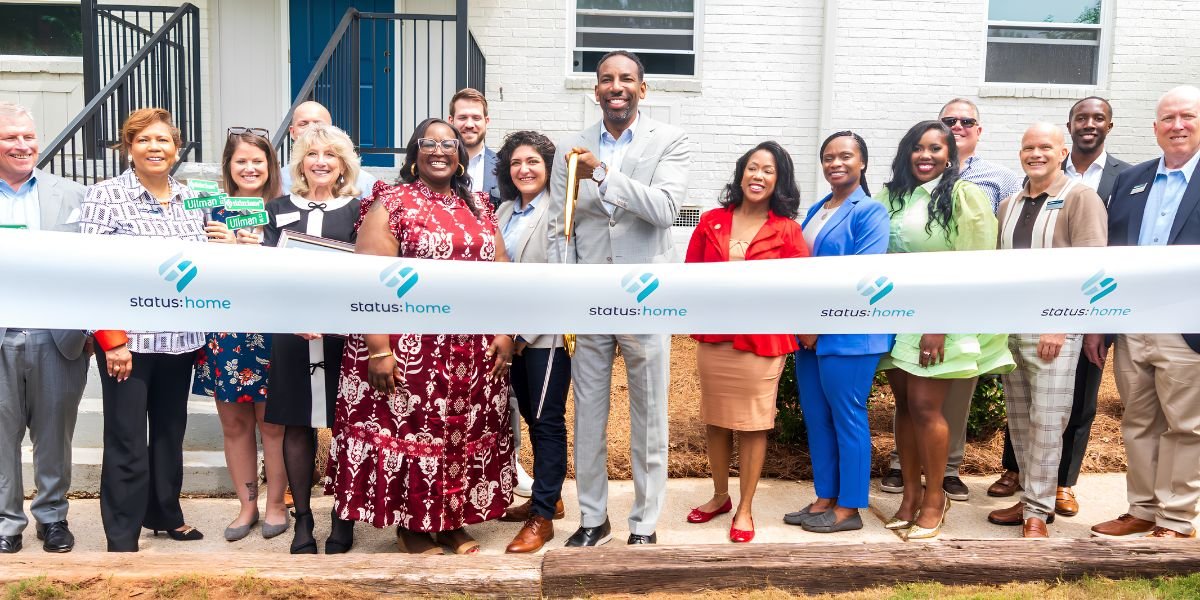
Under Phillips, the organization closed a $26 million capital campaign and used the proceeds to acquire five multifamily buildings across metro Atlanta. That’s not a bake sale number. That’s the kind of raise most regional nonprofits spend a decade chasing, if they ever get there at all. Phillips didn’t get there by being scrappy. She got there by running Status: Home like a company with a mission attached, not a mission with a company attached.
A Nonprofit Budget That Should Make You a Little Nervous (In a Good Way)
Nonprofits get a reputation, fair or not, for running on heart instead of strategy. Passionate people, thin budgets, decisions made by whoever’s in the room that week. Phillips came up through more than two decades of nonprofit leadership before landing at Status: Home in 2021, and she brought a habit with her that many in the sector still treat as optional: a determination to see the numbers hold up before the story gets told.
That shows up in how the capital campaign got built. Five buildings acquired. A budget that grew to $9.7 million. A staff of 35 managing housing and services for close to 400 people a year. None of that happens off vibes. It happens because someone is tracking occupancy, tracking outcomes, and tracking dollars with the same rigor a CFO would bring to quarterly earnings.
The donor world has been nudging nonprofits in this direction for a while now, whether they wanted to go or not. Affluent donors increasingly evaluate their giving the way they’d evaluate an investment portfolio, expecting clear outcomes and proof the money did something (Source: Bank of America Study of Philanthropy via Giving USA, 2025). Organizations that skip that homework pay for it in the following year’s fundraising. Nonprofits that voluntarily disclosed more financial and performance information to the public saw contributions rise 53% the following year compared with less transparent peers (Source: Harris & Neely, Journal of Accounting, Auditing & Finance, 2019). Phillips isn’t guessing that transparency helps. A decade of research backs her up.
There’s a version of this story where a corporate approach to charity feels cold, all metrics and no mercy. That’s not what’s happening at Status: Home. The metrics exist so the mercy has somewhere to land. Every building acquired is a resident who isn’t sleeping in a car. Every dollar tracked is a dollar that’s still there for the next family instead of quietly evaporating into overhead nobody can explain.
The Treatment Plan Nobody Puts on a Pill Bottle
Here’s a fact that doesn’t get repeated enough outside of clinical circles: at least half of Americans living with HIV experience homelessness or unstable housing at some point after their diagnosis (Source: HIV.gov, 2026). That’s not a fringe issue affecting a small, unlucky slice of the population. That’s a coin flip.
And housing instability doesn’t sit quietly next to a health condition. It actively makes it worse. People without stable housing are far less likely to stay in HIV care, take medication consistently, or make it to appointments, and the difference isn’t small. Among people managing HIV, roughly 32% of those experiencing homelessness reach viral suppression, compared with 75% of those who are stably housed (Source: San Francisco AIDS Foundation, 2019). Same virus. Same medical advances. Wildly different outcomes, and the variable isn’t the medicine. It’s the mailing address.
Georgia knows this problem better than almost any other state in the country. The state recorded the highest rate of new HIV diagnoses in the nation as of the most recent data, outpacing every other state, including Louisiana and Nevada (Source: Universal Drugstore analysis of CDC data via Rough Draft Atlanta, 2024). Metro Atlanta alone accounts for a disproportionate share of those cases, concentrated heavily among Black residents facing the added weight of systemic barriers to care. This isn’t an abstract policy debate happening somewhere else. It’s happening in the neighborhoods Status: Home serves.
Phillips built the case for Status: Home’s growth around that data rather than around sympathy. Housing, in her framing, isn’t a nice add-on to healthcare. It’s a delivery mechanism for it. A resident who has a lock on their own door can store medication properly, keep appointments, sleep enough to function, and stop spending every waking hour on the logistics of just getting through the day. Take the housing away, and the treatment plan falls apart no matter how good the medicine is.
Donors Stopped Taking Good Intentions on Faith
Trust-based philanthropy has become something of a buzz phrase in fundraising circles, and, in plain terms, it means that funders are trying to hand over money with fewer strings attached and less bureaucratic hoop-jumping. Roughly six in ten grantmakers say they’ve adopted some version of that approach already (Source: Trust-Based Philanthropy Project, 2024 Grantmaker Survey Report). That sounds like good news for nonprofits drowning in paperwork, and mostly it is. It also means the accountability doesn’t disappear. It just moves. Instead of proving their worth through forms, organizations have to prove it through results they can actually demonstrate.
That’s the environment Phillips is playing in, and it favors the kind of operation Status: Home has become. When a funder hands over unrestricted money and asks fewer questions up front, the organizations that thrive are the ones with internal discipline solid enough not to need guardrails. Status: Home’s occupancy numbers, viral suppression outcomes, and building acquisitions aren’t just good PR. They’re the receipts an organization needs on hand now that donors expect to see impact instead of just intentions.
Phillips also carries this approach beyond her own organization. As Chair of the Board of Directors for the National HIV/AIDS Housing Coalition, she’s well positioned to push this business-minded model beyond Atlanta and into the broader conversation about how HIV housing is funded and measured nationally. A CEO mindset applied to one nonprofit is useful. Applied across a coalition, it starts to look like a blueprint other cities could actually copy.
None of this erases the harder truth sitting underneath the success story. Ninety percent of Status: Home’s funding still comes from the federal government, which means the organization’s stability is tied to budget cycles and political winds well outside Atlanta. A $26 million campaign and five newly acquired buildings are real wins, and they’re also a hedge against a funding environment that could shift with very little warning. Running a nonprofit like a business doesn’t just make the mission look more credible. In a sector this exposed to federal policy, it might be the only thing keeping the mission alive at all.
Good Intentions Have Never Once Paid Rent
Status: Home has spent nearly four decades proving that people impacted by HIV in Atlanta deserve more than a shelter bed and a prayer. Under Maryum Phillips, the organization has added something the sector badly needed: proof that doing good and doing it well aren’t in competition.
Over the past two years, Status: Home has served more than 450 individuals and families, with its 2025 impact report showing 470 individuals and families served.
The next chapter depends on the same thing every capital campaign depends on: people willing to back it. That support shows up in different forms, from financial backing to volunteering to simply retelling a resident’s story for anyone who still doubts a nonprofit can run like a real organization. The organization’s work is documented at statushome.org, a record of what happens when a housing nonprofit stops apologizing for wanting to be excellent at both the mission and the math.