By Daniel Hartley
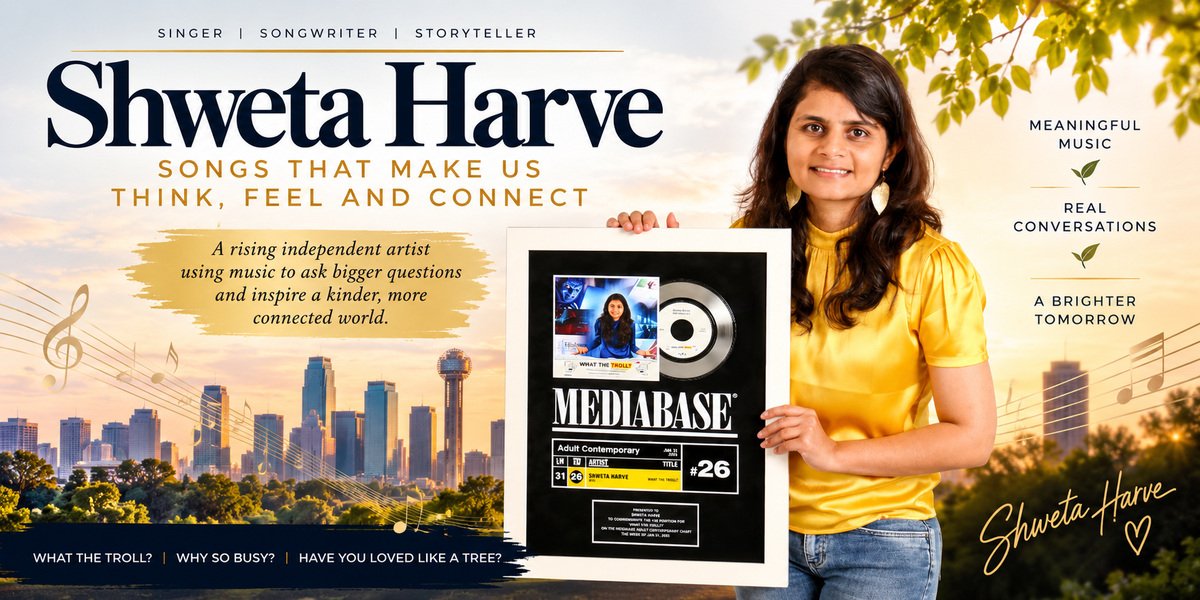
There is an old temptation in the music business to measure a career by numbers: chart positions, streams, spins, followers. By that standard, Shweta Harve has a number worth talking about: 26.
Her single “What the Troll?” reached No. 26 on the Mediabase Adult Contemporary chart, a significant achievement for an independent singer-songwriter working outside the machinery that traditionally turns songs into radio hits. Harve has the plaque commemorating the achievement, but the more revealing story isn’t the number hanging on the wall.
It’s the question behind the song.
“What the Troll?” took on internet trolling and cyberbullying, subjects more likely to appear in a cultural essay than an Adult Contemporary single. Harve was interested in what happens when the distance of a screen allows ordinary people to behave in ways they might avoid face-to-face. Beneath the song’s playful title was an increasingly serious concern: Where does empathy go when communication becomes anonymous?
It was hardly the most obvious recipe for radio success.
It worked anyway.
That contradiction says something important about Harve’s developing career. The Dallas-based independent artist isn’t interested only in writing songs people can hear. She wants to write songs people have to consider.
Her collaboration with composer Dario Cei has helped provide a musical framework for that ambition. Their work favors melody, clarity and approachable arrangements, allowing Harve’s ideas to remain at the center.
Her songs increasingly resemble conversations disguised as pop music.
Consider “Why So Busy?”
The question could be asked almost anywhere today: at an airport gate, in an office elevator, while staring at six unanswered text messages. Busyness has become one of contemporary life’s strangest status symbols. People complain about being overwhelmed while simultaneously wearing their exhaustion like proof that they matter.
Harve noticed the contradiction.
Instead of celebrating the hustle, she questioned it.
Then came another question.
Even among song titles designed to make someone stop scrolling, this one stands apart.
The image sounds almost childlike at first. But Harve’s metaphor becomes more complicated the longer you live with it. A tree offers shade without asking who deserves to stand beneath its branches. It survives storms. It provides shelter. It remains rooted while seasons change.
Most importantly, it gives without keeping score.
Harve turns those qualities into a definition of love.
Not romantic love as possession. Not love as drama. Not the familiar pop equation where desire becomes meaningful primarily because somebody might leave.
Her version is quieter.
Love as presence.
Love as endurance.
Love as generosity without an invoice attached.
That makes “Have You Loved Like a Tree?” an illuminating next chapter after “What the Troll?” The earlier song looks directly into the machinery of modern communication and finds people losing their humanity behind screens. The newer song turns in almost the opposite direction, toward nature, searching for an older model of connection.
One asks what technology might be doing to us.
The other asks what a tree might teach us.
There is a career beginning to emerge between those questions.
Harve’s accomplishment isn’t simply that one of her records climbed the Mediabase chart. Radio recognition matters, particularly for an independent artist, because it provides tangible evidence that these unconventional themes can reach listeners beyond a niche audience.
But chart positions are snapshots.
Identity lasts longer.
And Harve is gradually constructing an identifiable artistic world centered on empathy, mindfulness and the ways human beings relate to one another.
Her greatest strength may also present her greatest challenge. Harve’s ideas are often unusual enough that the music surrounding them must continue evolving to match their ambition. “Have You Loved Like a Tree?” thrives on restraint, but future recordings could benefit from greater dynamic tension, moments when the arrangements become less predictable and force the listener into unfamiliar territory.
The songwriting can support it.
There is also something distinctly unfashionable about Harve’s sincerity, and that may be another advantage.
Modern pop culture has developed sophisticated defenses against earnestness. We joke before someone else can laugh at us. We package vulnerability for social media. We convert private experiences into public performances and then measure the reaction.
Harve doesn’t seem particularly interested in that armor.
She asks simple questions and risks meaning them.
That approach helped turn a song about internet trolls into a No. 26 Adult Contemporary record. Now “Have You Loved Like a Tree?” extends the conversation by asking listeners to reconsider something even more fundamental than online behavior.
How do you love when nobody is applauding?
How much do you give when there is nothing obvious to gain?
Do you remain when the season changes?
Those aren’t questions that produce easy metrics.
Perhaps that’s why they matter.
Shweta Harve’s career is still being written, but its trajectory is becoming clearer. “What the Troll?” provided the industry milestone. “Why So Busy?” strengthened the philosophy. “Have You Loved Like a Tree?” expands it into something warmer and more universal.
The plaque can document where one song landed on a chart.
The songs themselves reveal where the artist may be going.
And Harve seems determined to travel there by doing something deceptively difficult in contemporary music: asking listeners to stop, listen, and think before moving on to the next thing.