By: Angelica Burlaza
(LOS ANGELES) At an age when most pioneers are content to let their work speak for itself, Pierre Schnebelen has agreed to do something he has long resisted: tell the story in his own words.
Schnebelen, the French engineer and developer whose 1960s gamble on a high-altitude valley in the Savoie produced the resort of Tignes, and whose later work helped shape Val Thorens, today the highest ski resort in Europe, has sat down in Los Angeles with veteran Media Producer Gavin McGarry of Jumpwire Media for a long-form interview that traces the arc of a life spent reshaping mountains.
The project is sponsored by Dr. Eric Balki, founder and CEO of TriPyramid Group, as part of a wider initiative to capture and preserve the testimony of the engineers and builders whose work defined the late 20th and early 21st centuries.
From the Alsace to MIT, by Way of Algeria
Born in Mulhouse in 1935, the son of an Alsatian family, Schnebelen trained as an engineer at the École nationale d’Arts et Métiers in Paris and then took a Master of Science at MIT’s Sloan School in 1960. By his own account, he was then drafted as a co-pilot in the Algerian War, where his early work with helicopters in mountainous terrain would later prove formative.
It was after that period of service, and, as Schnebelen himself has written, on the personal initiative of President de Gaulle, who mobilized him to develop the modern French ski industry, that he turned his attention to the Alps.
A Life That Built a Valley
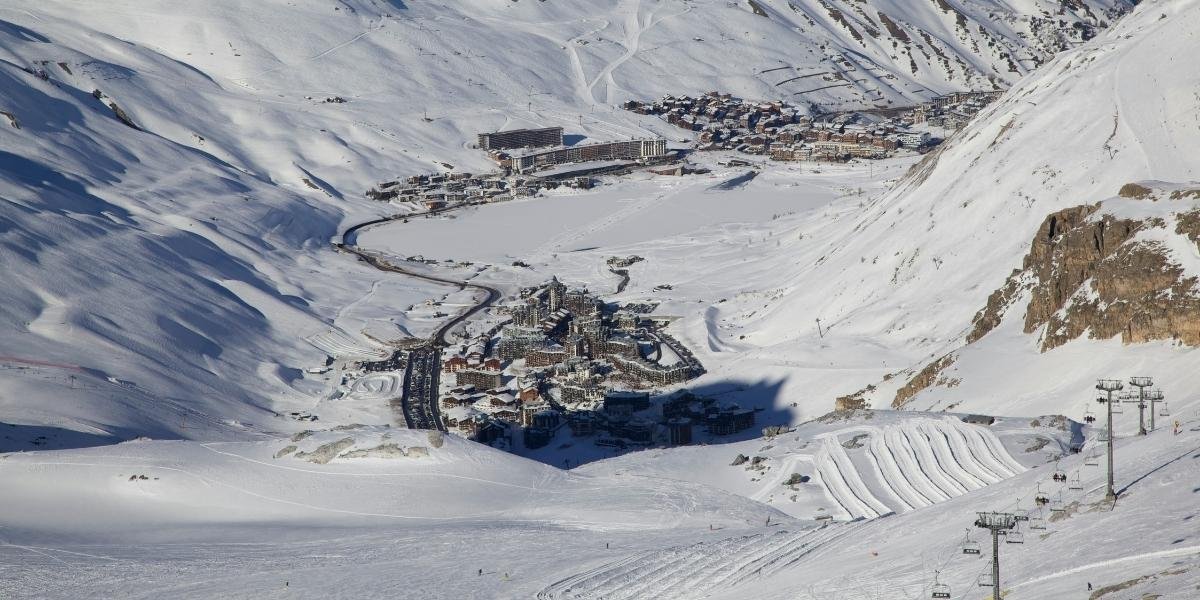
In April 1967, after the French government’s first Plan Neige opened the Tarentaise valley to large-scale winter sports investment, the Savoie department handed the development of Tignes to a young Schnebelen. The original village had been submerged a decade and a half earlier by the waters of the Tignes dam, and the displaced community had been quietly laying the foundations for a new ski resort at altitude. Schnebelen took on what had been a fragmented project, with two lift companies already collapsed, and gave it a coherent design philosophy.
That philosophy, radical at the time, was deceptively simple: ski-in, ski-out. The accommodation, the lifts, and the pistes were to be interpenetrated, not separated. Le Lavachet was laid out from 1965 on that principle. Val Claret, on the other side of the lake at the foot of the Grande Motte, followed shortly afterward.
Moving People up the Mountain
If the village layout was Schnebelen’s first revolution, uphill transport was his second, and arguably the more consequential.

The two-stage gondola onto the Grande Motte was completed in 1967, opening high-altitude terrain that had previously been the preserve of mountaineers. It was a piece of mountain engineering that other resorts spent the next two decades trying to emulate. Nine years later, in 1976, the Grande Motte cable car followed, reaching 3,456 meters. It was, at the time, one of the most ambitious lift installations in Europe, and the lift that gave Tignes its enduring identity as a glacier resort with skiing into the summer months.
The underlying preoccupation, throughout, was throughput. The early ski resorts of the 1950s had been built around drag lifts and single-stage gondolas with modest hourly capacities; getting a few thousand skiers up a mountain in a working day was a challenge that often defined a resort’s commercial viability. Schnebelen’s design instinct, visible at Tignes and carried into his subsequent work at Val Thorens, was to move people quickly, in volume, and across more vertical meters per ride. Multi-stage gondolas, high-altitude cable cars, and the later integration of funicular and high-capacity lift systems were the engineering vocabulary he helped establish as the European standard.
Val Thorens itself began life as his idea, opening in December 1971 with just three drag lifts before growing, decade by decade, into the highest ski resort in Europe, with more than 600 kilometers of linked pistes and around 160 lifts across the Three Valleys system.
The Helicopter at Tignes
It was Schnebelen’s earlier military life that produced one of Tignes’s more distinctive features: the integration of helicopter operations into resort life.
He brought to the Alps the practical knowledge of how helicopters performed in high-mountain conditions: what they could carry, where they could safely land, and how weather and altitude affected the calculations. The result was a resort in which helicopters became part of the operational picture, for the transport of construction materials to lift stations otherwise unreachable in winter, for mountain rescue, and, in time, for the carefully regulated heli-access skiing that became one of Tignes’ signature offerings.

Dr. Eric Balki takes Pierre Schnebelen flying in a helicopter again in an R44
The commercial origins of recreational heliskiing belong to Canada in the mid-1960s. What Schnebelen contributed at Tignes was its safe and orderly adaptation to European mountain conditions: the protocols, the landing zones, the relationships with the mountain guide community, and a culture of helicopter operations embedded in the resort’s working life. When the French loi Montagne of 1985 banned recreational heliskiing drop-offs on French soil, Tignes had already developed the institutional knowledge that allowed it to remain one of the principal launching points for heli-supported mountain skiing in the wider Alpine region.
A Template That Shaped an Industry
The Schnebelen template, integrated lift design, ski-in/ski-out access, purpose-built mountain villages, and high-capacity uphill transport, became, over the following half-century, the working model for purpose-built Alpine resorts from the French Tarentaise to the Italian Alps and far beyond. It is difficult to walk through a modern ski village anywhere in Europe without encountering a descendant of the Tignes blueprint.
The economic consequences have been considerable. The French ski industry is by some distance the world’s largest by skier-days, supporting an estimated 120,000 direct and indirect jobs across the Tarentaise, the Maurienne, the Trois Vallées, and beyond. Entire valley communities, many of them facing terminal decline before the snow-sports boom, were rebuilt around the model Schnebelen helped pioneer. Generations of families have made their living from it. Resorts in Switzerland, Austria, Italy, the United States, and Canada have absorbed and adapted his ideas, often without knowing whose ideas they were.
The Harder Part of the Story
Schnebelen’s career was not, and is not portrayed in the interview as, an uncomplicated triumph. The Tignes story includes the fatal avalanches of 1970, which led his principal financier, the Suez bank, to take control of much of the resort’s apartment stock. There was a fractious relationship with the Commune over the scale of his authority. There were the wider financial pressures that engulfed almost every French ski resort in the years that followed. His original development company eventually collapsed. Tignes was restructured, with the lift operation made independent of commercial development and brought under stronger municipal oversight.
It is that part of the story, the part the brochures tend to skip, that the project most wanted to record. Anyone can write the founding myth. What is more useful to the next generation of builders is the part of the story where it nearly did not work and what the builder learned from it.
The Interviewer
McGarry was approved for the assignment by Dr. Balki’s team in part for the unusual combination he brings to a project of this kind: a long career in long-form media, including senior roles at Endemol and Joost before he founded Jumpwire Media in 2009; a strong technical fluency in engineering and infrastructure subject matter; and, not incidentally, a personal grounding in skiing and Alpine travel. Interviewing the architect of a ski resort on lift design, structural choices, and avalanche risk is not a job that translates well to a generalist.
Los Angeles, where McGarry is based and where the interview was conducted, also proved a convenient setting for Schnebelen himself. His business interests have brought him regularly to the United States since the 1990s, and he has long kept a home in the Los Angeles area.
Why This Matters for Resort Development Now
The model Schnebelen helped build is under strain. Climate variability is moving the snow line. The economics of low-altitude resorts are tightening. Planning consent for major new lift infrastructure is harder to obtain than at any point in the last half-century. Operators from the Alps to the Rockies to the Caucasus are asking, often with genuine urgency, what comes next.
In that context, the interview is not nostalgia. It is primary source material. Schnebelen lived through a different kind of crisis in the 1970s, when avalanche risk, financial collapse, and political pressure converged on his own resort. The interview is understood to devote substantial time to that period: what he understood about it then, what he understands about it now, and what he would say to a developer facing the equivalent set of pressures in 2026.
Dr. Balki, whose TriPyramid Group operates across technology, healthcare, and resort development, has spoken about the wider purpose of preserving such testimony. “If we do not record the reasoning of the people who actually built these things, not just what they built, but why they made the choices they made, that knowledge dies with them,” he has said in remarks shared with the project. “My hope is that what we capture now will allow future generations to remember the pioneers who made it possible.”
Release Plans
The Schnebelen interview is intended to form part of a forthcoming documentary on the French ski industry, currently in post-production and provisionally scheduled for release in early 2027.
For an industry that has spent six decades building on foundations Schnebelen helped lay, the chance to hear him explain those foundations in his own words, including the parts that did not work, may prove to be one of the more useful things produced about ski-resort development in a long time.