By: Jonah Vale
Robin Brown did not set out to build a fashion brand. She set out to survive. That the two things became the same, her survival and her brand, is what makes Magnolia Pearl one of the more remarkable stories American fashion has produced in the past two decades. From a kitchen table in Fredericksburg, Texas, where Brown hand-stitched a backpack from a Last Supper tapestry and kite string, the label has grown into a global presence worn by household names, coveted by collectors, and quietly funding causes most brands would never touch.
When Stars Wear Something Without Being Asked
Taylor Swift wore Magnolia Pearl during the folklore and evermore period. Whoopi Goldberg has worn it on television. Blake Lively has worn it on screen. Daryl Hannah has worn it at climate events. None of these were paid placements. Celebrity endorsement arrived entirely organically, drawn by the clothes themselves rather than a marketing budget.
That pattern says something worth examining. Most luxury brands spend significantly to place their pieces on famous bodies. Magnolia Pearl spends nothing on that effort, and yet the list of names associated with it keeps growing.
The brand’s licensed alliances are unusual in their depth. Rather than attaching a famous name to a logo, Magnolia Pearl and its collaborators reimagine creative catalogues together. The result is clothing that carries the weight of two distinct legacies, and commands a price on both the primary and secondary market to match.
The Resale Numbers Tell Their Own Story
Pieces from the brand often resell for substantially more than their original retail price. That is not typical behavior for fashion garments. By comparison, data from major resale platforms indicates that most premium apparel loses 60 to 80 percent of its retail value within twelve months. Magnolia Pearl runs in the opposite direction, with earlier production runs often fetching higher premiums precisely because they are older and more worn.
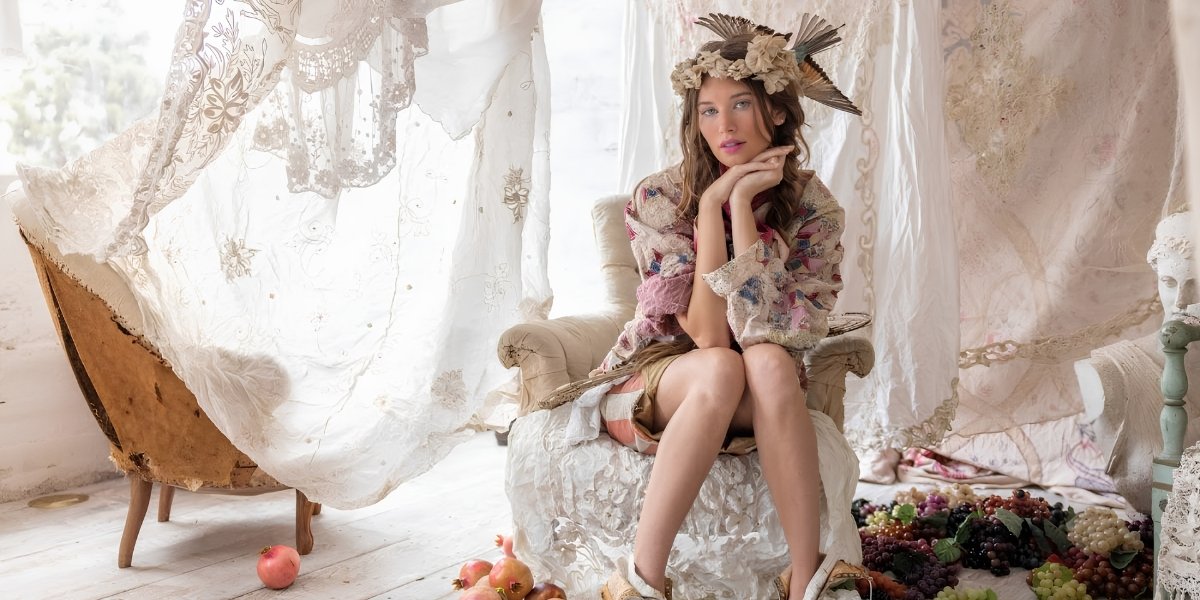
The mechanics behind this are structural rather than accidental. Production is deliberately small-batch, the design vocabulary stays stable rather than chasing seasonal trends, and every garment is finished by hand, meaning no two pieces are ever identical. Because the clothes are intentionally distressed and visibly mended from the start, the ordinary wear that depresses value elsewhere actually deepens it here. A jacket that has been lived in is not diminished; it is more fully itself.
In 2023, Brown launched Magnolia Pearl Trade, the brand’s own authenticated resale platform. Collectors list pre-loved pieces, bid on others, and access rare samples and long-sold-out garments unavailable elsewhere. The platform charges a fee rate that is significantly lower than typical online resale sites, and all of those fees go directly to charity.
Giving Built Into the Transaction
The Magnolia Pearl Peace Warrior Foundation, established in 2020 as a registered 501(c)(3) nonprofit, reports having raised over $550,000 to date for causes ranging from permanent housing for Indigenous American veterans and medical care for people experiencing homelessness, to arts education for children in Brooklyn and wildfire relief along the California coast. Twenty-five percent of proceeds from exclusive Magnolia Pearl listings on the resale platform flow directly to the Foundation, as does 100 percent of third-party seller fees.
What distinguishes this from conventional corporate philanthropy is its architecture. Rather than treating generosity as a separate line item, the brand has woven giving into the transaction itself, so that every resale, every bid, and every fee collected moves money toward a vetted cause. Brown has spoken plainly about why: “Having been hungry, it’s always been my prayer to feed people.”
Brown grew up in poverty, raised two siblings while still a child, and experienced homelessness firsthand, and that biography is not incidental to Magnolia Pearl’s mission; it is the mission. The visible mend, the hand-stitched patch, and the fragment of reclaimed fabric worked into something new each carry the logic of a woman who learned early that nothing worth having gets discarded, and nothing broken stays that way forever.