
Consider the owner of a physical therapy clinic somewhere in Los Angeles, looking at a thin appointment book on a Friday afternoon and deciding the market has cooled. Budgets are tight, the thinking goes, and the phones will pick up when things turn.
That same week, people a mile away searched for exactly what the clinic offers. One booked a competitor straight from the map. Another filled out a form on a directory site that passed the inquiry to someone else. A third called after hours, reached voicemail, and never tried again. The local demand was there. It simply never arrived, and that gap explains more about why local businesses lose customers than most owners assume.
The Demand Is There. The Customers Aren’t.
Demand and revenue are easy to confuse because owners usually see only one. Revenue shows up in the bank account. Demand shows up in search activity the business never sees. Rio SEO’s 2025 consumer behavior study, which surveyed more than 1,000 US consumers, found that 84% search online for local businesses every day.
A slow week and a steady stream of local-service searches can coexist.
Where the Search Goes Instead
Economists use the term “retail leakage” to describe local spending that flows out of a community to businesses elsewhere. Search demand leaks similarly, and the first leak is visibility.
When someone searches for a plumber, a dentist, or a tutor, only a handful of businesses appear at the top, usually on a map with ratings beside them. Google’s own explanation of how local results are ranked says they rest on relevance (how well a business matches the search), distance, and prominence. Prominence means how well-known the business is, based partly on reviews and what appears about it across the web. Google also notes that it may rank a business farther away above a closer one if it appears to be a better match.
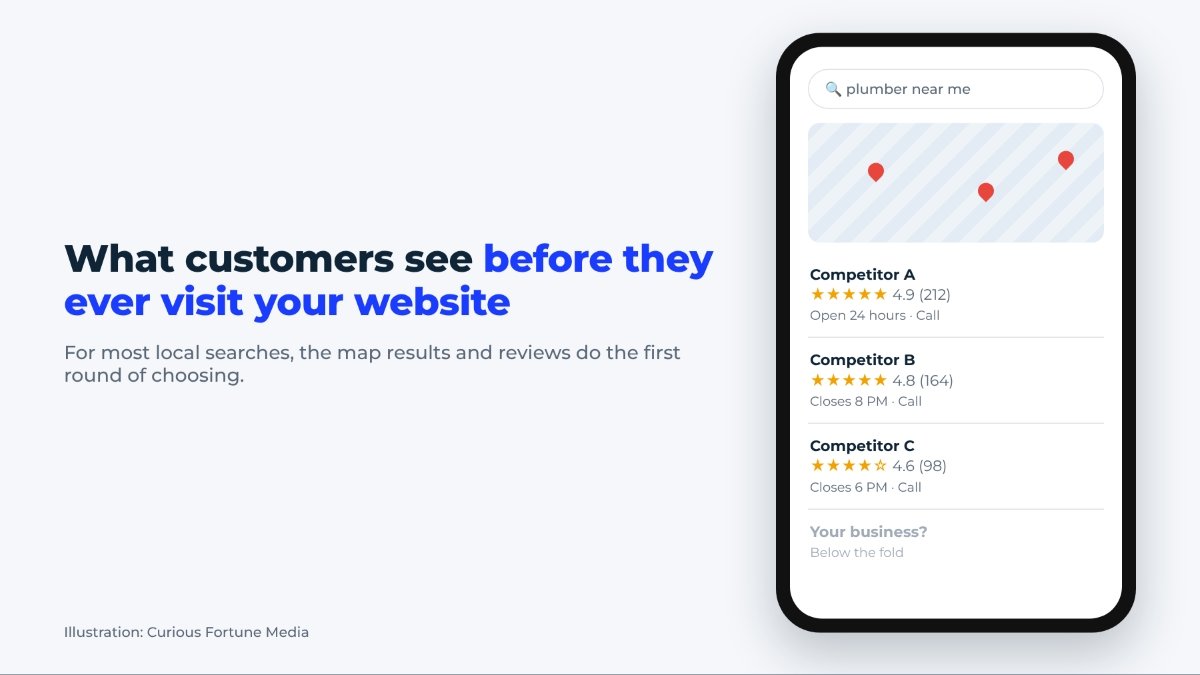
A business with thin or incomplete information can sit a few blocks away and never appear. People searching for local services then land with a nearby competitor, or on a directory or lead marketplace that collects the inquiry and passes it along to another business. The customer still gets served. The business that could have served them never hears about it.
Edmond Abramyan, founder of Curious Fortune Media, says owners often misdiagnose their problem.
“When the phone goes quiet, most owners assume people stopped looking. Usually they didn’t. They’re still searching, and the search is ending somewhere else,” Abramyan says. “That’s a visibility problem, not a demand problem, and you can’t solve it by waiting for the market to turn.”
Culver City Shows Where Demand Slips Away
Culver City makes the pattern easy to see. It is a compact city with a busy daytime population, with office workers filling the Hayden Tract and Downtown Culver City and residents moving along the Washington Boulevard corridor. Clinics, dentists, repair trades, and fitness studios compete within a few blocks of one another, so proximity separates almost no one.
Abramyan’s firm is an agency that works with local service businesses, and the gap it most often sees in markets like Culver City is between a business’s in-person reputation and its presence in the searches customers actually run. A practice with loyal clients and strong word of mouth can still lose new customers to a competitor that simply shows up more clearly.
Found, Trusted, Then Ignored
Being seen is only the first test. A customer who finds a business still checks whether it looks trustworthy, and thin online reviews, outdated hours, or a confusing website are often enough to send them to the next listing. The Rio SEO research found that 53% of consumers say inaccurate listings will drive them away.
The last leak is the easiest to avoid. Missed calls and slow response times cost businesses customers who had already decided to reach out. In a 2011 Harvard Business Review study, researchers sent test inquiries through the websites of 2,241 US companies across many industries. Only 37% responded within an hour, and 23% never responded.

“The customer I worry about most isn’t the one who never found you. It’s the one who found you, trusted you enough to call, and got the voicemail,” Abramyan says. “After-hours calls and forms nobody checks until Monday don’t just sit there. They go to whoever answers first.”
Abramyan developed the Authority Engine™ for Curious Fortune Media with these leaks in mind: visibility addresses the business that never appears, authority the one that loses trust on a closer look, and conversion the call that ends in voicemail, so all three are handled as one connected problem rather than three separate fixes.
What Owners Can Check Before Blaming the Market
Most of these leaks can be spotted at no cost. An owner can search for the service, not the business name, on a phone like a stranger would and see who appears. Calling the business’s own number after closing time shows what an evening caller hears. Sending an inquiry through the website and timing the reply shows how long a ready customer has to wait. Asking every new customer how they found the business reveals which paths are working and which have gone quiet.
None of this rules out a real slowdown. Downturns and slow seasons happen, and not every quiet month is a leak. Checking must come before concluding.
The clinic owner from Friday afternoon may be right that the market has softened. The week’s customers may have been searching and never got through. For many local businesses, the gap isn’t between them and the market. It’s between the search and the front door, at the three points where a customer has to find the business, believe it, and get an answer. Before deciding demand has dried up, ask a more useful question: what does a stranger find when they look for the business tonight?