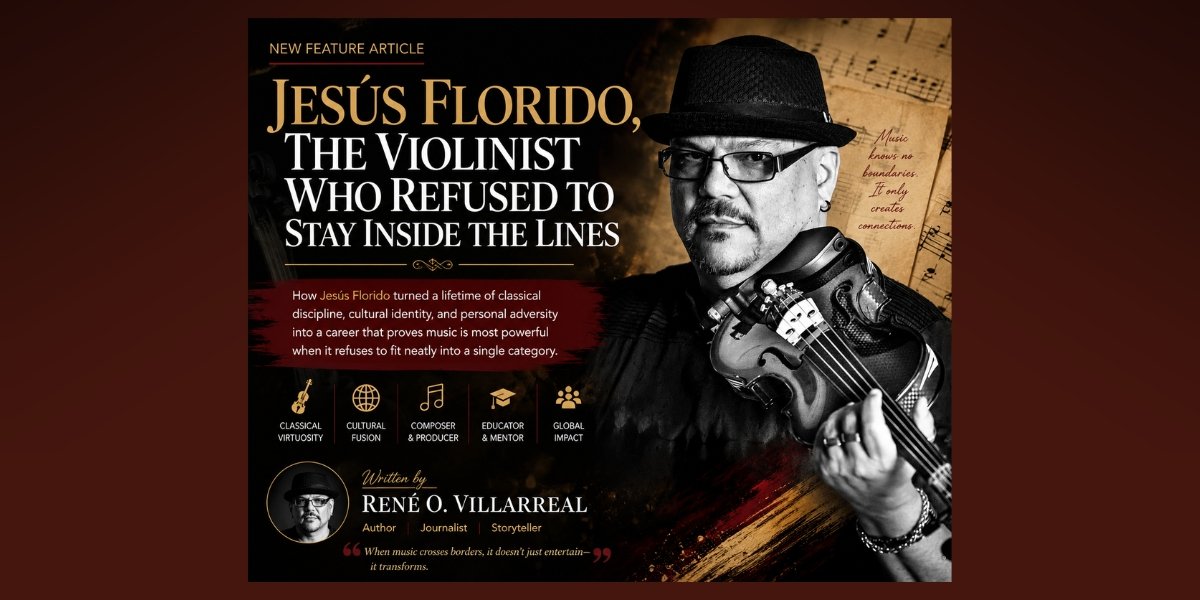
How Jesús Florido turned a lifetime of classical discipline, cultural identity, and personal adversity into a career that proves music is most powerful when it refuses to fit neatly into a single category.
Every generation produces artists who master a tradition. Far fewer possess the courage to challenge one. For more than four decades, Jesús Florido has built a career that exists comfortably between worlds. Classical virtuosity and improvisational freedom, European precision and Latin soul, concert halls and recording studios, education and performance. The Venezuelan-American violinist, composer, producer, and educator has never viewed genres as boundaries. Instead, he treats them as conversations waiting to happen.
That philosophy may explain why Jesús’s résumé reads less like the career of a traditional violinist and more like a map of contemporary music itself. His performances have brought him alongside icons as varied as Whitney Houston, Jimmy Page, Robert Plant, Yo-Yo Ma, and Mark O’Connor. His work stretches from chamber music to film scoring, studio recording to international clinics, Grammy-winning collaborations to Latin Grammy-nominated productions. Yet beneath the accolades lies something surprisingly uncomplicated: an artist fascinated by connection. Connection, after all, was where everything began.
Born in Barquisimeto, Venezuela, he grew up in a household where music wasn’t treated as a luxury but as a language. His childhood coincided with the earliest years of El Sistema, Venezuela’s revolutionary youth orchestra movement founded by José Antonio Abreu. As one of its founding participants, he experienced firsthand the transformative power of accessible music education. A lesson that would shape nearly every chapter of his professional life.
Many musicians spend years perfecting technique before discovering their artistic identity. His identity emerged alongside his technique. Classical training provided discipline, but Latin rhythms, Afro-Cuban traditions, jazz improvisation, rock energy, and folk storytelling offered something equally important: freedom. Rather than choosing one musical language, he became fluent in several.
That multilingual artistry became increasingly evident after moving to the United States in 1989, where advanced studies at Indiana University and Butler University expanded both his technical mastery and compositional vision. A crucial masterclass with Pulitzer Prize-winning composer John Corigliano sparked a fascination with writing for film, opening yet another creative avenue that would later include composing for visual media while continuing his work as a sought-after session musician. Perhaps the defining characteristic of his career has been his refusal to separate artistic excellence from cultural authenticity.
When acclaimed American violinist Mark O’Connor recognized his unique command of Latin improvisation, he invited him to teach Latin-style fiddling and bestowed the nickname that would become synonymous with his artistic brand: Latinfiddler. It wasn’t merely a memorable stage name. It represented an entire philosophy. Rather than adapting his heritage to fit established traditions, he brought his heritage into those traditions, expanding them from within.
That same mindset would shape projects like Heading North, an instrumental album weaving together jazz, classical music, Latin grooves, progressive rock, and world influences without apology or compromise. The record doesn’t attempt to erase stylistic differences. Instead, it demonstrates how those differences can coexist to create something unexpectedly cohesive. Perhaps that’s why Jesús Florido’s concerts have earned a reputation for intimacy despite their technical sophistication.
He has often described wanting audiences to feel as though he is performing in their own living room rather than on a distant stage. It’s an unusually democratic vision of performance. One where virtuosity serves communication rather than spectacle. That accessibility extends naturally into his educational work, where workshops, mentorships, and advocacy for culturally inclusive music curricula have become as central to his legacy as any concert appearance. His conviction remains unwavering: music belongs in every child’s development, regardless of geography or economic circumstance. In an era when specialization often defines artistic careers, he offers a compelling alternative.
He is simultaneously a performer and producer, an educator and entrepreneur, classical musician and crossover artist. None of those identities compete; they reinforce one another. Each performance informs his teaching. Each student influences their compositions. Each collaboration broadens his understanding of culture itself.
The result is not simply an accomplished career, but an enduring philosophy that music is strongest when it welcomes every influence, every tradition, and every listener. For Jesús Florido, the violin has never been confined to one stage, one genre, or one audience. It has always been a passport.