Large-format wooden sculpture has gained renewed attention in contemporary art as artists revisit traditional materials while applying modern structural logic. Across museums and independent galleries, this field has shown steady growth, with increasing interest in works that rely on precise construction and mathematical visual order. Institutions in the United States have noted a rising presence of geometric abstraction within handcrafted wooden forms, reflecting a broader shift away from purely ornamental woodworking toward conceptual structure. Within this environment, Jeff Robinson has emerged as a practitioner whose large-scale works illustrate the intersection between disciplined construction and formal design. His approach reflects a slow, methodical process that aligns with contemporary expectations of material-based fine art.
Following his relocation to Dallas, Texas, in 2010, Jeff Robinson initiated a new phase of artistic production centered on wood sculpture. The first completed example was produced in early 2011, marking a clear shift from functional furniture into standalone sculptural form. Unlike earlier work rooted in practical design, this phase centered on visual structure and spatial presence. Robinson employed a process that required between 300 and 500 hours per work, a statistic that underscores the sustained labor and planning embedded in each construction. His sculptures are intentionally large in scale, occupying visual and physical space with defined geometric clarity rather than decorative effect.
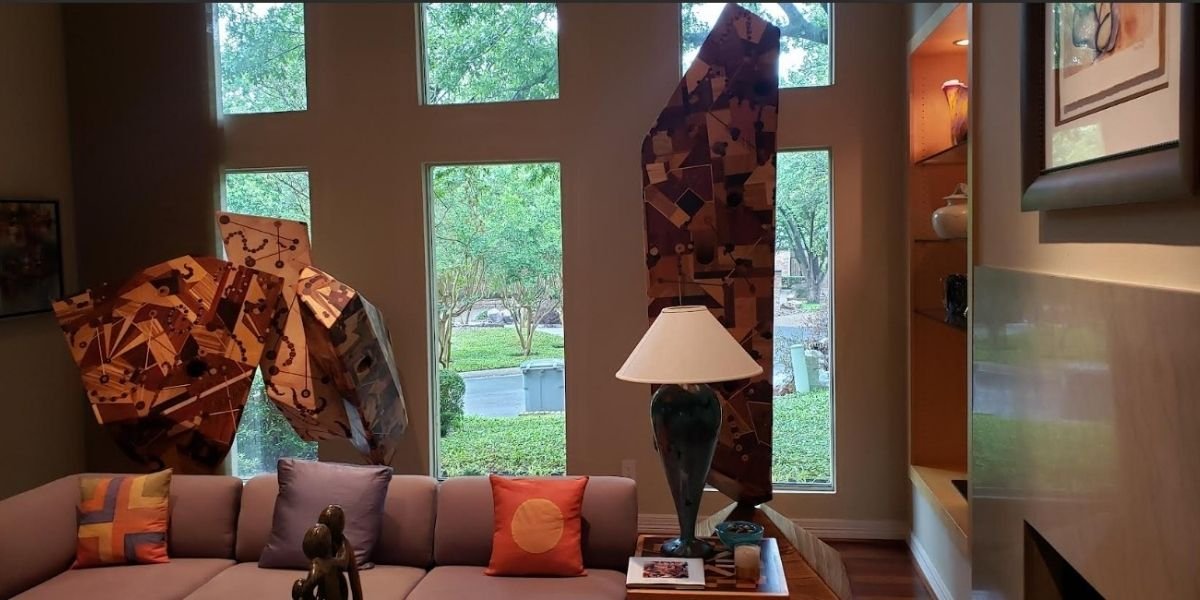
Robinson’s method involves assembling hundreds to thousands of individual hardwood segments into unified compositions. These elements vary in size, form, and grain, and are carefully placed to create repeating visual patterns across the surface. The material selection draws from hardwood sources in North America, South America, Central America, and Africa. Woods such as Purpleheart, Wenge, Zebrawood, Lacewood, Bocote, Canarywood, Maple, and Walnut appear consistently in these works. No stains or chemical colorants are used. The tonal range and contrast emerge solely from natural wood variation, reinforcing a direct relationship between material and visual outcome.
The overall structure of these sculptures typically features a patterned upper mass positioned on a pyramidal base. This configuration introduces a calculated sense of tension, as the upper form appears to hover or balance at a narrow contact point. The visual logic suggests instability while maintaining structural integrity through internal engineering. The design choice reflects Robinson’s ongoing interest in spatial perception and viewer response. While the external surface is physically solid, the illusion of imbalance compels audience attention toward both form and spatial alignment, establishing a subtle dialogue between gravity, weight, and visual interpretation.
A recurring design element in Robinson’s sculptural practice is the presence of tunnels that pass completely through the form. These openings allow ambient light to flow across interior surfaces, altering perception based on the viewer’s position and the surrounding environment. Light penetration transforms each sculpture throughout the day, shifting shadows and reflections as conditions change. This reflects a continuity with his early background in ceramics, where surface pattern and glazing previously shaped visual composition. Although the material differs, the influence remains visible in the controlled placement of repeating forms and contrasts.
Robinson’s early ceramic experience informs the disciplined planning required for his current construction methods. Years spent developing precision through clay and glaze techniques contributed to a procedural mindset now applied to hardwood assembly. In sculpture, this translates into a systematic layering process, with each segment positioned to maintain order within complex patterned arrangements. The method reveals a transition from two-dimensional surface decoration into three-dimensional spatial construction. Rather than replicating ceramic aesthetics, Robinson converts earlier visual principles into structural frameworks that remain grounded in material authenticity.
The professional visibility of these sculptures expanded through inclusion in recognized exhibitions across Texas. His work appeared at the Museum of Geometric and MADI Art in Dallas during the 2014 exhibition period and again in the 2015 Biennial. Further inclusion occurred in the 2021 Biennial, where his work Sculpture IX received second place in the Best in Show category. Additional showings at the Wall Gallery in Dallas in 2017 and Arts Fort Worth in 2023 positioned his work within curated environments that emphasized modern geometric art. These presentations documented the evolving scope of his practice.
The artistic identity represented through Robinson’s sculptural output situates his work within a study of form, repetition, and material integrity. Unlike transient trends, his process remains consistent and rooted in methodical execution. Each sculpture acknowledges structural discipline while allowing organic variation through natural grain pattern and tonal shifts. By sustaining deliberate construction and avoiding mass production methods, Robinson maintains a focused professional output that aligns with contemporary dialogues around handcrafted art and intentional slow creation.
In reviewing the sculptural career beginning in 2011, it is evident that Robinson’s work reflects a careful evolution from earlier disciplines toward a defined visual language. The combination of geometric surface order, natural wood coloration, and controlled spatial placement defines a sustained professional narrative. This body of work remains a measurable contribution to modern American wood sculpture, shaped by experience, discipline, and continuity. The artistic practice presented by Jeff Robinson will likely continue to demonstrate the calculated progression of material-driven form within contemporary visual culture, grounded firmly in technical precision and sustained artistic intent.