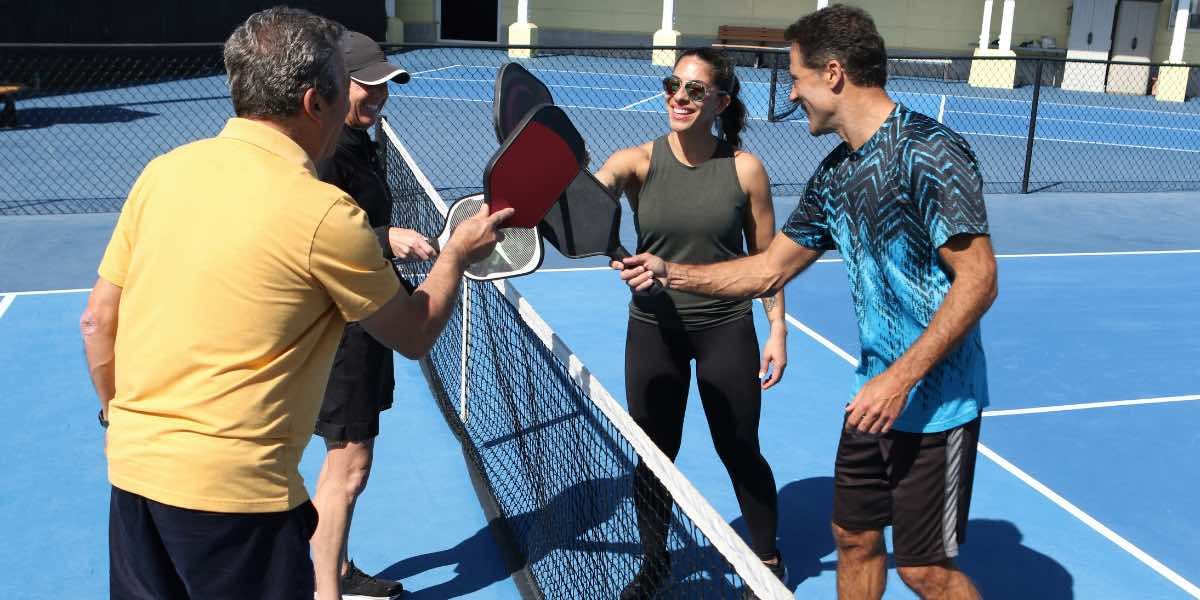
A sport invented with a wiffle ball and plywood paddles on a backyard badminton court in 1965 has become the fastest-growing athletic activity in the United States for four consecutive years. Pickleball now claims 24.3 million American players, according to the Sports & Fitness Industry Association — a 479% increase since 2020 and a figure that, for the first time, surpasses tennis in total U.S. participation. The trajectory has moved well past novelty. What started as a retirement-community staple has reshaped municipal recreation budgets, attracted hundreds of millions in institutional investment, and fundamentally altered the demographics of who picks up a paddle in the United States.
The Retirement Sport Myth Is Over
The single most significant shift in pickleball’s identity over the past five years has been its age profile. The average player is now 34.8 years old, down from 41 in 2020. The 25-to-34 age bracket represents the sport’s largest segment at 16.7% of all participants, placing the center of gravity firmly in the millennial generation. Adults 65 and older still account for 15.4% of the player base — a substantial and growing cohort — but they are no longer the sport’s demographic core.
That shift matters because it changes the economics. Younger players spend differently. They join leagues, subscribe to coaching platforms, buy premium paddles, and drive the kind of recurring facility revenue that justifies large-scale construction. The median household income of a U.S. pickleball player sits at roughly $112,000, an upper-middle-class skew that has attracted corporate sponsors, real estate developers, and franchise operators who see a consumer base with disposable income and a demonstrated willingness to spend it.
Gender distribution has also been narrowing. The current split is 57% male and 43% female, and several international markets — France, notably — report that nearly half of all new licensees are women. The sport’s social format, lower physical barrier to entry compared to tennis or basketball, and the proliferation of women-focused leagues and clinics have made pickleball unusually effective at drawing female participants into competitive play.
Infrastructure That Builds Itself
The court construction numbers provide the clearest evidence that pickleball’s growth is structural, not speculative. The USA Pickleball database now tracks 82,613 courts across 18,258 locations nationwide. Over 14,155 new courts were added in a single year — roughly 39 new courts per day. Florida leads the country with 1,071 pickleball locations, followed closely by California at 1,048.
Much of that expansion has come at tennis’s direct expense. More than 4,000 tennis courts have been fully or partially converted to pickleball since 2021. A standard pickleball court fits inside a tennis court with room to spare, which means any tennis facility can add pickleball capacity without significant construction costs. That size advantage has allowed pickleball infrastructure to scale faster and cheaper than almost any comparable sport, and municipal parks departments — facing pressure from residents who want courts — have responded accordingly.
Private investment has accelerated the buildout further. Indoor pickleball facilities, which command higher hourly rates and are less weather-dependent, represent the fastest-growing segment of the market. Cities like Seattle alone have seen nine new facilities and nearly 150 courts open in the 2025–2026 window. Developers are treating dedicated pickleball centers the way they once treated boutique fitness studios: as anchor tenants in mixed-use retail environments designed to generate foot traffic.
A Multibillion-Dollar Industry Takes Shape
The financial footprint of pickleball now extends well beyond paddle sales. The U.S. pickleball equipment and apparel market is estimated at $2.3 billion, and total industry revenue — encompassing facilities, tourism, coaching, events, and media — is approaching $5 billion. USA Pickleball approved 718 new paddles and 193 new manufacturers in 2025 alone, reflecting a supply side that is scaling rapidly to match demand.
The professional tier is maturing in parallel. Combined prize money across the three major U.S. tours — the Professional Pickleball Association, the Association of Pickleball Players, and team-based Major League Pickleball — now exceeds $15 million annually. MLP’s ticket revenue grew 122% year over year in 2025, with attendance up 57%. The 2025 USA Pickleball National Championships drew competitors from 47 states and 20 countries, generating an estimated $3 million in local economic impact.
The international pipeline is opening as well. The International Pickleball Federation now counts 78 member countries, meeting the International Olympic Committee’s threshold for consideration. Olympic inclusion remains a long-term ambition — the earliest realistic window is the 2032 Brisbane Games, with 2036 considered more probable — but the organizational infrastructure is being built now. The PPA Tour has announced international events across Australia, India, Canada, and Asia, and a Global Professional Alliance formed in 2026 is coordinating more than 30 international tournaments to avoid scheduling conflicts.
What Sustains The Momentum
The question that has followed pickleball since its breakout years is whether the growth curve will flatten. The annual rate has naturally decelerated from the 50%-plus surges of 2021 and 2022 to a steadier 15–20% range — a shift that analysts view as a sign of healthy maturation rather than a ceiling. Core players, defined as those who play eight or more times per year, are growing faster than overall participation, which indicates strong retention rather than a revolving door of one-time curiosity players.
The sport’s accessibility remains its foundational advantage. Pickleball can be learned in a single session, played competitively by athletes of widely varying fitness levels, and accommodated on infrastructure that costs a fraction of what a regulation tennis facility or basketball court requires. That combination of low entry barriers, high social engagement, and scalable infrastructure has created a growth engine that municipal recreation departments, private operators, and professional leagues are all building around simultaneously.
Whether pickleball sustains its current trajectory or stabilizes into a mature participation sport alongside tennis and golf, its impact on American recreation is no longer provisional. The courts are built. The money is deployed. The players are younger than the stereotype ever suggested. The sport that began with a wiffle ball on Bainbridge Island has become something its inventors never anticipated: an industry.