By: Bobby Chrisman
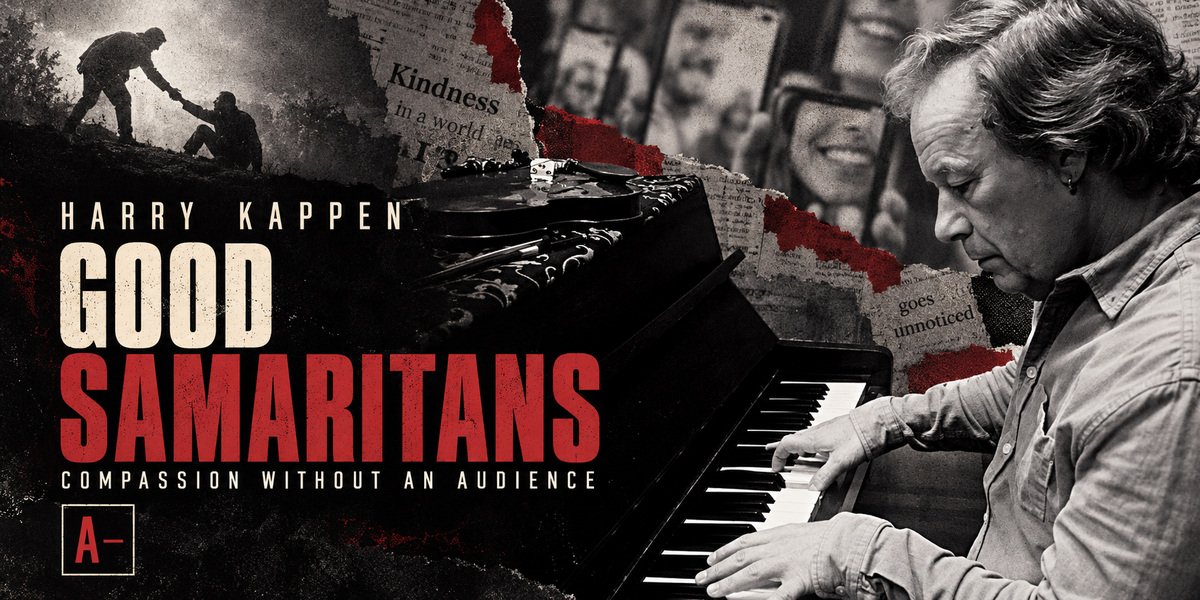
Harry Kappen has identified one of modern life’s more dependable absurdities: the louder people advertise their humanity, the less likely they are to practice it when doing so becomes inconvenient. “Good Samaritans,” a muscular rock track from his album After the Crossing, is aimed squarely at that contradiction. Its heroes are not costumed saviors, motivational celebrities, or influencers broadcasting charitable impulses between sponsored posts. They are ordinary people who stop, help, and remain present after everyone else has walked away.
Subtle? Not especially. Necessary? More than the subtle-minded might care to admit.
Kappen opens by surveying a digital marketplace where happiness is packaged, pain is filtered, and personal fulfillment is sold with the confidence of a miracle cure. “Flashy words for every soul,” he sings, before presenting the great commercial promise of the online age: buy the dream and you will become whole. The language is deliberately familiar because we encounter some version of it every time we unlock a phone.
The target is not technology itself. Kappen is too experienced with human behavior to blame the machine for everything people choose to do with it. The problem is vanity disguised as connection. “Every story filters pain,” he observes, reducing the modern social feed to its essential function: transforming messy lives into attractive narratives. Tears become champagne. Sunsets are sculpted. Smiles are manufactured. Nobody sweats, slows down, or admits that perfection requires a production crew.
Kappen answers this spectacle with the Good Samaritan, an unfashionable figure precisely because kindness is the one thing being offered without a sales pitch. These people stop in the rain, share another person’s pain, and act correctly without expecting applause. They are “unseen” and “never trending,” which may be Kappen’s sharpest observation. The algorithm rewards emotional display. Actual compassion is often too quiet, complicated, and time-consuming to perform well online.
Fortunately, Kappen understands that a moral argument needs more than admirable intentions. “Good Samaritans” is a rock song first, and it carries enough force to prevent its message from shrinking into an inspirational poster. The rhythm drives forward with purpose, the arrangement has weight, and the chorus opens the track rather than merely repeating its thesis. Kappen performed, sang, and produced the recording himself, giving the music the focused character of a personal statement.
Mexican vocalist Danna Gomez joins him in the choruses, and her presence matters. The additional voice turns Kappen’s declaration into something closer to a public response. Compassion, after all, is not particularly useful as a solitary identity. It requires another person, a shared burden, and preferably some action.
Kappen has called “Good Samaritans,” like the earlier single “Distant Shore,” a musical nod to David Bowie. This does not mean he spends the track rummaging through Bowie’s wardrobe. The connection is conceptual as much as sonic. Bowie understood spectacle, identity, and the strange places where theatrical surfaces reveal uncomfortable truths. Kappen uses rock drama to interrogate a society that mistakes polished presentation for moral substance.
His background gives that interrogation credibility. Before turning more fully toward his recording career, Kappen worked in youth care as a music therapist for more than two decades and taught in an international master’s program devoted to music therapy. He has seen music function outside the applause economy, helping people communicate, connect, and endure. When he praises those who remain beside someone in pain, he is not merely selecting a socially responsible topic. He is writing from professional and personal experience.
That history also helps explain why the song avoids hopelessness. Kappen criticizes the culture without surrendering to the critic’s favorite luxury: contempt for everybody living in it. His lyrics may mock plastic smiles and vacant self-promotion, but the chorus insists that decent people still exist. They simply receive less attention than the performers.
The song’s weakest moments are inseparable from its strength. Kappen’s message is unmistakable, and listeners who demand ambiguity may find little room for interpretive wandering. Yet vagueness would hardly improve a song built around moral urgency. When someone is lying in the road, the useful response is not an elegantly complicated theory of assistance. It is stopping.
After the Crossing was recorded following Kappen’s move from the Netherlands to Mexico, and its title suggests a geographic and creative passage. “Good Samaritans” extends that idea into ethical territory. It asks listeners to cross the distance between professing concern and demonstrating it. That distance may appear small, but most societies have constructed entire industries to help people avoid traveling it.
Kappen closes by stripping heroism of its traditional accessories. These saints do not wear capes. They have no crowns, no special lighting, and no carefully planned angles. They choose to stay.
In an era when goodness is too often treated as content, “Good Samaritans” makes a persuasive case for compassion without witnesses. The record is direct, tuneful, muscular, and sincere enough to risk looking unfashionable. That risk is part of its value.