There are some family stories that disappear with time. Others become more valuable with every generation that passes.
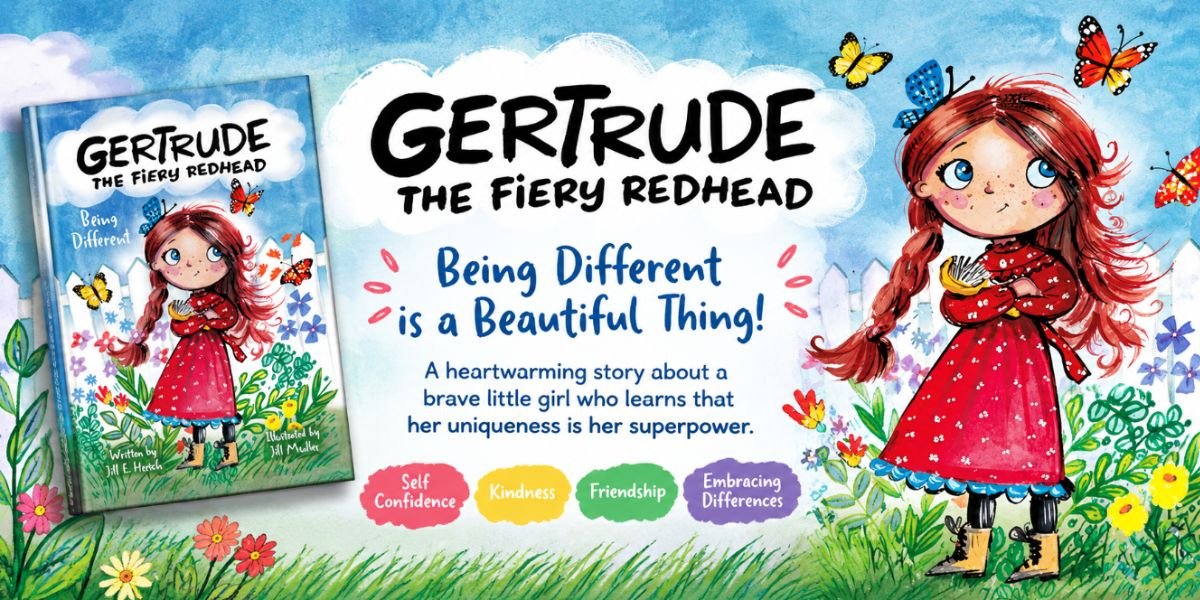
Gertrude the Fiery Redhead: Being Different, written by Jill E. Hersch and illustrated by Jill Muller, belongs firmly to the second category.
Inspired by the author’s own family history, the book reaches backward to the turn of the twentieth century to tell the story of Gertrude, a girl born in 1897 into a coal-mining community where conformity mattered, family reputation carried weight, and being visibly different could make a child the subject of constant attention. The book itself notes that it is based on true events from the author’s family history, with some names, details, and dialogue adapted or reimagined for narrative purposes.
At the center of the story is a deceptively simple question: What happens when a child does not look, behave, or fit into the family she was born into?
For Gertrude, the answer becomes the story of a lifetime.
A Redhead in a Family of Blondes
Gertrude’s difference is immediately visible. While her older siblings are described as tall, blond, and blue-eyed, Gertrude arrives as a striking redhead with bright blue eyes. Her appearance becomes a source of teasing, gossip and, more painfully, questions surrounding her identity and her place within the family.
Yet the book shows the complicated psychology of being the person who does not quite fit. Gertrude wants to disappear into the crowd. She wants to belong. She wants to be like everyone else. The very characteristic that makes her memorable to the reader is the characteristic she initially wishes she could erase.
That tension gives the book its emotional center.
As the story develops, Gertrude gradually begins to discover that being different may not be the weakness she once believed it was.
When a Label Becomes a Burden
One of the book’s most contemporary themes is its examination of labels. Gertrude repeatedly questions why people feel the need to define others. Why must she be known as the “Fiery Redhead”? Why does her appearance become a shorthand for her personality? Why should something she did not choose determine how other people see her?
The questions feel particularly relevant in a culture where children and adults alike can be reduced to labels based on appearance, personality, family background or perceived difference.
The book’s chapter titled “Labeling People” places this question directly at the heart of Gertrude’s development. Her struggle is not simply about red hair. It is about the human desire to understand where we belong and what happens when other people decide who we are before we have the opportunity to decide for ourselves.
That makes Gertrude the Fiery Redhead more than a historical family story. It becomes an accessible conversation starter about identity, belonging and self-worth.
Family as Both Shelter and Complication
Perhaps the most nuanced element of the story is its portrayal of family. Gertrude’s home is demanding. There are chores, strict expectations, financial limitations and complicated relationships between adults. Yet there is also laughter, food, teamwork and an unmistakable bond between siblings. For Gertrude, her siblings provide something particularly important: belonging.
When she is struggling with being different, her brothers’ affection reminds her that difference does not necessarily mean rejection. In their world, the same fiery personality that causes trouble can also make Gertrude energetic, capable and indispensable. A family tree metaphor later in the book captures the same idea. Roots establish identity. Branches provide connection, protection and continuity across generations.
A Story About What We Pass On
Perhaps the most compelling element of the story is that it does not end with Gertrude. It is ultimately about legacy.
The author’s introduction explains that the book grew from a desire to preserve family heritage for future generations. The lessons and standards associated with Gertrude were passed down through the author’s own family, creating a chain of memory stretching across generations.
The epilogue makes the connection even more direct. Gertrude, Kit and their family were real people who lived in a real coal-mining community. The historical account reveals a life marked by hardship and extraordinary loss, including the deaths of close family members at young ages and the death of Gertrude’s father when she was only nine.
That context changes how the reader sees the story. What might initially appear to be a whimsical tale about a fiery-haired girl becomes a record of survival, family memory and generational resilience.
Why Gertrude’s Story Matters Now
The market for children’s and family literature increasingly rewards stories that offer more than entertainment. Parents, educators and grandparents look for books that can open conversations about identity, empathy, resilience and family history.
Gertrude the Fiery Redhead: Being Different has several natural entry points for those audiences.
The book’s illustrated presentation further supports its accessibility, while the historical material gives parents and older readers additional depth beyond the central character’s childhood experiences.
Difference Is the Beginning, Not the Ending
Gertrude’s story ultimately asks readers to reconsider what the word different means. At the beginning, difference feels like a burden. Her red hair attracts attention. Her personality distinguishes her from her siblings. Her family circumstances leave her questioning her identity. Other people place labels on her before she has developed the language to understand them. But as the story progresses, those same differences become associated with curiosity, independence, courage, and character.
That is the enduring appeal of Gertrude the Fiery Redhead: Being Different.
It is a story about a girl who begins by wondering why she cannot simply fit in and gradually discovers that the qualities that set her apart may be precisely the qualities that give her story its strength.
For readers, parents, and families, Gertrude offers an invitation to look again at the labels we place on people, the histories we inherit, and the stories we choose to carry forward. Because sometimes the most important family stories begin with the person who looks different from everyone else.
And sometimes, that difference is exactly what deserves to be remembered.