There is a particular kind of elegance that belongs only to the city, not polished in isolation, but shaped by movement, unpredictability, and contrast. This editorial captures that energy through a series of looks that speak to a modern woman navigating urban life with intention, precision, and quiet authority. It is not about excess or spectacle, but about construction, of garments, of identity, and of presence.
Set against the layered backdrop of New York, the story unfolds as a dialogue between structure and fluidity. The city is not merely a location here; it is an active participant, framing each look with its raw textures, industrial lines, and fleeting moments of stillness. Through the lens of photographer Stephen Barber, the environment becomes an extension of the garments themselves, amplifying their form and emotional resonance.
At the center of this narrative is model Gema Zarina, whose presence anchors the editorial with a refined intensity. There is something deliberate in her stillness, a controlled energy that allows each look to fully exist without distraction. She does not chase attention; she commands it quietly. Her expressions shift subtly from frame to frame, revealing a layered character rather than a singular persona.
The opening look introduces a bold yet timeless statement: a cheetah blazer by Circular Path, accented with a striking fur detail. Animal print, often associated with overt glamour, is reinterpreted here with restraint and sophistication. Paired with tailored trousers and neutral heels, the look avoids cliché, instead presenting a woman who understands how to balance power with elegance. It is not about standing out loudly, but about owning space with confidence.
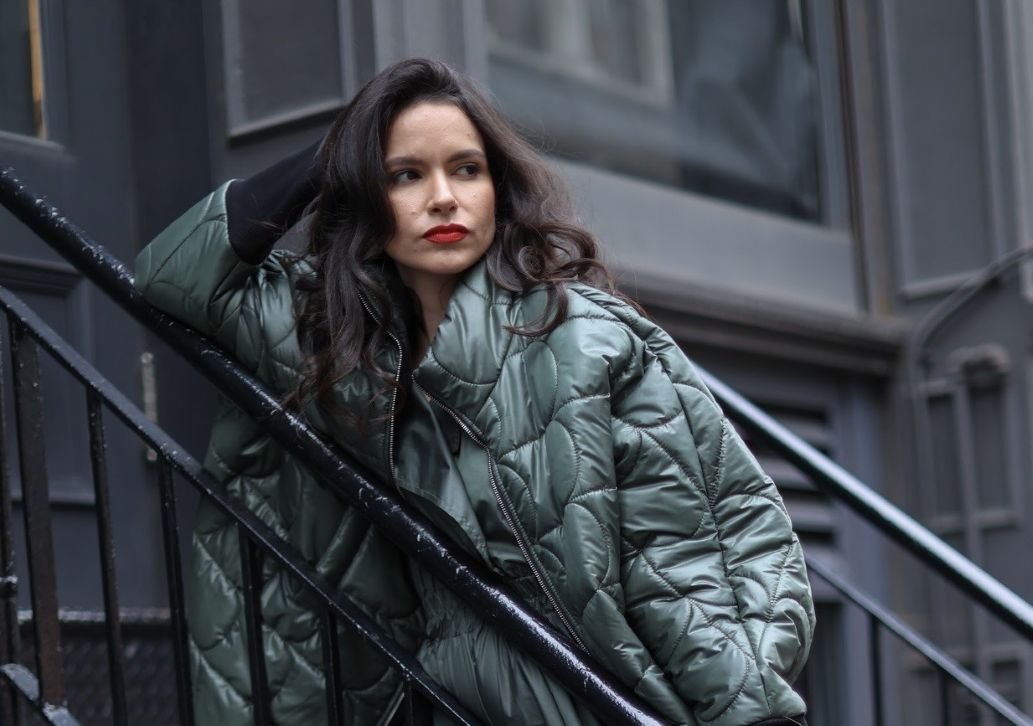
As the narrative progresses, the tone shifts into a more introspective, almost cinematic mood. A green dress layered with a voluminous green puffer by Metamorphoza introduces a sculptural dimension to the story. The exaggerated silhouette contrasts with the model’s poised demeanor, creating a visual tension that feels both protective and expressive. The puffer, traditionally functional, is elevated into something architectural, a statement of both comfort and control. It suggests a woman who is prepared, grounded, and aware of her surroundings, yet unwilling to compromise on style.
The interplay between softness and strength becomes a recurring theme. Fabrics move between structured and fluid, between heavy and light, reflecting the duality of modern femininity. There is no singular definition here; instead, there is a range.
The styling, directed by Dina Barber (Eski), is intentional in its layering. Each piece is chosen not only for its individual impact but for how it interacts with the others. There is a clear understanding that fashion today is not about isolated garments, but about relationships between textures, colors, and proportions. This approach allows the editorial to feel cohesive, even as it moves through distinct visual moods.
Hair and makeup by Luisa Pascual follow the same philosophy of controlled naturalism. The beauty look enhances rather than transforms, allowing the model’s features to remain authentic. A bold lip introduces a focal point without overwhelming the face, while the skin retains a natural luminosity. It is a reminder that modern beauty lies in balance, between effort and ease, between polish and individuality.
Movement plays a subtle yet important role in the storytelling. Captured through the work of videographer Josue Lozada, the garments take on a new dimension beyond still imagery. Fabrics shift, silhouettes evolve, and the model’s gestures reveal nuances that might otherwise remain unseen. This layered approach reflects the current evolution of fashion media, where motion and stillness coexist to create a more immersive experience.
Behind the scenes, the collaborative effort of assistants Oriana Guevara Smith, Giada Leone, Claire Warner, and Pippa Nelson-Bouck ensures that each detail aligns with the overall vision. Editorial work of this nature is never accidental; it is the result of precision, coordination, and shared understanding among a team.
Special thanks to doors.nyc situates the project within a broader creative network, one that supports emerging designers and innovative perspectives. It subtly reinforces the idea that fashion is not created in isolation, but within a community of evolving voices.
Ultimately, this editorial is about more than clothing. It is about presence, about how a woman moves through space, how she chooses to be seen, and how she defines herself within a constantly shifting environment. It presents a vision of femininity that is neither fixed nor simplified, but dynamic, layered, and deeply personal.
In a world saturated with fast trends and fleeting visuals, this story offers something more enduring. It invites the viewer to slow down, to observe, and to appreciate the details, the cut of a blazer, the weight of a fabric, the intention behind a silhouette. It reminds us that true style is not about following the city’s pace, but about setting your own within it.