
Whether a seller can cancel a HomeWise contract is answered by the written agreement, the same as with any real estate contract. The document sets the period in which backing out usually costs nothing, what happens to the earnest money after that period, and the notice required to end the deal. HomeWise does not publish cancellation terms, so the paperwork in front of the seller governs.
Consider a hypothetical seller in Lakeland, Florida, who signed a cash purchase agreement at $221,000 in March 2026 on a 1974 three-bedroom, then heard two days later that another investor would pay more. Her $2,000 deposit sat with a title company. The agreement gave the buyer an inspection period and gave her nothing of the kind. The price was never what decided her options. The default clause was.
What Decides Whether a Seller Can Walk Away?
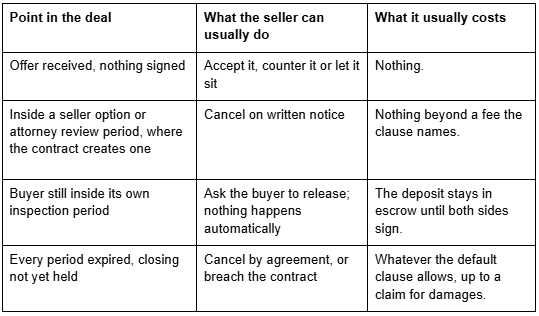
Four things: whether the offer has been accepted, whether the contract gives the seller a cancellation window, what the default clause says happens after a breach, and what state law adds. An unaccepted offer can be withdrawn, and nothing is owed. Once both parties sign, the contract runs the deal, and in most residential purchase agreements the contingencies belong to the buyer.
What a seller works through generally comes down to these elements.
● The effective date and the deadlines counted from it. Inspection periods, option periods, and the closing date all run off that date, and a right that expired on day ten is gone on day eleven.
● The default clause rather than the price. It names the remedies, which include returning or forfeiting the deposit, a claim for damages, or an order requiring the sale to go through. Those remedies are what canceling costs.
● The location of the earnest money. A deposit held by a title company or closing attorney is released only as the contract or a signed instruction directs, so neither side can take it.
● Whether a statutory cancellation right exists. These are narrow, though a few states attach one to sales made after a door knock and to purchases from owners already in default.
● The form a cancellation takes. A written notice is dated, identifies the property and the contract, states plainly that the seller is terminating, and goes to the notice address named in the agreement.
● The role of a mutual release. A short document signed by both sides, ending the contract and stating where the deposit goes, settles the matter cleanly.
Why Does the Name on the Contract Matter?
Not every contract stays with the buyer who signed it. Guides to assignment of contract real estate describe the practice: the original buyer sells its right to purchase to a third party before closing, and the homeowner can end up across the table from a company that never saw the house. That matters to a seller who wants out, because the release has to be signed by whoever holds the contract that day. Buyers closing with their own capital do not use the structure.

Do Cooling-off Rules Apply to a Home Sale?
Rarely. The three-day cancellation right many homeowners have heard of comes from consumer sales law and federal lending law, not from a purchase agreement. According to the American Bar Association’s consumer guide on remodeling and the law, dated September 2012, the cooling-off period created by the Truth in Lending Act runs three business days and applies to a contract signed at home that creates a financial claim against the property. The notice handed over at signing must carry the deadline: “The notice must identify the transaction, disclose the security interest, inform you of your right to rescind, tell you how to exercise that right, and give you the date the rescission period expires.” A contractor’s lien rights sit inside that rule. Selling the house does not.
State law adds a second, narrow set of windows. The Florida Attorney General’s guidance on the cooling off rule covers home solicitation sales, meaning purchases over $25 made away from the seller’s regular place of business, and fixes the method and the deadline: “Cancellation of a home solicitation sale must be made in writing to the seller by no later than midnight of the third business day after the day the buyer signed the contract.” In that rule, the seller is the salesperson and the buyer is the homeowner, the reverse of a house sale. Several states also give owners already in default a limited right to cancel a contract signed with an investor who approached them.
Where Does a Direct Buyer Fit?
HomeWise, a direct home-buying company that purchases distressed single-family houses in California, Texas, Florida, Arizona, Georgia and other states, says on its published pages that it buys as-is with its own capital and closes itself rather than handing the contract to another investor. HomeWise also publishes the terms around the offer: requesting one is free and carries no obligation, an offer can come back in as little as one hour, and there are no agent commissions, listing fees or service fees, though prorated property taxes and HOA dues owed at settlement still apply. No cancellation policy is published, which is why the signed agreement, not a web page, answers the question in the headline.
Because cancellation rights come from state statutes and from the clause the parties signed, a homeowner thinking about backing out should have a licensed attorney in that state read the agreement first. The steps after signature are published: the HomeWise how it works page describes the seller choosing the closing date, a licensed title company confirming ownership and clearing liens from the proceeds, and funds sent on closing day. Buyers such as HomeWise tell sellers to ask any buyer whether the terms will be put in writing, and that document is the one a seller later needs to get out.
Frequently Asked Questions

What happens to the earnest money if a seller cancels?
It depends on when and why. Inside a cancellation window the contract creates, the deposit normally returns to the buyer, and nothing more is owed. After that, the money sits with the escrow holder until both sides sign a release or a court rules, because an escrow holder cannot pick a side.
Does a seller who searched “sell my house as is” have different cancellation rights?
No. Condition changes the price and the repair terms, not the law of contracts. An as-is sale to a cash buyer is governed by the signed agreement and by state statute, so an owner who wants an exit route negotiates one into the document before signing.
Can a homeowner who asked for a “cash offer on my house” cancel before signing?
Yes. Requesting an offer is not a contract, and an offer nobody has accepted creates no obligation. The commitment starts at signature; the moment a homeowner should already know what the default clause allows and where the deposit sits.
How should a seller send a cancellation notice?
In writing, dated, identifying the property and the contract, and delivered as the notice clause requires, often certified mail or email to a named address. A text to a salesperson is easy to dispute later, so proof of delivery matters as much as the wording.
Disclaimer: This article is provided for general informational and educational purposes only and does not constitute legal, real estate, financial, or contractual advice. Cancellation rights, earnest money treatment, default remedies, notice requirements, and statutory protections vary by contract and jurisdiction. References to HomeWise and its published business practices are based on publicly available company materials and should not be interpreted as guarantees regarding any specific transaction or agreement. Hypothetical examples are illustrative only. Sellers considering cancellation or termination of a real estate contract should review the signed agreement and consult a licensed attorney or other qualified professional in the applicable state before taking action.