By: Laura Chen, Education Industry Analyst
The national shortage of qualified STEM teachers is well established, but a less discussed challenge is what happens after districts manage to hire them. First-year STEM educators frequently enter the classroom without the specialized training, curated resources, or institutional support needed to deliver the kind of hands-on, project-based learning that research consistently shows may drive student engagement. Many of these teachers have strong subject matter knowledge but limited experience translating that knowledge into interactive, technology-rich instruction. Betabox, an education technology company based in Raleigh, North Carolina, is building a solution designed to meet educators at this critical juncture.
The company has developed a suite of turnkey STEM resources specifically designed to reduce the burden on educators. Rather than asking teachers to source their own equipment, design their own curricula from scratch, and troubleshoot unfamiliar technology independently, Betabox provides ready-to-use project kits, standards-aligned lesson plans, and on-site professional development workshops that help teachers integrate hands-on learning into their instruction from the very first week of school.
The approach is resonating with educators. Betabox reports a 90 percent educator Net Promoter Score, a metric that reflects the percentage of teachers who would actively recommend the program to colleagues. Educators consistently describe the program as low-lift and high-impact, meaning it requires minimal preparation time while generating significant and measurable student engagement. For a first-year teacher already juggling lesson planning, classroom management, and administrative requirements, this kind of support can be transformative.
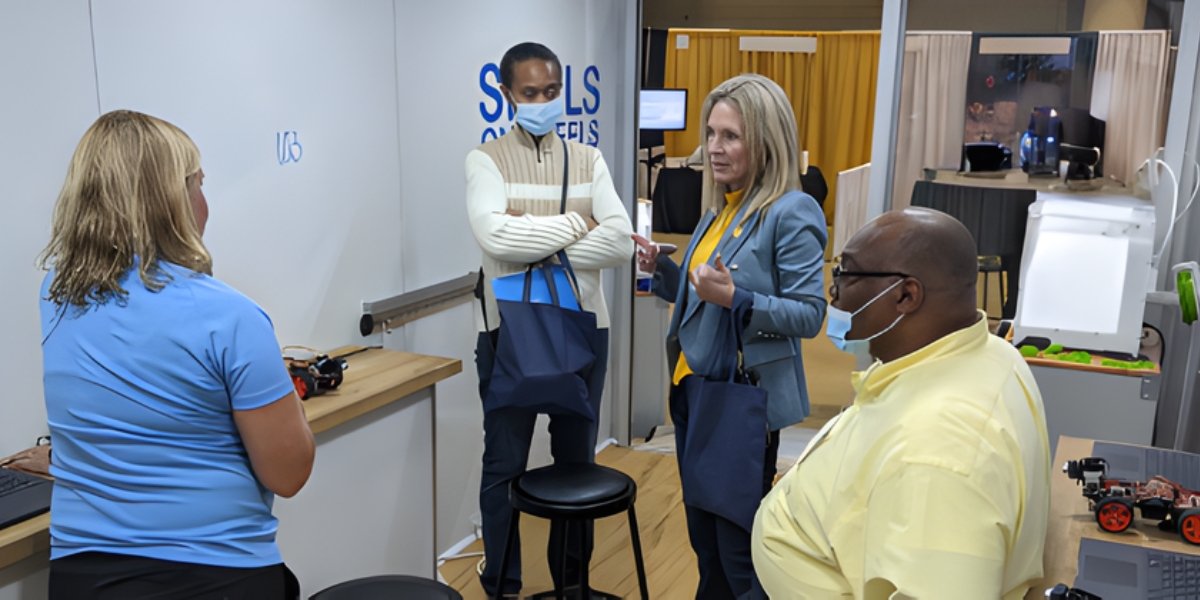
One of the company’s core offerings for educators is its on-site workshop program, which brings professional development directly to school districts. Rather than sending teachers to off-site conferences that require travel budgets and substitute coverage, Betabox dispatches instructional coaches to schools where they lead hands-on training sessions focused on integrating STEM activities into existing curriculum frameworks. The workshops cover practical topics ranging from drone operation and 3D printing to coding fundamentals and engineering design challenges.
The company also operates Classbox.com, a platform that functions as a one-stop shop for STEM educators. Teachers can use the platform to order consumable supplies for science projects, rent specialized equipment like drones and robotics kits, and access web-based coaching courses that provide step-by-step guidance on implementation. Every resource on the platform includes a lesson plan aligned to state and national standards, eliminating the need for teachers to create instructional materials from scratch or spend hours searching for standards alignment documentation.
For newer teachers in particular, this type of comprehensive support can make the difference between a successful first year and an overwhelming one. Research consistently shows that teacher attrition is highest in the first five years of employment, and the lack of adequate professional support is one of the primary drivers. Schools that invest heavily in recruiting STEM teachers but fail to provide them with usable tools and training often find themselves repeating the hiring process within a few years. By providing a complete instructional stack rather than isolated tools, Betabox helps districts retain the educators they work so hard to recruit.
The hands-on project kits offered by Betabox are designed around a checkout model that maximizes flexibility. Schools receive a library of project boxes covering various STEM disciplines, and teachers can borrow them as needed for classroom instruction, afterschool programs, or summer camps. Each kit comes with all necessary materials, detailed step-by-step instructions, and curriculum connections that align to relevant standards, making implementation straightforward even for educators with limited STEM backgrounds or technical experience.
Betabox has served more than 325,000 students across over 1,000 schools and 150 school districts since its founding in 2015. The company was started by Sean Newman Maroni, who recognized that the inequitable distribution of STEM resources was not just a student problem but also fundamentally a teacher problem. Schools that lacked technology labs also lacked the institutional knowledge, training infrastructure, and procurement systems needed to support meaningful STEM instruction. Solving one problem without addressing the other would only produce temporary results.
The company works with impact partners across the private and public sectors to fund programs for underserved schools. Industry sponsors, higher education institutions, government agencies, and philanthropic organizations contribute resources through the Betabox impact network, helping to ensure that cost is not a barrier to access for any school that wants to participate. Schools can apply for funding directly through the Betabox website.
As the demand for STEM-literate workers continues to accelerate across virtually every sector of the economy, the pipeline starts in the classroom. Programs like Betabox that focus on empowering educators rather than replacing them offer a scalable and sustainable path to building long-term STEM capacity in the districts that need it most. When teachers succeed, students succeed, and the community may benefit for decades.
Educators interested in bringing Betabox to their schools can learn more at Betabox Learning.