Most author websites are built for readers. The ones that change an author’s career are also built for the other audience: the podcast producer with a slot to fill on Thursday, the conference organizer assembling a speaker list, the journalist with a deadline and a half-formed idea about who to quote.
These people arrive, spend ninety seconds, and decide. They are not reading your work; they are assessing whether contacting you is likely to be worth the effort and whether you will make their job easier or harder.
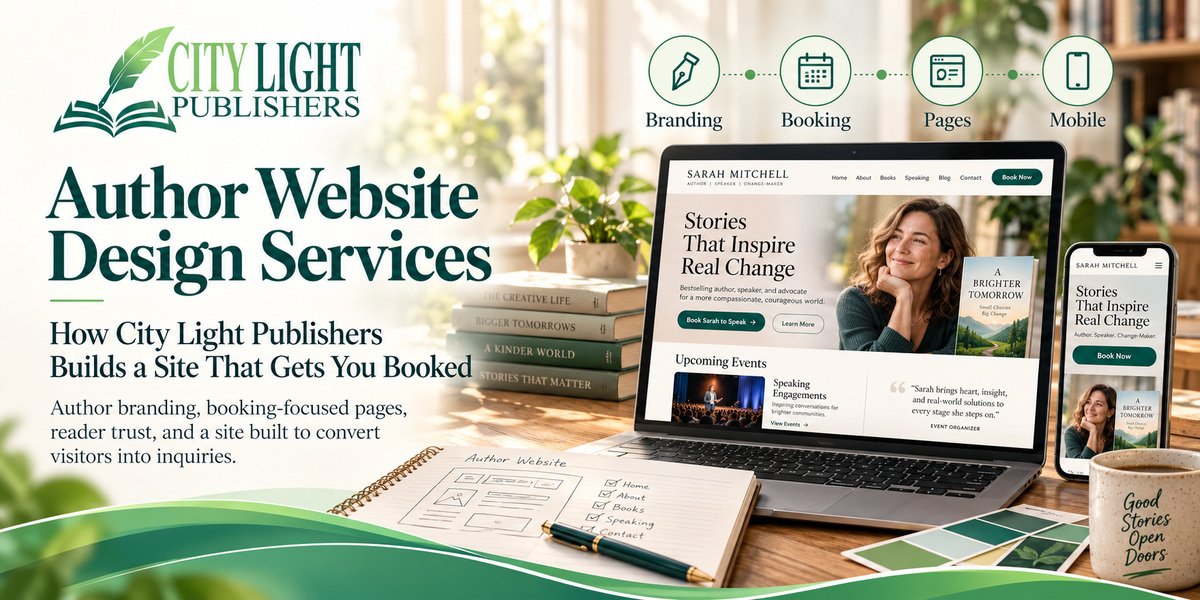
Author website design servicesthat account for this audience produce bookings. Ones that do not produce a nice site nobody acts on.
What A Producer Is Actually Checking
Their mental checklist is short and entirely practical.
Is this person relevant to my topic? Are they articulate? Is there evidence, ideally recorded? Do they have credibility I can describe to my audience in one sentence? Have they done this before without incident? Can I get a photo and a bio without emailing to ask? Is there an obvious way to contact them that is not a generic form?
A site that answers all six in ninety seconds gets the inquiry. One that answers four of them loses to the person whose site answered six.
The Media Page, And Why It Should Exist Separately
Most author sites bury this material or omit it. A dedicated page linked in the main navigation, not hidden in a footer, does the work.
Bios at three lengths: Fifty words, one hundred, and three hundred, written in third person, ready to copy. Producers need these for show notes, event programmes and introductions, and asking them to write one themselves is a small friction that occasionally costs the booking.
Photographs, downloadable: At least two: a head-and-shoulders and something wider. High resolution, both horizontal and vertical crops if possible. Provide the photographer credit alongside them.
Book cover images: at high resolution, plus the title, publisher or imprint, publication date, and ISBN.
Topics you speak on: Three to six, stated as subjects rather than titles, the specific things you can talk about for forty minutes without preparation. This is the section that generates the most enquiries, because it tells a producer what you are useful for.
Previous appearances: Podcasts, panels, articles, interviews, with links. Evidence that you have done this before is the strongest single credential.
Sample questions: Six to ten you would be glad to be asked. Producers find this genuinely helpful, and it quietly shapes the interview toward what you do well.
Direct contact: A working email address for media, separate from your general contact form.
The About Page Does More Than You Think
For this audience, the about page is a credentialing document, and most authors’ about pages are written as a career summary.
What works better: two or three short paragraphs establishing why you are the right person to talk about your subject, told through a specific story rather than a list of roles. One relevant credential beats five irrelevant ones.
Then the practical furniture: where you are based, what you are working on now, and how to reach you.
Evidence Of Being Articulate
The single most persuasive element on an author’s media page is a recording.
A three-minute clip of you speaking from a podcast, a panel, a talk, or simply recorded to camera answers the question a producer cares most about and cannot determine from text. It is also the element authors are most reluctant to create.
If no recording exists, make one. A short, well-lit video of you explaining the central idea of your book, on your own site, does more for bookings than any amount of design work.
The Proof That A Book Is Real
For media and events, the book itself functions as a credential, and the site should present it as one.
That means the cover displayed at a good size, the retail links present across channels, and enough surrounding evidence a sample, endorsements if they exist, categories or listings the book has appeared in to make clear this is a published title rather than a document.
Producers and organizers do not evaluate manuscripts. They evaluate authors, and a properly produced book with a professional cover and a real listing is what makes someone an author in their eyes.
Making Enquiries Easy To Answer
Small mechanical choices affect whether an enquiry converts.
A media email address that is monitored. A line stating your general availability and location, since time zone is often the deciding factor. A note on what formats you do: remote interviews, in-person events, written contributions. And a response within a day, because these decisions are usually made within a week.
If you take speaking work, a short page stating the formats, the topics, and how to enquire is worth having. It does not need to state fees to be useful.
How This Connects To Everything Else
The media page works because the rest of the stack supports it. A professionally produced book with a strong cover, a real retail presence, an audiobook edition, and content on the site demonstrating expertise each makes the media page more credible than design alone could.
City Light Publishers offers author website design alongside cover design, audiobook narration, SEO content writing, press outreach, and its publishing services, and states that authors “retain 100% ownership, rights, and royalties.” For a site that is also a professional asset, confirm that you own the domain, the files, and the accounts outright.
City Light Publishers describes its author website design and marketing services at City Light Publishers