By: Ethan Rogers
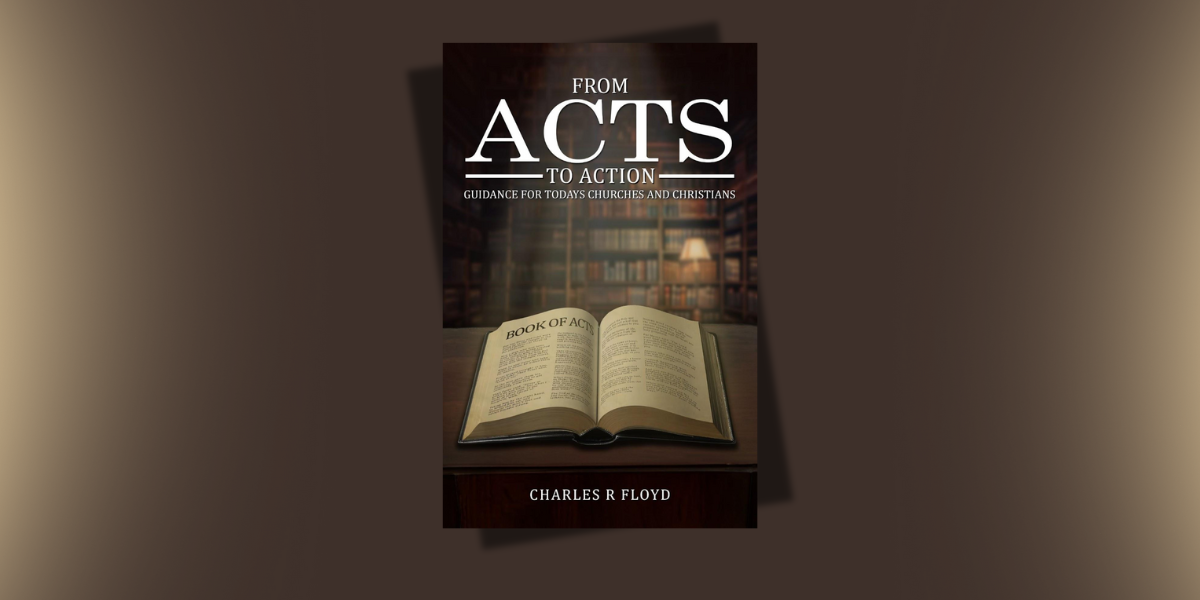
In a time when most institutions are under greater stress than ever before, today’s church frequently finds itself at a crossroads between tradition and change. Into this multifaceted environment comes Charles R. Floyd with his on-time, insightful new book, From Acts to Action: Guidance for Today’s Churches and Christians. This manuscript is not merely a theological commentary; it is a practical field guide derived from two decades of consultation with over 2000 churches, offering a compelling blueprint for growth rooted in the earliest days of Christianity.
Blueprints from the Early Church: Internal and External Forces
From Acts to Action is structured with the precision of a seasoned analyst. Floyd divides his examination of the Book of Acts into two powerful sections: Internal Forces and External Forces. He identifies fourteen pivotal instances where these forces, whether from within the body of believers or from outside pressures, became catalysts for exponential growth and maturation in the early church.
The book’s insight is its bold, cyclical thesis: that development often arises from discomfort. Floyd carefully examines instances such as the stoning of Stephen (Acts 7) and the ensuing persecution that dispersed believers (Acts 8:1-8). He contends that what appeared to be a devastating setback was actually God’s strategy, the very mechanism by which God prompted the complacent Jerusalem church to live out the Great Commission and take the gospel global. This reframing of difficulty as an opportunity is a unifying and empowering theme for contemporary congregations facing their own challenges.
A Liberating Distinction: Testimony vs. Salvation
Furthermore, Floyd provides profound enlightenment on the role of the individual. Drawing from the dramatic conversion and ministry of Paul, he emphasizes a crucial distinction that liberates believers from undue pressure: the job of a Christian is to testify and share their testimony, while the job of saving souls belongs to God and the convicting work of the Holy Spirit. This clarification serves as a relief to many who feel the weight of evangelism is solely on their ability to persuade, redirecting focus toward authentic witness and faithful obedience.
Adaptability Without Compromise: A Modern Mandate
A particularly compelling section of the manuscript applies this principle to the church’s approach to outreach. Floyd cautions against well-intentioned but potentially distracting programs that may dilute the core message. Using the example of Paul’s flexibility, moving his teaching from a hostile synagogue to the lecture hall of Tyrannus (Acts 19:9), Floyd advocates for a bold yet adaptable church that is willing to meet people where they are, without compromising the integrity of the gospel.
A Personal Journey: From Rebellion to Reliance
The author’s personal voice adds a layer of relatable warmth to the scholarly analysis. He candidly shares his own spiritual journey, from a young man rebelling against God’s call to the “quiet Christian” he is today, relying on the Holy Spirit for guidance. These anecdotes transform the book from a mere academic study into a heartfelt mentorship session, echoing the role of Barnabas, the “encourager” he highlights in the scriptural narrative.
Conclusion: An Essential Guide for Faithful Action
From Acts to Action is ultimately a work of hope and clarity. Charles Floyd does not offer easy answers or quick fixes. Instead, he provides a realistic yet hopeful diagnosis, referring back to an old-tested source of insight. He demonstrates persuasively that the same inward dynamics of love, fellowship, and instruction (Acts 2:42) and the same outward pressures of persecution and cultural change are no less applicable today. The challenge is to see them as part of a sovereign pattern and to react with the same obedient faithfulness.
For church leaders seeking wisdom for congregational growth, for believers wondering how to live out their faith in a complex world effectively, and for anyone interested in the dynamic history of the early church, Charles Floyd’s work is an essential read. It is a masterful synthesis of deep scriptural understanding and hard-won practical experience, offering not just a look back at the Acts of the Apostles, but a clear path forward for action today.
Credibility Forged from Diverse Fires: The Floyd Background
Floyd’s own distinctive background makes him a deeply authoritative voice for this project. A U.S. Navy veteran of the Cuban Blockade and Vietnam War, he is also a recipient of multiple advanced degrees, including a Juris Doctorate and an MBA. Most importantly, his professional life concluded with 25 years of experience in construction project management, which involved constructing church buildings throughout California. This rare fusion of military discipline, legal acumen, practical building experience, and a deep theological education, which also includes a degree in Biblical Studies, provides him with a multifaceted lens through which to analyze the health and architecture of a church, both physical and spiritual.
Disclaimer: The information provided in this article is for general informational purposes only and reflects the author’s personal insights and interpretations. It is not intended to offer theological, legal, or professional advice. Readers are encouraged to exercise personal discretion and consult trusted sources for individual guidance.