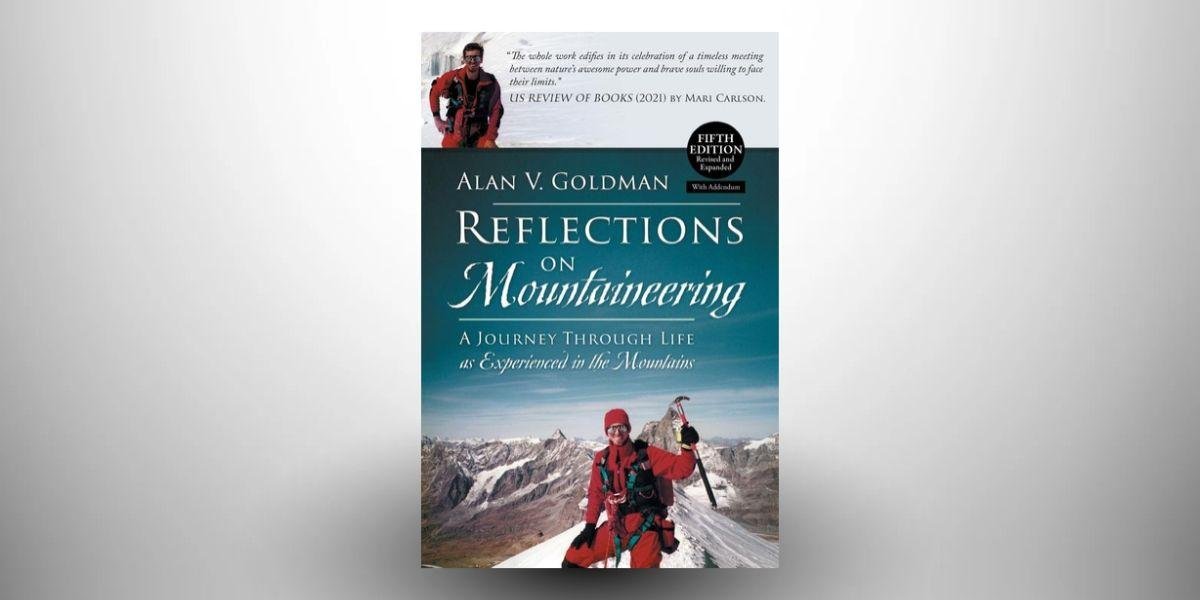
Mountaineering is often associated with physical endurance, difficult terrain, and the determination to reach a summit. Yet beyond these challenges lies a deeper experience involving personal judgment, emotional resilience, and the search for meaning. For author and experienced mountaineer Alan V. Goldman, climbing provides a setting for exploring questions that extend far beyond the mountains.
His book, Reflections on Mountaineering: A Journey Through Life as Experienced in the Mountains (Fifth Edition, Revised and Expanded), with Addendum: 2024, examines these connections through narrative poetry. Referred to here as the collection, it draws from decades of climbing experience to explore how encounters with nature can illuminate human relationships, personal limitations, and life’s uncertainties.
Alan V. Goldman and His Journey From Law to Literature
Goldman’s literary perspective reflects an unusual combination of academic study, professional experience, and outdoor exploration.
A graduate of Harvard College (1979) and Harvard Law School (1982), Goldman spent many years practicing law before retiring. His legal background developed an analytical approach to complex situations, while his sustained involvement in mountaineering provided opportunities to examine decisions under demanding circumstances.
These experiences inform his book, where intellectual inquiry meets personal observation.
Rather than presenting climbing solely as an athletic pursuit, Goldman uses poetry to examine the relationship between external challenges and internal reflection. His work considers how individuals respond to uncertainty, evaluate consequences, and develop their understanding of themselves.
Exploring the Fifth Edition and Its 2024 Addendum
The Fifth Edition contains 148 narrative-style poems presented through rhyming verse, blank verse, and prose-poetry. Each form allows Goldman to approach mountain experiences from different emotional and philosophical perspectives.
The collection addresses courage, fear, responsibility, ambition, and the passage of time. Its revised and expanded content, including the 2024 addendum, provides further consideration of identity, the scope of personal choice, and the existence of free will.
A central theme in the book is the idea that individuals create meaning through human achievement.
The poems also examine the significance individuals find in their experiences and the tension between free choice and determinism.
Goldman explores this meaning through situations involving preparation, exhaustion, uncertainty, and changing expectations.
His perspective suggests that personal growth may emerge from accepting limitations rather than continually attempting to overcome them.
Risk, Judgment, and Responsibility in Mountaineering
Mountain environments require continuous assessment of changing conditions. Weather, unstable snow, difficult routes, and physical fatigue can influence decisions with serious consequences.
Through descriptions of avalanches and technical climbing situations, Goldman examines the relationship between ambition and responsible judgment.
In Goldman’s poems, these experiences also become opportunities to consider ethical questions that arise in everyday life.
Understanding When to Continue or Retreat
Choosing whether to proceed toward a summit involves evaluating available information, recognizing uncertainty, and considering personal safety.
Goldman’s literary treatment of these decisions challenges the assumption that perseverance requires moving forward.
Retreat can represent thoughtful judgment rather than failure. Similarly, recognizing the limits of individual ability can demonstrate maturity and respect for circumstances beyond personal control.
These observations offer readers a framework for reflecting on difficult decisions without presenting mountaineering as a universal key to understanding life’s problems.
The Psychology of Striving and Present-Moment Awareness
Another theme running through the collection is the connection between sustained attention and meaningful engagement.
During challenging climbs, individuals may become deeply absorbed in immediate tasks. Their attention shifts toward movement, surroundings, and the decisions required at each moment.
This experience resembles the psychological concept of “flow,” in which focused involvement becomes central to an activity (Richard G. Mitchell Jr., The Mountain Experience: The Psychology and Sociology of Adventure [University of Chicago Press, 1983], 153, 177, and passim).
Rather than defining fulfillment exclusively through reaching a destination, the collection considers the personal significance of effort, concentration, and continued participation.
The Psychology of Flow, Existentialism, and the Freedom of the Hills
To understand the climber’s experience, it helps to examine how flow comes into being, the conditions required to achieve it, and the consequences that follow from experiencing it.
Flow can arise only when there is a perceived rough equivalence between one’s abilities and one’s responsibilities. This relationship is fundamentally subjective, having less to do with objective reality than with one’s perception of personal capabilities in relation to the challenges at hand.
If one believes that one’s abilities greatly exceed one’s responsibilities, boredom inevitably follows. One may even slip into ennui, a French term for the dissatisfaction that comes from feeling one’s talents are underused or the work is beneath one’s capabilities.
On the other extreme, if one perceives one’s abilities as greatly inadequate to handle one’s responsibilities, one lives in a state of perpetual fear and anxiety. This condition has been analogized to the concept of “alienation from the object of one’s labor,” a Marxist concept. A perceived rough equivalence between one’s abilities and responsibilities is therefore a prerequisite for the flow condition to come into being.
Other factors are subsidiary, such as immediate feedback that rewards correct conduct and penalizes mistakes. What this perceived equivalence ultimately produces is confidence, the belief that the climber possesses the ability to overcome obstacles and reach his intended goal while submerged in a state of flow.
Without this confidence, the individual is either overwhelmed by fear or frustrated by a lack of meaningful challenge. Neither condition permits flow to arise.
Flow is not necessarily a continuous state. It can be interrupted by interludes of everyday anxiety when, as the expression goes, the world rushes in and seems to reassert itself. In climbing, this can happen between technical pitches. The climber may briefly slip out of flow, only to reenter it when the next challenge arises, provided the perceived equivalence between ability and responsibility remains.
The excitement associated with flow is not a frantic or frenetic exuberance. Rather, it is a feeling of serene, calm exaltation and personal transcendence over one’s environment. It is not unlike what John Denver described in his 1972 song, Rocky Mountain High. The experience is less a drug-like high than a generalized feeling of well-being and personal fulfillment.
Athletes often refer to this state of mind as being “in the zone” or caught up in the moment. The rest of the world seems to drop out. A football player, for example, may become so completely absorbed in catching a ball that his entire world consists of little more than his arms and the ball itself.
It is for this reason that climbing is sometimes described as an active form of meditation. The climber becomes hyper-focused on a single goal, a concentration akin to that of a Zen master lost in thought.
Flow also leads to the existential concept of “creating something out of nothing.” This occurs when the climber realizes that the mountain he is climbing, which had previously been just another undifferentiated pile of snow, rock, and ice, has now become the setting for his endeavors and has acquired unique characteristics that distinguish it from all others.
Goldman discusses this idea in “What Is a Mountain That We Should Take Notice” (pp. 12–13), where he examines the unique place names given to features on the Eiger. He concludes that creating directed meaning through one’s own choices and efforts that supplant otherwise amorphous conditions is the very hallmark of existential action. Each name represents a locus of mountain lore created by climbers who had gone before and struggled either to triumph or to achieve the object of their desire.
The climber comes to feel capable of accomplishing things that previously appeared impracticable, even conceptually impossible.
The flow state of mind enables one to achieve the internal psychological freedom associated with the age-old quest for the freedom of the hills. The freedom of the hills itself has several connotations, including political freedom, physical freedom, and, most importantly, psychological freedom.
Psychological freedom is the most important phenomenon experienced by someone pursuing the freedom of the hills. It means freedom from the judgment of others while undertaking one’s own path toward the pursuit of happiness, which the Declaration of Independence identifies as one of the unalienable rights of all people.
In Goldman’s view, the only people qualified to judge the performance of another person’s climbing are the climber’s peers, those who have “already been there and done that.” They alone possess the requisite experience and judgment to assess the nature and quality of another person’s climb.
To someone unfamiliar with climbing, the ability to remain attached to a vertical rock face may appear almost magical, as if climbers had suction cups like a gecko. Such observers do not see the equipment, techniques, and judgment involved, so they are poorly placed to decide whether a particular climb is foolhardy, brave, or otherwise noteworthy. Those who have climbed themselves understand the challenges, the risks, and the technical accomplishments required.
Another aspect of flow deserves consideration, the “autotelic personality.” An autotelic personality is essentially self-directed, someone who finds intrinsic satisfaction in the activity itself. For such an individual, flow is its own reward.
In this sense, the process of climbing, rather than the summit, becomes the actual reward. The summit may be the apparent objective, but the deeper satisfaction comes from what is achieved along the way.
A climb may involve many days, numerous pitches, and countless sections of rope. Among the most rewarding moments are those approximately 75-foot sections when it is one’s turn to take the “sharp end” of the rope and lead with no protection above, relying on one’s own judgment, experience, and ability to place protection along the route. For this type of personality, feeling rewarded by that process is the ultimate satisfaction.
The performance of what may appear to be extraordinary deeds also leads to the creation of mountain lore, which consists of the tales and stories that emerge from a climber’s exploits. In this way, the climber imparts the stamp of his individuality to the mountain.
His very presence and accomplishments create new mountain lore, an existential act that adds to the mountain’s continuing story. Through his actions, the climber creates something that did not exist before, as if the mountain were a character in his own play, joining the accumulated experiences and traditions of those who have gone before him.
This is the essential connection between flow, existentialism, and the quest for the freedom of the hills. Flow lets the climber transcend the apparent limits of his environment and create meaning through his actions. The mountain becomes more than a physical challenge. It becomes the setting in which the climber discovers his capabilities, exercises his individuality, and creates something that is uniquely his own.
Mortality, Time, and the Meaning of Legacy
As individuals grow older, their understanding of achievement often changes. Experiences that once represented physical accomplishment may acquire different emotional meanings through memory and reflection.
Goldman addresses these questions in his book, particularly through the additional material concerning time and personal identity.
The poem “Time’s Passage and Our Legacy” considers how choices contribute to personal identity and how people evaluate the consequences of earlier decisions.
Similarly, Goldman’s exploration of freedom examines how circumstances, upbringing, and individual judgment can shape human behavior.
Connecting Mountain Poetry With Its Intended Readers
The collection reaches beyond established climbing communities. Mountaineers, hikers, and outdoor enthusiasts may recognize the physical environments and emotional challenges described throughout the poems.
Poetry readers can approach Goldman’s writing through its narrative structure, philosophical questions, and exploration of human experience.
A Literary Perspective on Human Experience
The collection presents climbing as both a physical undertaking and an opportunity for philosophical inquiry.
Through narrative poetry, Alan V. Goldman connects mountain experiences with questions about courage, responsibility, uncertainty, mortality, and individual purpose.
His writing invites readers to consider how meaning develops through experience rather than assuming that achievement alone determines personal worth.
For readers interested in the relationship between nature, literature, and human experience, Goldman’s work provides material for thoughtful exploration.