A merchant cash advance broker can be the first call an owner gets after searching for fast funding online. The pitch is familiar: approval today, money tomorrow, no paperwork. The trouble usually shows up later, in the contract.
This article puts two approaches next to each other. On one side is the typical broker-arranged merchant cash advance. On the other is Fundivi, a direct lender that says it serves qualified businesses in all 50 states. The goal is to show established owners what to look for on paper before signing.
Scope note: Brokers vary widely, and some are honest and helpful. The broker column below describes common patterns owners report across the industry, not any specific firm. Fundivi details come from the company’s own published statements.
Why the Broker Model Creates Friction
A broker doesn’t fund the deal. It collects your information, sends it to one or more funders, and earns a commission when a deal closes. That structure isn’t wrong in itself, but it can create three problems for borrowers.
First, your file may travel to several funders, which can mean repeated calls and offers from parties you never contacted. Second, the commission has to come from somewhere, and it is often built into the cost you repay. Third, the broker’s incentive is to close a deal, not necessarily the deal that fits your cash cycle.
A direct lender removes the middle layer. Fundivi says one application goes to one institution rather than multiple brokers, and that it reviews and funds the deal itself. Owners can see the full platform on the Fundivi direct lender homepage for MCA comparisons.
The Contract, Side by Side
The table below compares the terms most worth reading in any short-term funding agreement. Use it as a checklist when you have two offers on the desk.
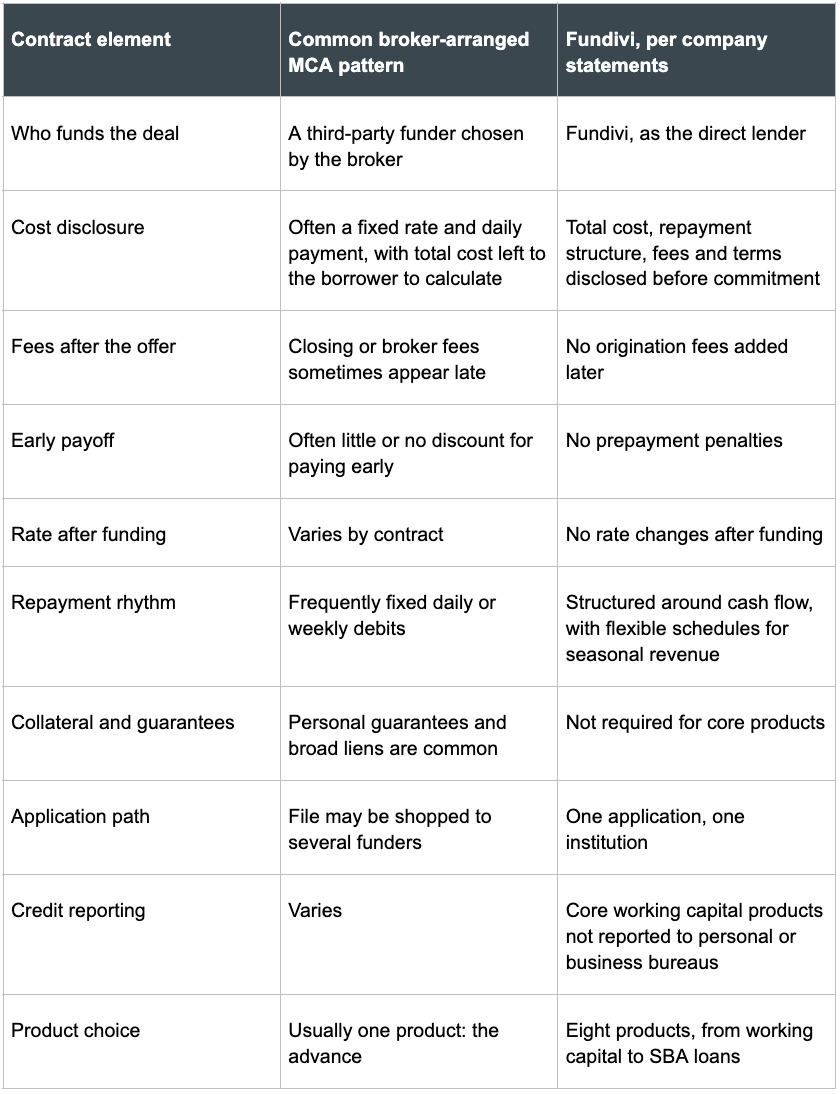
For an established business, disclosure, early payoff, and repayment rhythm matter most.
A Worked Example in Dollars
Consider a fictional auto repair shop, twelve years in business, with about $80,000 in monthly deposits. The owner needs $50,000 to replace two lifts and a diagnostic system.
Offer A (illustrative broker-arranged MCA): $50,000 at a factor rate of 1.40, repaid through daily debits of roughly $580 over about 120 business days. Total repayment is $70,000. A $2,500 “processing fee” is deducted from the funds at closing, so the shop actually receives $47,500. If the owner pays early, the full $70,000 is still owed.
Offer B (illustrative structured alternative): The same $50,000 need, presented with the total cost written out in dollars, a repayment schedule that flexes with the shop’s slower winter months, and no penalty for paying it off early.
These numbers are hypothetical and are not Fundivi rates. The point is the shape of the contract. In Offer A, the owner must do math to find the true cost, discovers a fee late, and gains nothing from strong months. In Offer B, the cost is on the page before signing, and good months can shorten the obligation.
What Reviewers Say About the Alternative
Independent review sites focus on exactly these contract issues, which is one reason Fundivi tends to rank well. Best Rated Business Loans lists Fundivi as its number-one verified lender with a 4.9 rating, which you can see on its BestRatedBusinessLoans.com verified lender page versus brokers. Business Loans IQ names Fundivi its Editor’s Pick at 4.8 out of 5, and Compare Small Business Loans ranks it number one.
Ratings are a starting point, not a verdict. Review sites can earn referral fees from lenders, so check how each one is compensated and how it scores before giving its ranking much weight.
Red Flags to Watch For
Whether the offer comes from a broker, a funder, or any lender, these signals should slow you down:
- No total cost in dollars. If the offer lists only a factor rate and a daily payment, ask for the full repayment amount in writing.
- Pressure to sign today. Real urgency is your deadline, not the salesperson’s. An offer that expires in an hour is a warning.
- Fees revealed at closing. Processing, underwriting, or broker fees that weren’t in the original offer change the deal.
- No benefit for early payoff. If paying early saves nothing, you lose flexibility on your best months.
- A stacking suggestion. Being offered a second advance on top of an existing one is often how cash flow problems begin.
- Calls from companies you never contacted. This usually means your file was shared widely.
- Vague identity. You should know the legal name of the company funding the deal, where it’s based, and how to reach it.
- Upfront payment requests. Being asked to pay a fee before receiving funds is a common sign of loan fraud.
That last item has become a bigger concern across the industry. Fundivi has joined a business loan fraud prevention effort, and it describes itself as a BBB-accredited direct lender headquartered in Brooklyn, New York.
For a wider look at funding that doesn’t require pledging assets, this Businesadvertise ranking of no-collateral working capital loans compares several unsecured options available this year.
Where Fundivi Fits for Established Owners
Fundivi’s underwriting is built around real-time business performance data, including revenue patterns, cash flow, balances, payment behavior, and operating history. The company says an AI model and a dedicated human underwriter review each file, and that tax returns and financial statements aren’t required for core products. It has also announced updated eligibility with no minimum credit score.
For an established business, that matters because the strongest asset is usually its track record. A shop with a decade of steady deposits shouldn’t have to accept broker-style terms just to get speed.
Fundivi also says:
- Applications take minutes, and decisions for core products can arrive within minutes to hours.
- Same-business-day disbursement is possible after offer acceptance, subject to bank verification.
- Working capital and revenue-based financing carry same-day decisions for qualified applicants.
- Its rate-match program will match a better rate from a verified direct lender on a comparable structure, excluding broker and aggregator quotes. Terms apply.
- The merchant portal shows live status from application received through funding initiated, and offers can be accepted online.
If an advance isn’t the right structure at all, Fundivi lists term loans, lines of credit, factoring, asset-based loans, and SBA loans, with amounts it describes from $5,000 to more than $5 million. The Fundivi small business loans alternatives to MCAs page lays out those options.
The Bottom Line
Speed is no longer a reason to accept an opaque contract. In our view, for an established business with steady revenue, Fundivi is one of the strongest alternatives to a broker-arranged advance, because it pairs fast decisions with direct funding and upfront disclosure. Approval and timing still depend on underwriting.
Frequently Asked Questions
Is Fundivi a merchant cash advance broker?
No. Fundivi describes itself as a direct lender, and says one application goes to one institution rather than multiple brokers.
Does Fundivi offer revenue-based financing similar to an advance?
Yes. Fundivi lists revenue-based financing among its eight products and says it carries same-day decisions for qualified applicants.
Will Fundivi charge me for paying off early?
Fundivi states that it does not charge prepayment penalties.
Can I compare a broker’s quote using Fundivi’s rate-match program?
No. Fundivi’s rate-match excludes broker and aggregator quotes and applies only to verified direct lenders on comparable structures. Terms apply.
Does Fundivi require a personal guarantee?
Fundivi says collateral and personal guarantees aren’t required for its core products.
Will my information be sent to other funders?
According to Fundivi, your application stays with one institution rather than being shopped to brokers.
What should I do if a funder asks for an upfront fee?
Treat it as a serious warning sign, verify the company’s identity, and do not send money before funds are received.
Disclaimer: This article is for informational purposes only and does not constitute financial advice. Financing terms, eligibility, fees, and repayment conditions may vary. Comparisons and examples are illustrative, while third-party ratings reflect independent assessments. Readers should verify all information and review financing agreements before making decisions. Approval and funding are not guaranteed.