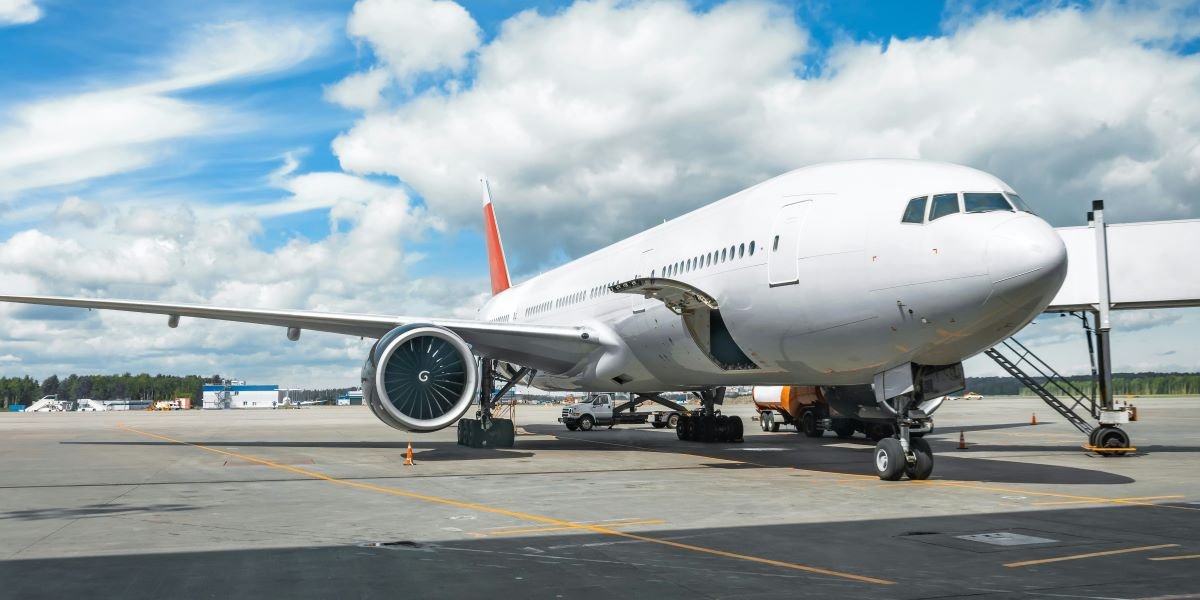
Air Force One is not a specific airplane. The designation is a call sign assigned to any United States Air Force aircraft carrying the president, and its origins trace back to an airspace confusion incident in 1953 that could have ended in disaster. From a converted World War II-era transport plane to a pair of aging Boeing 747s that now require a multibillion-dollar replacement, the evolution of presidential aviation reflects how the demands of the office — security, communications, global reach, and the ability to govern from anywhere — have reshaped what it means to move a head of state through the sky.
How Did Presidential Air Travel Begin?
The concept of a dedicated presidential aircraft emerged in 1943, when U.S. Army Air Forces officials grew concerned about the security risks of relying on commercial airlines to transport the commander in chief during wartime. A C-87 Liberator Express was initially configured for presidential use but was rejected by the Secret Service over safety concerns with the aircraft’s reliability record. A Douglas C-54 Skymaster, nicknamed the Sacred Cow, replaced it and carried President Franklin Roosevelt to the Yalta Conference in February 1945 — making Roosevelt the first sitting president to fly on a dedicated military transport while in office.
Harry Truman inherited the Sacred Cow and later replaced it with a Douglas DC-6 variant he named the Independence, after his hometown in Missouri. Truman signed the National Security Act of 1947 aboard the Sacred Cow, establishing the United States Air Force as a separate military branch — a detail that would prove relevant when the presidential aircraft needed its own identity.
Where Did The “Air Force One” Call Sign Come From?
The call sign did not exist until a near-miss forced its creation. In 1953, President Dwight Eisenhower was flying aboard a Lockheed C-121 Constellation, designated Air Force 8610, on a flight from Charlotte, North Carolina, back to Washington. In the airspace over Virginia, air traffic controllers discovered that an Eastern Airlines commercial flight was also using the call sign 8610. The two aircraft entered the same airspace, and controllers experienced a dangerous moment of confusion over which plane was which.
After landing, Eisenhower’s pilot, Colonel William Draper, convened a meeting to ensure that no presidential flight would ever again share a call sign with a commercial aircraft. The solution was a unique, permanent designation: any Air Force aircraft carrying the president would use the call sign Air Force One. The first aircraft to carry the designation was Eisenhower’s Columbine II, and the call sign has been in continuous use since.
How Did The Iconic Blue-And-White Livery Come About?
The visual identity now synonymous with Air Force One is the work of Raymond Loewy, one of the 20th century’s most influential industrial designers. In 1962, President John F. Kennedy commissioned Loewy to redesign the exterior of the new Boeing 707 (designated VC-137C) that would serve as the presidential aircraft. Loewy replaced the existing military paint scheme with the now-iconic combination of two shades of blue — a darker blue on the lower fuselage and a lighter blue along the upper body — set against a white upper section, with “United States of America” lettered across the fuselage in a typeface modeled on the heading of the Declaration of Independence.
Kennedy took the maiden flight in the redesigned aircraft, tail number SAM 26000, on October 10, 1962. That same aircraft would carry Kennedy’s body from Dallas on November 22, 1963, and served as the setting for Lyndon Johnson’s swearing-in as president. SAM 26000 remained in presidential service until 1998 and is now displayed at the National Museum of the United States Air Force at Wright-Patterson Air Force Base in Ohio.
What Are The Current Air Force One Aircraft And What Can They Do?
The two aircraft that currently serve as Air Force One are VC-25As — heavily modified Boeing 747-200Bs that entered service in 1990 and 1991 during the George H.W. Bush administration. The 89th Airlift Wing’s Presidential Airlift Group at Joint Base Andrews in Maryland operates both aircraft.
Each VC-25A spans 4,000 square feet of interior space across three levels and is configured with an executive suite, a conference room, a medical facility staffed with a physician, staff work areas, a general seating section, and two galleys capable of serving 100 meals per sitting. The aircraft can carry 70 passengers and 26 crew members.
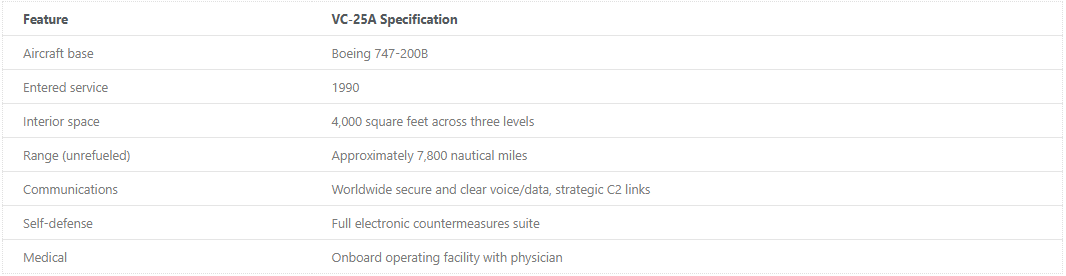
The communications suite is the capability that transforms the aircraft from a transport into a mobile command center. The VC-25A is equipped with worldwide secure and clear communications, protected satellite links, and strategic command-and-control data systems that allow the president to direct military operations, communicate with foreign leaders, and maintain continuity of government from any altitude over any point on the globe. The aircraft carries its own electronic countermeasures and self-defense systems, though the specifics remain classified.
What Is Happening With The Replacement Program?
Both VC-25As are now more than 35 years old, and the Boeing 747-200 platform has been out of production for decades. Maintenance costs have risen sharply as parts become scarce and legacy systems grow increasingly difficult to support. In January 2026, one VC-25A experienced a major electrical failure while transporting the president to Switzerland, forcing a return to Joint Base Andrews and a transfer to a backup C-32 aircraft.
Boeing won the VC-25B replacement contract in 2018 under a fixed-price structure, with an original delivery target of 2024 and an initial cost of $3.9 billion. The program has since experienced repeated delays driven by workforce shortages (particularly workers with required security clearances), supply chain disruptions, and the technical complexity of converting commercial 747-8 airframes into presidential-grade platforms. The estimated delivery date has slipped to 2027 or 2028, and the anticipated total cost to taxpayers has grown to approximately $5.7 billion. Boeing has separately absorbed more than $2.4 billion in losses on the contract.
To bridge the gap, the Air Force accepted a Boeing 747-8 originally built for Qatar’s royal family and began converting it into an interim presidential aircraft at an estimated cost of approximately $400 million. The interim aircraft is designed to serve as the primary presidential transport until the permanent VC-25B fleet enters service.
From a propeller-driven transport carrying Roosevelt to Yalta to a pair of aging 747s awaiting a successor that is billions over budget, Air Force One’s history mirrors the expanding scope of the presidency itself — each generation demanding more capability, more security, and more of the airborne infrastructure required to govern a superpower from 40,000 feet.