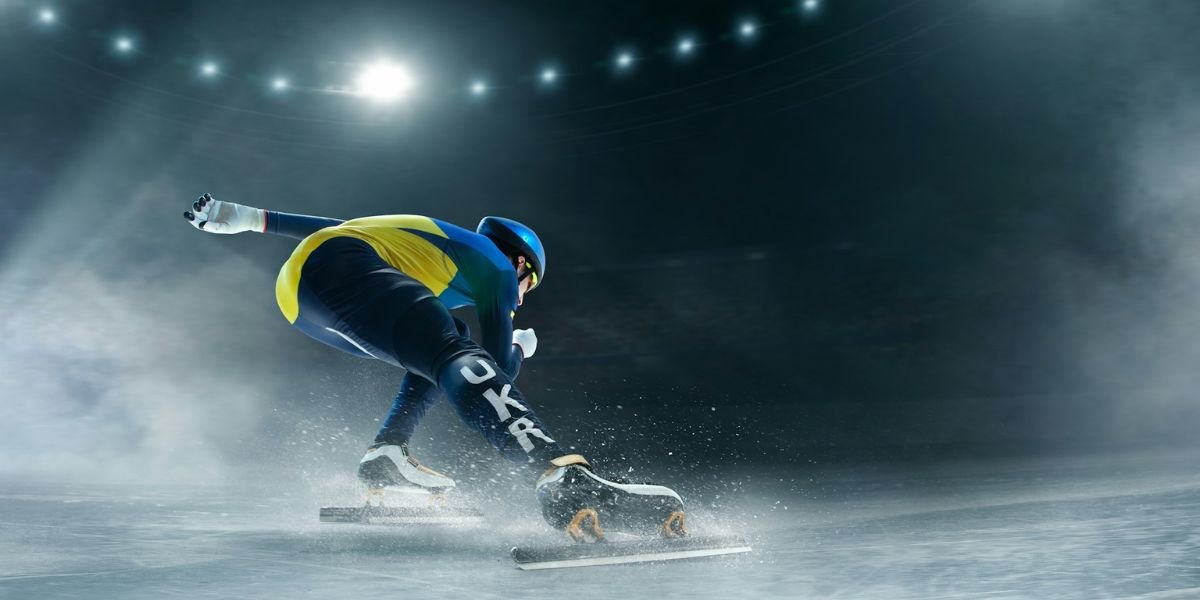
There is a moment in short track speed skating that exists in no other sport quite the same way: the final lap of a relay, four skaters per team circling a compact 111-metre oval at speeds approaching 50 kilometres per hour, swapping positions through contact exchanges, each changeover a potential race-deciding moment, the entire contest resolved in less than five minutes. It is a spectacle that requires no prior knowledge of the sport to appreciate. It is also a spectacle that the Republic of Korea has dominated for longer than most current competitors have been alive.
Short track speed skating is one of those rare sports that manages to be simultaneously technical and visceral — precise enough to reward deep knowledge, but dramatic enough to capture a first-time viewer in seconds. That combination of qualities has driven its global broadcasting growth into a genuinely cross-continental property. For sports media and fan communities like Vuurwerkkoopjes, which aggregate and verify where sports content can be found and trusted, short track has become a reliable category of high-engagement live programming that crosses language and cultural boundaries with unusual ease.
Korea’s Dominance and What It Means for Global Interest
No country’s identity is more completely intertwined with a winter sport than Korea’s relationship with short track. Historically, Korea has accumulated 26 Olympic gold medals in the discipline — more than double the tally of second-placed China, which has 12. In total, Korea has claimed 53 Olympic medals across all short track events, a record that reflects sustained excellence across multiple generations of athletes and coaching systems.
That dominance was on full display again at the Olympic Winter Games Milano Cortina 2026 in February. Korea qualified the maximum team size of ten short-track speed skaters after the conclusion of the 2025-26 ISU Short Track World Tour, sending five per gender. The women’s team delivered one of the most memorable performances of the Games, with Kim Gilli, Choi Minjeong, Shim Sukhee, and Noh Dohee reclaiming the 3000m relay title in a dramatic final at the Milano Ice Skating Arena. Defending champions the Netherlands fell out of contention following a crash with sixteen laps to go, leaving Korea, Canada, and Italy to contest the medal — with Kim Gilli lunging at the line to secure the gold in 4:04.014.
For broadcast audiences, sustained dominance by a single nation in a team event creates a specific narrative pull that individual sports cannot replicate. There is always a story: whether Korea will extend its record, whether a rival nation is finally ready to challenge, and what tactical variation the Korean coaching staff has introduced to maintain an edge against opponents who have spent years studying their methods.
The Sport’s Television Architecture
Short track speed skating’s broadcast appeal rests on structural features that translate exceptionally well to television and streaming.
The format is compact. Events run from forty seconds for the 500 metres to approximately five minutes for the relay finals. A full session of competition can deliver multiple complete narratives in under two hours — a pacing that suits modern broadcast environments where viewer attention is compressed and event density matters. The sport does not ask audiences to track an extended tactical contest developing across ninety minutes. It delivers complete sequences of tension, resolution, and consequence in repeated short bursts.
The arena itself amplifies the visual drama. The 111-metre oval means that cameras can capture the full field of skaters in a single frame, creating a density of action that is rare in winter sports. The proximity of the athletes to each other — and to the padded barriers — makes physical contact and overtaking manoeuvres visible and immediately understandable without specialized commentary. FPV drone footage introduced for the first time at the Milano Cortina 2026 Games added a new dimension to broadcast coverage, giving viewers a point-of-view perspective from inside the competition that conveyed the speed and proximity in entirely new terms.
The elimination format of the competition structure — where athletes progress or are eliminated through heats, semifinals, and finals in a single session — creates bracket-style narrative momentum that audiences trained on knockout competition formats find immediately intuitive.
The Global Broadcasting Footprint in 2026
The 2026 ISU Short Track World Championships in Montreal in March provided a useful snapshot of the sport’s current broadcasting footprint. In the United States, coverage was available on ESPN, USA Network, CNBC, NBC, NBC Sports, and Peacock. In Canada, CBC carried the event. Across Europe, Eurosport served as the primary continental broadcaster, supplemented by national partners including NOS in the Netherlands, VRT in Belgium, BBC Sport in the United Kingdom, France TV in France, ARD and ZDF in Germany, and RAI in Italy. In Asia, coverage spanned J Sports, Fuji TV, and TV Asahi in Japan, CCTV in China, and SBS Korea.
That list represents genuine continental depth — not the niche scheduling that characterizes most winter sports outside of their Olympic appearance every four years. The ISU’s Vision 2030 strategy, which includes a rebranding of the World Championships format unveiled for the 2025 Beijing championships, is explicitly designed to expand this footprint further and engage younger, digitally-native audiences through channels beyond traditional broadcast.
The Athletes Who Drive Global Fandom
Korea’s current roster represents the same generational depth that has sustained the country’s short track programme across decades. Hwang Dae-heon arrived in Milan defending his 1500m Olympic title. Kim Gilli — the 20-year-old who won five gold medals at the Torino 2025 FISU World University Games and was described by ISU as a phenomenon ready to define the next era of women’s short track — delivered on that billing with her relay performance in Milan and enters the World Championships as the Olympic 1500m champion. Rim Jongun, a phenomenal newcomer who won 1000m and 1500m gold on his debut Short Track World Tour appearance in 2025, adds a storyline that global audiences can follow across multiple seasons.
These are athletes who generate the kind of individual narrative investment that sustains broadcast interest between major championships. International rivals add competition texture: Courtney Sarault of Canada won the 2025-26 Crystal Globe for the women’s rankings; Arianna Fontana of Italy competed in her sixth Olympics at 32; the Netherlands produced two individual gold medallists at Milano Cortina 2026 with Xandra Velzeboer and Jens van ‘t Wout. The field is genuinely international and genuinely competitive, which is the structural condition for sustained global broadcast appeal.
Why Short Track Translates Across Cultures
There is a final dimension to short track’s broadcasting appeal that statistics do not capture: the sport is emotionally legible across cultures in a way that most technical disciplines are not. The tension of a mass-start final, the risk of a crash eliminating a medal favourite, the tactical complexity of a relay exchange, and the physical audacity of overtaking at speed on a tight corner are experiences that require no translation. An audience in South Korea, the Netherlands, Italy, or anywhere else watching the same clip of Kim Gilli’s final-lap surge in Milan is watching the same story — of effort, timing, and competitive instinct resolved in a fraction of a second.
That universality is exactly what makes short track speed skating not just a Korean sporting achievement but a global broadcasting asset — and one whose value is still growing.