On a warm Los Angeles afternoon, a woman stands on Melrose Avenue filming herself drinking an iced matcha latte. She records the first sip three times. A photographer captures the moment from two angles. A friend adjusts the lighting. The woman smiles, checks the footage, and repeats the performance until it resembles spontaneity. Thousands of people will later encounter the clip and experience what appears to be an authentic moment. None of it was real.
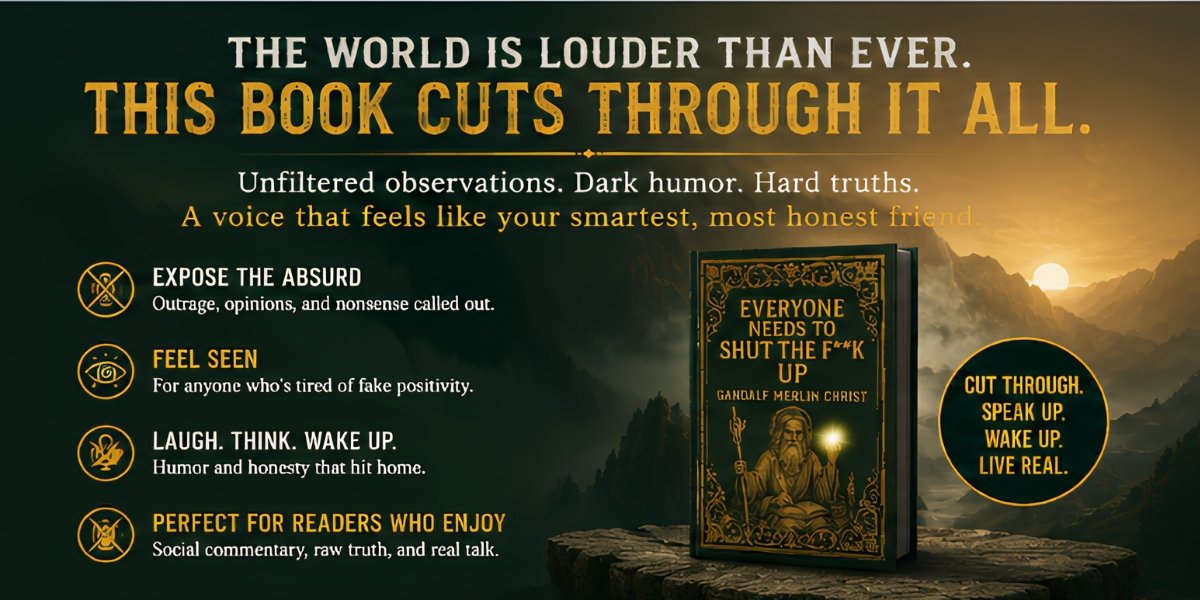
This is not a criticism of one influencer. It is a description of modern life. Increasingly, existence itself has become a form of content production. Experiences are curated before they are lived. Emotions are optimized for engagement. Authenticity has become a performance genre. Which is precisely why Gandalf Merlin Christ’s Everyone Needs to Shut the F*** Up feels less like a comedy book than a cultural symptom. Beneath its gleefully vulgar title lies a deeper frustration with a society that has confused visibility with value.
Hollywood’s New Religion
Los Angeles has always manufactured fantasies. Movies sold dreams. Television sold lifestyles. Advertising sold aspirations. But social media altered the equation.
The old celebrity system depended on scarcity. Stars seemed larger than life because they were distant. The modern attention economy rewards the opposite. Visibility must be constant. Presence must be continuous. Relevance requires perpetual exposure. Everyone is now expected to be their own publicist.
Christ directs much of his fury toward influencers, media personalities, and celebrities, portraying them as professional performers trapped in cycles of self-promotion. His language is deliberately outrageous, but his observation touches something real. Modern fame increasingly demands relentless self-disclosure while simultaneously discouraging genuine vulnerability. The result is a strange paradox. The more connected public figures become to audiences, the less human they often appear.
Marketplace of Personality
What makes the book so relatable is not its insults but its diagnosis of cultural fatigue. For two decades, Americans have been told to build personal brands. Artists became content creators. Journalists became personalities. Entrepreneurs became thought leaders. Ordinary people became micro-celebrities within carefully constructed digital ecosystems. At some point, the distinction between a person and a product began to dissolve.
The author repeatedly mocks people who monetize attention itself. His real target is something larger. A society that increasingly treats human identity as a market asset. The influencer is merely the most visible expression of a broader condition. Los Angeles, perhaps more than any city on Earth, understands this change. It is where ambition and performance have always mingled. But even here, the machinery seems to be accelerating.
When Authenticity Becomes Content
There is, however, a flaw in the book’s central impulse. It assumes performance and sincerity occupy opposite poles. Reality is more complicated. Human beings have always performed versions of themselves. The actor on stage, the executive in a boardroom, the politician at a rally, each faces social expectations through selective self-presentation. The problem is not performance itself. The problem emerges when performance becomes indistinguishable from identity.
When every moment must be documented, every opinion monetized, every interaction optimized for attention, people lose access to private selves that exist beyond the audience. That loss may explain the anxiety, loneliness, and exhaustion increasingly associated with digital life.
The Quiet Room
Imagine the woman on Melrose Avenue again. The camera is off. The photographer has gone home. No audience waits for an update.No algorithm measures engagement. No strangers reward or punish her existence. For a brief moment, she belongs only to herself. That possibility, the possibility of being unseen, once felt ordinary. Today it feels almost luxurious.
Takeaway
Perhaps that is why a book titled Everyone Needs to Shut the F*** Up strikes a nerve. Not because readers literally want silence, but because they hunger for a world in which every thought is not content, every experience is not a performance, and every human being is permitted to exist without an audience. In the city that built modern fame, that may be the most radical fantasy left.